SELECTION GUIDES

Guides

A wall material selection guide for architects, designers and project procurement, with 30 articles organized by "space × problem": first a five-minute selection framework, then a four-category material comparison table explaining differences in thickness, self-weight, curved-surface methods and applicable locations among flexible stone, PU stone skin, wood veneer wall panels and WPC grille panels, and summarizing common judgment misconceptions, fire safety and export compliance criteria.

  • Title based on real procurement and design issues
  • Provide a direct answer at the beginning of each article
  • For designers, contractors, and engineering procurement

Continuous release · Can be searched by scene tags on the image

05 Selection Framework: What to judge first, what to do next

Most of the rework in wall material selection does not come from 'the color is wrong', but from asking the wrong question at the beginning. Follow the following four steps to prevent 80% of the rework in advance.

SequenceFirst judgment whatHow to judgeThe conclusion points
① Base layerStrength, flatness, moisture contentTap to check for hollow areas, use a 2m straightedge to check flatness, and first measure the moisture content of walls with high humidityLightweight walls/old walls/insulated walls → only lightweight adhesive materials can be selected; if the substrate is unqualified, treat it first—changing materials won't help either
② ShapeIs there any curved, cylindrical, or irregular corner?Check the drawings and site; measure the minimum arc radius→ Must be bendable material with curved surface, hard materials can only be spliced in small pieces, with dense diagonal seams
③ PartIndoor / semi-outdoor / outdoor, dry area / wet areaCompare the dry-wet partitioning diagram and the external wall rangeOutdoor weatherproof adhesive and waterproof edging are required; the material in the wet area must not absorb water
④ Perceptioncolor number, texture direction, jointing methodView the physical samples under the actual lighting of the projectBoth screens and exhibition halls can be deceptive; it is necessary to make color decisions after comparing on-site.

One-line mnemonic:The substrate determines whether it can be done, the modeling determines what to do, the location determines how to do it, and the perception determines what it will look like - the order cannot be reversed.

Four types of wall comparison: What are the differences in materials on the same wall?

The following table compares four types of commonly used materials under the same criteria. The values in the table are common ranges, used to judge the applicable boundaries, and do not constitute a ranking of any material.

Comparison itemFlexible Stone (Soft Stone)PU Stone Skin PanelWood veneer wallboard (bamboo charcoal wood)WPC lattice board
thickness / section2.3–9 mmMolded molding, divided into large plate / small plate by color5 mm / 8 mmList by model, such as 131×10.6 mm.
per square meter weightAbout 3-7 kg/square meterLightweight, polyurethane foam structureAbout 3.8 / 6.0 kg/square meterThe weight of the profile, hollow is lighter
Curved surface and columnCan be curved within a certain radius, covering the entire surfaceMainly in solid block molding, using matching corner piecesFlat panel installation is the main, curved surfaces are transitioned with closing partsThe direction of the profile is fixed, and short sections are used for splicing in arcs
Construction methodNo skeleton required, full adhesion after leveling the baseFull adhesion or clip, masonry walls can be directly pasted.Paste with no-screw adhesive or snap-together.Clip or nail fixed, can be installed in one piece
Moisture-proof performanceDoes not absorb water, does not swell.Non-porous, non-absorbentSolid extrusion of materials, not absorb water and deformWood-plastic composite, not deformed by moisture
Main Applicable AreasInterior and exterior walls, columns, ceilingDoor heads, exterior walls, feature walls, old wall renovationIndoor wall, cabinet and door wall integratedBackground wall, column wrapping, ceiling, and screen
Points to noteNot recommended for ground installation.The convex surface needs to avoid fixed partsNot recommended for outdoor useNot recommended to bend horizontally.

Common judgment misconceptions: These four sentences are most likely to mislead people

Common statementsWhere is the problemThe correct method
「The more the stone texture resembles the real stone, the better」Looking similar from a distance does not mean it looks similar up close; seams and batch differences are where problems most easily arise on siteFirst confirm the layout and joint relationship, then look at the texture; same project, same batch order enough.
Lightness is a result of structural choice, not a quality indicator; low self-weight is precisely the prerequisite for use on lightweight wallsCheck the base material structure and inspection report, not the absolute value of weight
「Having an inspection report can meet the fire safety standard」The report corresponds to specific models and samples, not the entire seriesCompare the names of the samples in the report with the selected models item by item
「First determine the color, then calculate the amount」Once the color is set, the layout is set, and only then can waste be calculated accurately; doing it the other way around leads to repeated re-measurementLayout diagram → jointing scheme → consumption → material preparation, follow this sequence.

Find guidelines by space (30 articles)

Problems faced by the same space type are highly similar. Enter the corresponding group directly according to your project type, which is faster than flipping from the latest one downwards.

Find guidelines by project phase (16 articles).

Procurement, construction, and acceptance are three separate activities, and problems arise differently in each. This group is arranged by "what to do when," and each article corresponds to a delivered project; the figures can be checked item by item on the case pages.

Find guidelines by problems.

If your question has been narrowed down to a specific point, follow these steps:

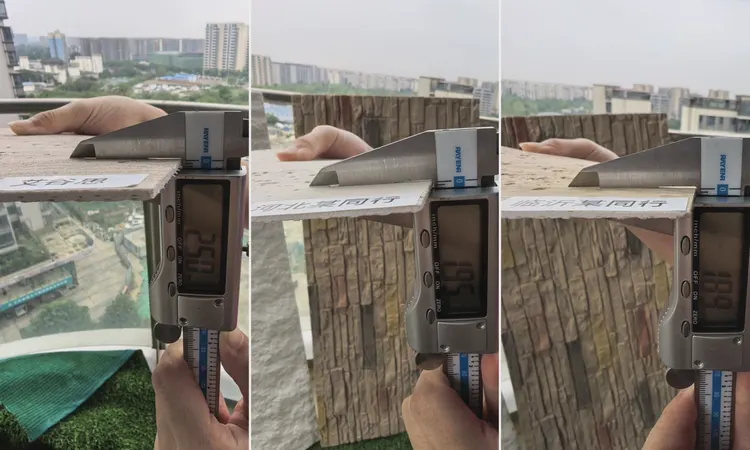
Thickness measurement of travertine sample: comparison of three groups of picture readings

The figure shows the digital caliper measurement results of three groups of flexible stone travertine samples. From left to right in the picture, the display reading of the IGOODS sample is 2.50 mm, the Hebei sample is 1.95 mm, and the Linyi sample is 1.89 mm. The table only records the readings visible in the photo, without filling in the second measurement point or thickness range not displayed.

Picture locationtravertine samplePicture shows reading
On the leftIGOODS travertine sample2.50 mm
middleSame category travertine samples (Hebei)1.95 mm
RightSame category travertine samples (Linyi)1.89 mm
Thickness comparison of three groups of travertine samples and caliper: IGOODS on the left 2.50mm, Hebei sample in the middle 1.95mm, Linyi sample on the right 1.89mm
Figure 1 · Reading of thickness of travertine sample: Left IGOODS 2.50 mm, middle Hebei sample 1.95 mm, right Linyi sample 1.89 mm.
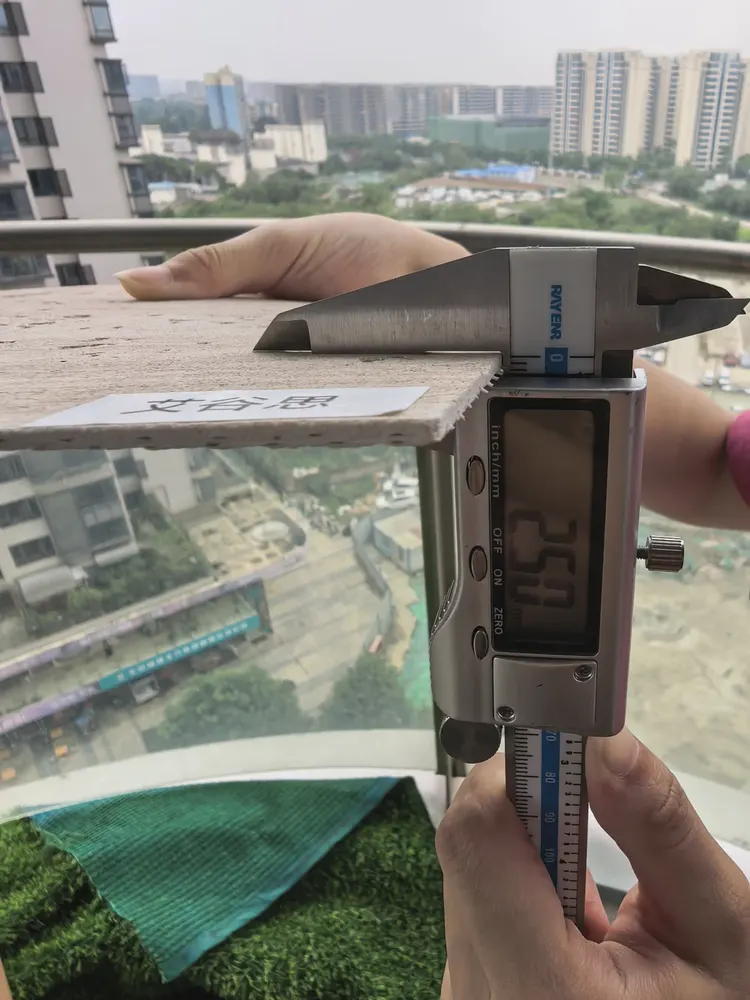
Close-up of thickness measurement of IGOODS travertine sample edge, digital caliper shows 2.50 mm
Figure 2 · IGOODS travertine sample close-up, the caliper shows 2.50 mm, consistent with the reading on the left side of Figure 1.

Data range:The data shown in the photo is the displayed reading of the travertine sample at the corresponding measurement location, which does not represent the thickness range of the entire plate, multiple batches, or all products from the same origin; the second measurement point record is not displayed on this page. The decimal places displayed on the caliper are not the same as the measured accuracy confirmed by the calibration, and the single-point reading cannot be used to determine the overall quality of products from other brands or origins.

How is thickness reading used for material selection

The thickness should be checked together with the nominal specifications, agreed tolerances, and measurement methods of the selected travertine model. The 2.50 mm, 1.95 mm, and 1.89 mm in the figure can only be used to compare the current readings of these three groups of samples and cannot be judged solely on the basis of thickness for impact resistance, weather resistance, fire resistance, weight, price, or indoor and outdoor suitability.

  • Firstly, check the model and specifications:Define the series, texture, backing, nominal thickness, and allowable deviation of travertine, and avoid directly comparing products of different structures with the same caliber.
  • Recheck the project conditions:Combined with base layer, curvature radius, adhesive system and material selection for application location; performance judgment should be based on the corresponding model specifications and test reports.
  • Supplement measurements when intervals are needed:Record readings of multiple positions and multiple samples according to the agreed method, then summarize the range; do not use the single-point value of a photo as the upper and lower limits of product thickness.

How to check the thickness when receiving goods

  • Use a suitable measuring tool:Check caliper zero position, blade cleanliness and contact status before measurement, to avoid deformation of flexible samples causing reading changes.
  • Uniform measurement location and diameter:Clarify in advance whether it includes backing, how to deal with the holes on the surface of the stone and its convex and concave, and note the location in the record to avoid the use of different measurement methods
  • Record multiple locations:Record the sample, batch, location and reading point by point, and keep photos; the three sets of photos on this page are not yet sufficient to establish a multi-point measurement range.
  • Acceptance according to procurement agreement:Compare the actual measurement records with the specifications of the specific model, the agreed tolerances, and the acceptance methods, and do not just make a qualified conclusion based on the thickness difference between the samples.

Material selection FAQ

The following are the eight most frequently asked questions in the design and procurement phases, with answers given from the perspective of engineering practice.

How to choose wall materials? Which indicator should be considered first?

First inspect the base, then the shape, and finally the appearance. The strength, flatness, and moisture content of the base material determine whether it can be directly adhered; the presence of curved walls, columns, and irregular corners determines whether rigid materials can be used; appearance and color are determined last, as they are most prone to rework and should not be repeated unnecessarily.

In what cases should flexible stone be chosen instead of tiles or natural stone?

In three cases, flexible stone should be prioritized: the subgrade is light-weight wall or old wall, without bearing conditions; there are arched walls, cylindrical or irregular corners that need to be covered in one piece; the construction period is tight, and dry construction without ridge and wet work is required. Conversely, it is not suitable for ground paving and exposed countertops.

How to distinguish the uses of flexible stone, PU stone skin and wood paneling

Flexible stone material with a stone texture and thinness, thickness mostly in the range of 2.3-6mm, self-weight about 3-7kg/㎡, suitable for expressing stone patterns on large-area walls; PU stone skin is a three-dimensional surface, imitating natural scattered stones and rock walls, suitable for door heads, exterior walls, and renovation of old walls; wooden paneling is indoor wood color and plain fabric texture, used in guest rooms, offices, and cabinet facings.

Can the arched wall and cylinder really be fully covered?

Yes, but the radius is not infinite. Large-radius arc walls can be bent and tiled in one piece, along the arc line of the seam; small radius must first take a physical sample and try to bend at the corresponding curvature, obvious rebound can be changed to narrow strip tiling - following the arc line is more neat than hard splicing small pieces.

Can the renovation of the old wall be directly pasted? Do I need to scrape the wall first?

If the original wall is firm and without hollows, it can be covered directly, and old tile surfaces can also be used. However, before construction, it is necessary to knock on the surface one by one to check, and the hollow and sandy parts should be scraped off to the solid base and repainted - this step cannot be skipped, as any material pasted on the hollow base will also bulge.

How are fire rating and environmental data confirmed?

Read the inspection report, not the promotional language. The combustion performance grade is based on the effective inspection report of the selected model (such as GB 8624-2012 classification), and the formaldehyde and VOC data correspond to specific samples. When the project has specific requirements, the sample name in the report should be compared item by item with the selected model.

What documents do I need to prepare for the export order?

The EU market usually requires CE compliance documents, RoHS and REACH test reports; other markets mostly recognize SGS or the performance and environmental protection reports of the National Inspection Center. What is actually needed should be determined according to the regulations of the destination country and customer requirements. It is recommended to provide the list all at once before placing an order.

What is the easiest thing to forget when making a quotation?

What is most likely to be overlooked is the loss and shape. The flat wall is basically sufficient for preparation by area × 1.12; the loss of the curved wall, column wrapping, door opening and large-area paving is obviously higher, and the shaped parts should be calculated separately according to the drawing. In addition, the labor cost of surface treatment and layout alignment is not included in the installation unit price.

Case-by-case Analysis · Product by Family Analysis

In addition to the above "write by question" guides, the site also has two sections covering items one by one:Case AnalysisSeparate each delivered project individually - material selection reasons, layout algorithms, construction nodes, lighting coordination, acceptance and maintenance follow-up;Product AnalysisExplain in series and color batch by group - color map, parameter specifications, construction commonality and scene adaptation, and link to the corresponding product file. Two columns refer to each other: the guide solves 'how to choose', and the analysis page answers 'which one is chosen, and how is it used.'

Case Analysisone article per project

Product Analysisone article per series

Samples and material selection support

Enterprise name
Chengdu Igoods Technology Co., Ltd. (IGOODS)
Consultation Hotline
19136341389(same number for phone / WeChat / WhatsApp)
Email
19136341389@163.com
address
No. 9001, 9th Floor, Building A, No. 166 Laifeng 5th Road, Wuhou District, Chengdu, Sichuan Province, China (Laifeng Digital Innovation Center)
Can provide
20×30 cm physical sample · Specifications · Inspection report and qualification documents · Construction phase suggestions
Material scope
The size, thickness, and weight on this page are in the common range, actual values are confirmed by product specifications and orders; combustion performance and environmental grade are based on the effective test report of the selected model
Relevant Pages
Products · Project Cases · Certificates & Test Reports · Contact Us
Publishing method
Continuously add real project issues, and attach relevant guidelines and product series entry at the end of each article

All guidelines

Please start from the latest article; related guidelines and product series entry are attached at the end of each article.

Guide on how to choose, samples on which to choose

Apply for 20×30cm physical samples, and determine the final material selection after comparing with the project lighting and adjacent materials on the site, and provide specifications, inspection reports, and construction suggestions.

Free Sample / Engineering Quote
Contact phone number Product Catalog Free Sample
WeChat ID copied