
For clubhouse curved corridor material selection, first clarify whether you want stone grain, continuous mineral feel, or warm wood feel, then compare curvature, seams, substrate, cleaning and repair.Flexible stone is suitable for solutions requiring stone textures and a certain degree of curved-surface adaptability; microcement leans toward continuous mineral surfaces; wood veneer can bring warmth and precise divisions. The three can be combined by different areas rather than fully replacing one another.
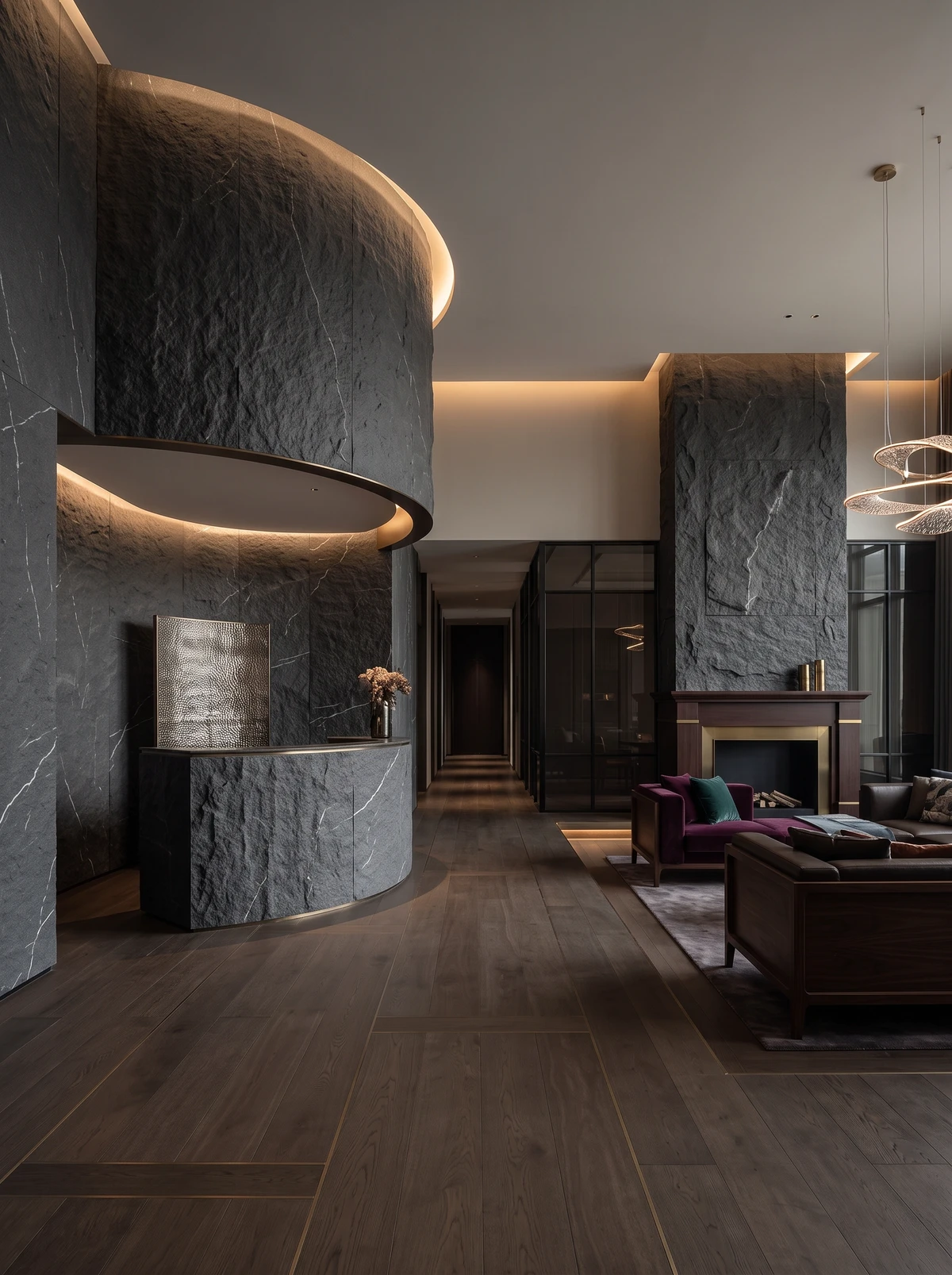
What problems need to be solved when choosing finishes for a clubhouse curved corridor?
Materials for curved corridors simultaneously affect walking rhythm, lighting shadows, and tactile experience. The longer the curved wall, the more unified the treatment of joints and texture needs to be.
Clubhouse projects often emphasize restraint and detail; material samples must be observed under real curvature, light strips and cleaning conditions, avoiding selection based only on flat samples.
First understand the relevant materials and project entities
Flexible Stone
A finish path for stone grain, mineral feel and certain curved-surface bonding, requiring verification by radius and series.
Microcement system
Multi-level continuous mineral coating path: substrate stability, processes, and repair color difference are the key points.
Wood Veneer System
Form warm curved surfaces through wood veneer, bent boards, or divided components, with attention to fire safety, moisture variation, and finishing.
How do three types of materials compare for curved corridors?
Judgment dimension | Flexible stone application methods | Design and construction focus points | Confirm actions | |
|---|---|---|---|---|
Stone texture expression | Flexible stone is relatively clear | Microcement tends toward a mineral continuous feel | Wood finish tends toward warm linearity | Look at the spatial theme |
Curved surface method | Adhere according to radius | Construct along a stable substrate | Bent board or flexible wood veneer | Look at geometry and substrate |
Joints | Layout and concealed-joint control | No board seams but crack prevention required | Dividing joints and edge finishing | Look at the visual goal |
Repair | Prepare panels from the same batch | Repair may have color differences | Panel replacement or color touch-up | Look at operational capability |
How can we avoid treating "continuous" as risk-free?
The continuous surface of microcement does not mean substrate cracks will not show through, and the panel layout of flexible stone does not equal visual fragmentation. Each material must control its specific risks through details and mock-ups.
When choosing flexible stone, confirm the direction of the stone pattern on the curved surface, the seam positions, and springback; when choosing wood veneer, confirm the curved-surface divisions and edge finishing; all three must be tested under actual lighting.
Execution steps from design judgment to on-site confirmation
Clarify spatial location, primary sightline, usage frequency, and visual goals
Re-measure the substrate, shapes, equipment openings, and finished surfaces of adjacent materials
Request samples, specification sheets, and application information for the corresponding series
Complete layout of texture, panel size, joints, corners and closing
Make a physical sample on the actual substrate and under the lighting
Sign off on samples, material numbers, construction boundaries and acceptance requirements
The product name can only help the project establish preliminary awareness and cannot replace specifications, test reports and installation system descriptions. Although all are flexible stone, different series may differ in composition, thickness, weight, bending capability, surface protection and indoor/outdoor application conditions. Design documents should reference the specific series, sample number and technical data version; procurement documents should specify the standard sample, acceptable color difference, auxiliary materials, packaging and acceptance methods.
Applicable conditions and risk boundaries
Under these conditions, it can enter key evaluation
Curvature parameters and main sightline clearly defined
Comparison of three types of materials under the same substrate and lighting
The project accepts the respective joint or repair boundaries
Planned maintenance and spare material method
These situations cannot lead directly to a conclusion
Understanding seamless as absolutely never cracking
Understanding bendability as requiring no radius verification
Look only at material samples without checking curved-surface samples
Ignoring low-level impacts and cleaning
Material advantages must be expressed together with specific conditions. Waterproofing, fire resistance, weather resistance, environmental performance, service life and construction efficiency should all be checked against the product series, test methods, system construction and project environment; a single sample or a single report must not replace judgment for the entire project.
How should project documents be delivered?
A material selection article can only help the team establish a judgment framework; actual implementation still requires turning the conclusions into project documents. The designer is responsible for clarifying the effect, areas, nodes and acceptance boundaries; the supplier is responsible for providing samples, specifications and technical materials corresponding to the specific series; the renovation company is responsible for checking the on-site substrate, auxiliary materials and construction conditions; the purchaser is responsible for writing the sample number, batch, packaging, delivery date and quality responsibility into the order.
Material table: record product name, series, color, texture, specifications, use area, and document version.
Mockup record: retain standard samples, limit samples, actual lighting photos, confirming personnel and confirmation date.
Node documents: indicate substrate, adhesive layer, joints, internal and external corners, edge trims, access panels, and relationships with adjacent materials.
Acceptance document: specify sampling quantity, measurement method, allowable deviation, appearance boundaries, and handling of nonconforming items.
Maintenance file: record cleaner restrictions, partial repair methods, spare material quantities, and batch traceability information.
Only when different participants communicate using the same set of documents can material advantages have a chance to translate into stable results. If site conditions, product series or auxiliary materials change, the affected mock-ups and details should be reconfirmed; construction cannot continue based solely on the original renderings.
Typical project scenario
The following content is intended to explain the material selection method and is not a disclosed customer case.
Typical scenario: The club entrance passage connects a light gray curved wall with wooden doors and metal light strips. The team compares flexible stone, microcement and wood veneer on the same curvature, ultimately using flexible stone to express the main stone texture, metal trim for the corners, and leaving microcement for the continuous background area.
About IGOODS
Chengdu Igoods Technology Co., Ltd. (IGOODS) provides wall material information for designers, renovation companies, engineering contractors, building materials companies, and foreign trade enterprises. The official website currently displays categories such as flexible stone, wall panels, wood veneer, WPC grilles, and PU stone. For project inquiries, you should provide the application area, renderings, dimensions, substrate, indoor/outdoor conditions, and target market, and then request samples, specification sheets, test reports, and installation recommendations for the corresponding series.
Frequently Asked Questions
Which material is most suitable for curved surfaces?
Requires sampling and judgment based on radius, visual effect, substrate and repair method.
Are flexible stone seams obvious?
Through panel size, layout, concealed joints, and lighting control; the actual effect should be based on the sample.
Will microcement definitely not crack?
Cannot guarantee; the substrate and system construction are key.
Can wood finish be used for curved walls?
Suitable construction can be adopted, but the radius, fire protection and environmental conditions need to be verified.
Can three materials be combined?
Yes, on the premise that the finish, color temperature, details and maintenance boundaries are coordinated.
Related reading
Related articles
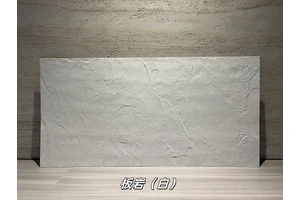
White Limestone Flexible Stone
White Limestone is a flexible stone in the Limestone and Natural Stone series...
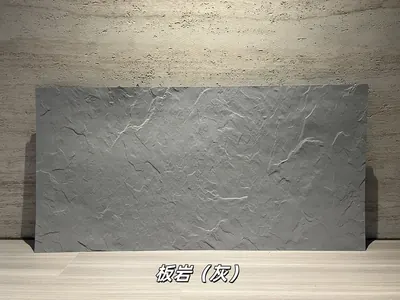
Grey Slate Flexible Stone
Grey Slate is a flexible stone with neutral gray tones, natural stratificatio...
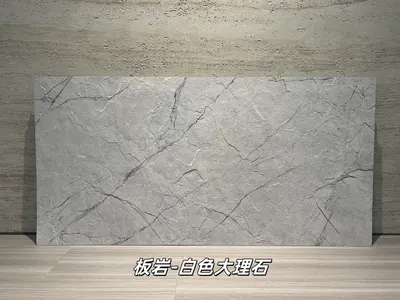
Flexible slabs of white marble rock
Extending from the light gray white stone base color to the dark gray marble ...
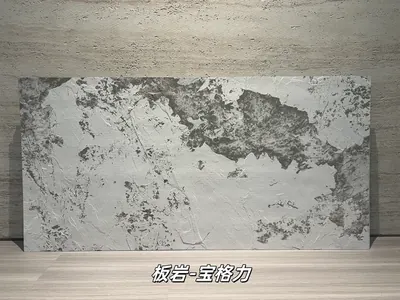
打印板岩宝格力柔性石材
浅灰白基底与深灰黑色斑驳纹理形成强烈对比,画面具有抽象矿物感和艺术张力,适合酒店大堂、精品商业及特色餐饮墙面。本页给出规格与包装参数、材质与性能、施工做法...
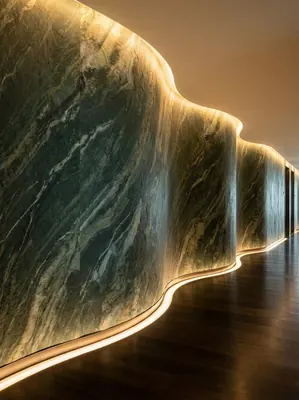
Hotel lobby 480㎡ printed granite (Glacier Green) wall construction case
IGOODS of AIGUOSI provides printed granite (Glacier Green) as wall material f...
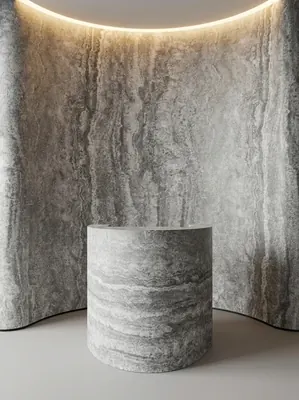
酒店大堂520㎡打印洞石(冰川灰)墙面施工案例
艾谷思IGOODS 为四川省西昌市一处酒店大堂项目提供打印洞石(冰川灰)作为墙面材料,采用满粘法直接上墙、无需龙骨基层。项目墙面概算约 520㎡,材料规格...

Light Mist Gray Charcoal Wood Veneer Panel 1060-5
Light Mist Gray is a charcoal wood veneer panel in the IGOODS solid color woo...

Ivory white bamboo charcoal wood veneer panel 1061-5
Ivory white is a bamboo charcoal wood veneer panel from the IGOODS wood venee...

Warm Sand Gray Bamboo Charcoal Wood Veneer Panel 1062-5
Warm Sand Gray is a bamboo charcoal wood veneer panel in the IGOODS solid-col...

Oat Color Charcoal Wood Veneer Panel 1063-5
Oat Color is a charcoal wood veneer panel in the IGOODS wood veneer solid col...