
For the same 3 mm panel, full adhesion, spot bonding, and keel dry hanging differ by up to double in labor, by half in auxiliary materials, and even more in rework probability. The difference is not in "whether it sticks" but in three places: the adhesive coverage area, whether there are cavities behind the panel, and where the stress goes. This article breaks the three methods into processes, costs, and failure conditions, providing figures you can take to a quotation.
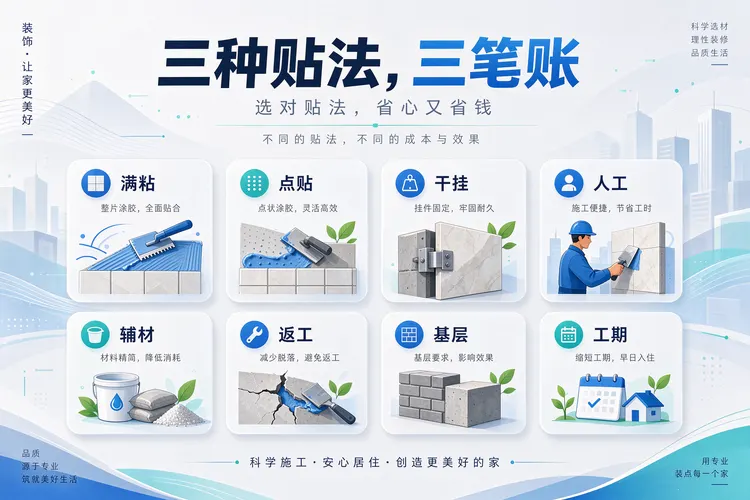
Image: three application methods, three cost calculations—full bonding, spot bonding, and framing dry hanging, each with different labor, auxiliary materials and rework probability.
I. The Essential Differences Among the Three Methods
Full adhesion. Apply adhesive in strips or notched ridges across the entire back of the panel; after pressing, the adhesive layer essentially covers the whole panel. There is almost no cavity between panel and substrate, and stress is transferred evenly through the adhesive layer.
Spot bonding. Adhesive is applied only at the four corners or several points in the middle of the panel, or in a few strips. Adhesive usage is significantly reduced, and local cavities form behind the panel.
Dry-hanging on keel. First install metal framing on the wall, then fix the panels to the framing. There is a continuous air layer between panel and substrate; flatness is adjusted by the framing, not by the substrate.
The three methods have different applicable scenarios, not because "expensive is better," but because they solve different problems: full adhesion solves bonding and load transfer, spot bonding solves adhesive consumption and local leveling, and dry hanging solves uneven substrates and locations requiring a cavity.
II. Three accounts: labor, auxiliary materials, rework
The following ranges are common reference figures used in project budgeting; actual calculations depend on layout, substrate conditions and local labor prices, and do not constitute a quotation commitment.
- ManualTaking full adhesion as the baseline, dot bonding is about 90% of full adhesion, and keel dry hanging is about 1.6 to 2 times full adhesion. The extra cost of dry hanging is keel installation, leveling, and fastener fixing.
- Auxiliary materials: Full bonding uses the most adhesive; spot bonding uses about half to sixty percent of full bonding; for dry hanging, the auxiliary materials shift from adhesive to framing, hangers and fasteners, giving a completely different unit price structure.
- Probability of reworkOn the premise of an acceptable substrate, full adhesion is the lowest; dot bonding is in the middle, with risk concentrated in the cavity; dry hanging itself has less rework, but has more nodes, and problems mostly occur at fasteners and closures.
- Schedule : Full bonding is the fastest, spot bonding is close, and dry hanging is the slowest. The dry-hanging schedule is mainly spent on the framing, not on installing panels.
- Subgrade requirements: Full bonding has the highest requirements for flatness; spot bonding is next; dry hanging can use the framing to absorb substrate tolerances.
Among these five items, the one most easily hidden in quotations is the "substrate requirement." When the substrate is not up to standard, full adhesion requires repairing the substrate to standard first, and this cost is often omitted; dry hanging converts this cost into a keel, which looks more expensive but actually turns the uncontrollable into the controllable.
III. The Processes of the Three Methods
The six steps of full bonding.
- Substrate acceptance: three items must pass—flatness, hollowing, and moisture content.
- Interface treatment: apply primer or leveling according to substrate type.
- Setting out lines and layout: set out lines according to the layout drawing and mark panel numbers.
- Adhesive application: spread with a notched trowel in one direction to ensure continuous adhesive beads.
- Panel application and compaction: complete within the adhesive's open time, and roll to expel air.
- Finishing and sealant application: treat internal corners, external corners, and openings according to the node drawings.
The sixth step is often treated as "wrapping up," but it is actually the key step that determines first-year performance.
The five steps of spot bonding.
The first four steps are the same as full adhesion; the fifth step is changed to "apply adhesive at points + attach panel + local compaction." What is saved is adhesive coverage; what is added is judgment of point locations: points must fall at reasonable load-bearing positions on the panel and cannot be placed arbitrarily.
The seven steps of dry-hanging on a keel.
- Setting out: determine keel layout and panel joint positions.
- Keel installation: fix vertical keels at specified spacing and apply anti-corrosion treatment.
- Keel leveling: level the keel surface with shims or adjustable parts.
- Hanger fixing: hanger positions correspond to panel fixing points.
- Panel installation: from bottom to top, place according to numbers.
- Joint width control: use spacers or positioning pieces to control joint width.
- Finishing and sealant application.
The success or failure of dry hanging lies in the third step. If the framing is not leveled, all the panels behind it will be crooked, and this cannot be corrected by adjusting the panels.
IV. Method Selection for Two Projects
Menghai Resort, approximately 2,100 ㎡ of curved rammed earth exterior wall. The curved section uses full adhesion, with trial bending before cutting. The reason for choosing full adhesion is straightforward: the edges of curved panels need continuous restraint, and spot bonding will create local cavities on the curved surface, which are most prone to bulging under temperature differences. The difficulty in this project is not the adhesive but the trial bending and the seams at the curved transitions.
Banquet pre-function hall, approximately 1,680 ㎡, 8.9 m clear height, 12 round columns. Full-height spaces use full adhesion with scaffolding construction. The adhesive layer in full-height areas must be continuous because the wind pressure and temperature differential stresses are greater at height; column-wrapping areas are laid out in equal divisions around the column perimeter, with joints falling on the sides.
Neither project chose dry hanging because the substrates were controllable. If the substrate is an old wall with unverifiable flatness, dry hanging would be the safer option, at the cost of budget and schedule.
V. The Failure Conditions of Each
Failure conditions for full adhesion: substandard substrate, expired adhesive, exceeded open time. If any of the three occurs, bond strength will drop significantly, and it cannot be found by observation afterward—only by tapping and pull-off testing.
Failure conditions for spot bonding: arbitrary placement of bonding points, use on exterior walls, water ingress into joints. The cavity formed by dot bonding will repeatedly breathe under negative wind pressure and temperature differentials; under long-term action, fatigue first appears around the adhesive dots. Dot bonding is not recommended for exterior walls—this is a clear boundary.
Failure conditions for dry hanging: framing not leveled, concentrated load on hangers, insufficient panel thickness. If the fastener positions on thin panels rely on only a few points for load bearing, local stresses will be very high. Dry hanging must design fastener density according to the panel's actual strength—stone fixing methods cannot be copied directly.
There is also a general failure condition: all three methods are vulnerable to "rushing the work." Bonding before the adhesive has reached its required time, installing panels before the keel is leveled, and tooling joints before positioning all lead to problems that will surface concentrated in the first year.
VI. Old walls and insulated walls: differences in handling three types of substrate
The most frequently asked question in renovation projects is "can it be applied directly?" The answer depends on the substrate type; the handling sequence differs completely for the three substrate types.
Original tile surface. First tap to check for hollowing; hollow areas must be removed. Non-hollow areas receive interface treatment and a pull-off test, and only after passing can full adhesion proceed. Directly applying adhesive on a glazed tile is the most common failure method, because the glaze does not absorb water and the adhesive cannot grip.
Old paint surface. First test adhesion strength; areas with peeling, chalking, or efflorescence must be removed down to the substrate; latex paint walls require sanding and primer. The most troublesome part of old paint is that it "looks flat" while the surface strength is actually very low, and the entire sheet falls off after adhesive is applied.
Insulation layer. Direct full adhesion is not possible. The strength of the insulation board is insufficient to bear the weight and stress of the panel and adhesive; a substrate board or leveling layer must first be installed to distribute the load to the structural surface. Dot bonding on insulated walls is an explicitly prohibited practice.
All three types of substrates require pull-off tests; the test results are the basis for determining "whether direct bonding is possible," not empirical judgment. When pull-off values fail to meet requirements, the handling sequence returns to "remove or reinforce"—there is no third option.
The usual sequence for an old renovation project is: check hollowing → test adhesion → pull-off → determine removal scope → leveling → interface treatment → full adhesion. The time spent on the first five steps determines how many years the result will last.
Seven, how to break down the quote
If the quotation only gives a single composite unit price, the differences among the three methods are hidden. It is recommended to break it down into five columns:
- Material (board)
- Auxiliary materials (adhesive, keel, hangers, sealant)
- Labor (Differentiated by Method)
- Measures (scaffolding, suspended platform, finished product protection)
- Substrate treatment (leveling, repair, primer)
Once the five columns are broken out, the client can understand "why this vendor's price is higher," and the contractor no longer needs to absorb substrate risk through a "comprehensive unit price."
Eight, eight questions
How much adhesive does spot bonding save?
The common reference is half to sixty percent of the adhesive used for full bonding. Saving adhesive does not equal saving money; it depends on whether the risk from cavities is acceptable.
Can exterior walls use spot bonding?
Not recommended. On exterior walls, wind pressure and temperature differences amplify the cavity effect, and the failure probability of spot bonding on exterior walls is significantly higher than on interior walls.
Is Dry-Hanging More Premium?
No. Dry hanging solves the problems of uneven substrates and the need for a cavity—it is not a "higher grade." Using dry hanging on interior walls with acceptable substrates spends money where it is not needed.
Can 3 mm panels be dry-hung?
It can be done, but hanger density must be designed according to the panel's actual strength; stone back-bolt methods cannot be copied directly. The specific plan needs to be calculated per project.
Roughly how much adhesive is used for full bonding?
Determined by the continuity of adhesive ridges from the notched trowel; specific usage is calculated according to layout and substrate flatness. The more uneven the substrate, the greater the adhesive usage.
Which of the Three Methods Has the Least Rework?
Under the premise of a qualified substrate, full bonding requires the least rework. Dry hanging has less rework but more nodes; spot bonding falls in between. Rework probability is related to the method, and even more to the substrate.
Which to choose for old wall renovation?
Check the flatness of the old wall. If flatness is controllable, choose full bonding; if not, choose dry hanging. For old tile surfaces and old paint surfaces, adhesion testing must be done first.
What is most easily omitted in a quotation?
Substrate preparation. It is often treated as "included in the unit price," but it is actually an independent cost, and the amount often exceeds the material cost.
Supplement one: how to show the adhesive model on the quotation
The adhesive model should not be just a line in the auxiliary materials list. Full adhesion and spot bonding differ by half in adhesive consumption. If the quotation only says "special adhesive," the client cannot judge whether a weather-resistant type is used. It is recommended to write three parts: adhesive type (weather-resistant or interior), specific model, and consumption basis (kilograms per square meter). If any of the three is missing, quotations are not comparable.
Supplement 2: When Pull-Off Testing Is Mandatory
Three situations are recommended as mandatory: old wall renovation, insulated wall substrates, and full-height walls over four meters. If pull-off values fail, the method must be reconsidered; it cannot be compensated for by "applying more adhesive." Adding adhesive can only improve local bonding; it cannot change the strength of the substrate itself.
Supplement 3: Acceptance Differences Among the Three Methods
Full bonding: check two things: Hollow areas and adhesive layer continuity. Hollow areas are checked by tapping; adhesive layer continuity is checked through construction records and cut-open spot checks.
Spot bonding: check two things: Point layout and cavity extent. Points must be checked against the layout drawing, and cavities are assessed by tapping to determine their extent.
Dry-hanging: check two thingsFraming flatness and hanger fixing. If the framing is not level, all the panels behind it will be crooked; if the hangers are not secure, individual panels will loosen.
The acceptance focus differs completely among the three methods; using the same acceptance checklist will miss items. Acceptance checklists should be versioned by method and cannot be one checklist for all.
Supplement 4: On-Site Method for Verifying Adhesive Quantity
The adhesive quantity in the quote is an estimate and must be verified on site. Three actions.
Action one, weighing method. Before opening the bucket, weigh one bucket of adhesive; weigh it again after use, and divide the difference by the construction area to get the actual unit consumption.
Action 2: Scratch Inspection. Before installing panels, check whether the adhesive beads are continuous and the notched profile is complete. Interrupted adhesive beads mean insufficient coverage.
Action 3: Cut-Open Inspection. A section of the mock-up can be cut open to see whether the adhesive layer is full and whether there are cavities. This step is destructive and should only be done on the mock-up.
Of the three actions, the weighing method is the most objective and also the easiest to skip. Adhesive quantity getting out of control is usually not because the wrong adhesive was purchased, but because no one checks.
Nine, further reading
- Flexible stone product page: Specifications and series; confirm panel thickness and bendability before choosing a method.
- Engineering Cases Library: Find comparable practices by location, focusing on three types: curved, full-height, and renovation.
- Selection Guides: individual practices for substrate, adhesive, closing, and acceptance.
- Facts and verification page: Weight and specification basis; use this as the basis for load calculations.
- Contact page: Provide substrate conditions and location, and a method recommendation can be made first.
The three methods have no inherent superiority—only suitability. Choose full adhesion when the substrate is controllable, dry hanging when the substrate is not, and reserve dot bonding for interior walls and localized areas. Choosing the wrong method means the auxiliary material savings will be paid back in rework.
Written and reviewed by: Materials Technology Group, Chengdu Igoods Technology Co., Ltd. (Parameters and conclusions reviewed according to current standards such as JG/T 540-2017 and the company's publicly available test data; the specific combustion performance rating and weather resistance conclusions are subject to the valid test report for the selected model.)
Related articles
How much can you trust a rendering: five deviations from design drawing to installed wall
Renderings are getting more and more realistic, but the five deviations betwe...

Three enemies of the white exterior wall: rain marks, alkali scaling, and seam dirt
White exterior walls look good on delivery day; the difference shows in the t...

How can one white color used across six spaces avoid looking perfunctory?
A white Star Moon Stone used across six spaces in a hotel public area can eas...
Cloth texture, coarse cloth texture, hemp weave: how to choose among three kinds of "fabric-feel" wall surfaces comes down to the same thing
For the three fabric-feel textures—cloth texture stone, coarse cloth texture ...