
Last winter I accompanied a client to an acceptance inspection. The wood grain wall in the hotel lobby had been completed, and the effect was good. After the inspection, he asked me one question: if 20 square meters of this batch of panels need to be supplemented three years from now, can you guarantee the color will be the same?
I couldn't answer at the time. The contract said "walnut wood-grain flexible stone, 1240㎡"—just that one line. No batch number, no reserved stock, no restocking lead time. That one question exposed every loophole in the entire contract.
Later we organized these kinds of questions into a table, nine cells, each cell corresponding to one sentence. Now I basically follow this table when discussing projects, and sign after the discussion; the probability of disputes can be reduced by more than half.
1. First, look at a project that spells out the parameters clearly
For that hotel in Yanta, Xi'an, four spaces—lobby, guest rooms, corridors, restaurant—all use the same walnut wood grain flexible stone, with a net area of 1240㎡, calculated material of 1364㎡, 10% waste, and an order of 394 pieces (382 pieces + 12 pieces of spare material), wall self-weight 5.9 tons, special adhesive 477 kg, adhesive calculated at 0.35kg/㎡, about 24 buckets.
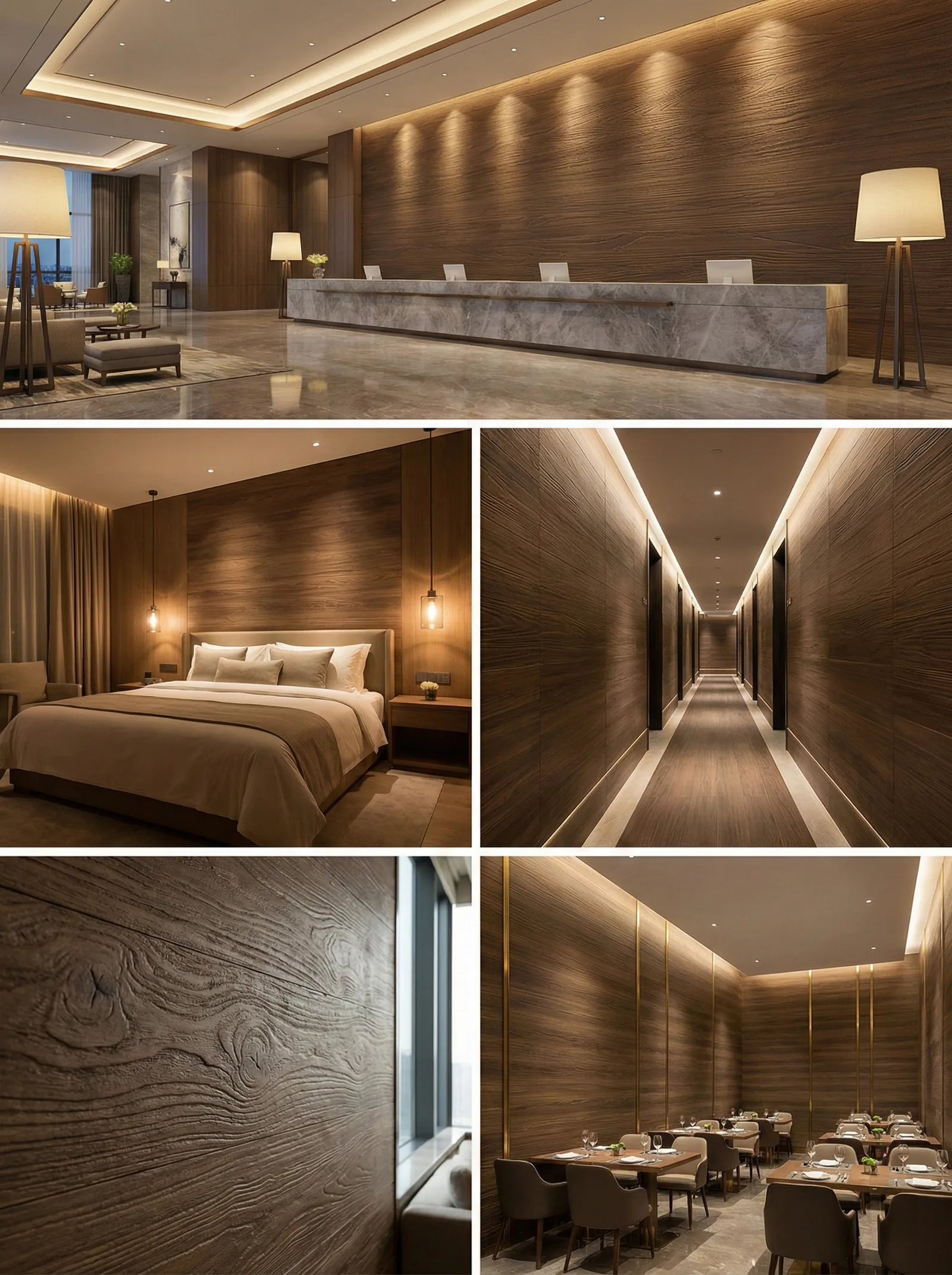
This combination drawing corresponds to the walnut-grain case and is not the same set of material illustrations as the earlier light-colored stone-grain guest room. When looking at the procurement list, it can help distinguish the horizontal-grain large wall, the vertical-grain dining area and local close-ups, but product batch numbers, thickness or acceptance results cannot be identified from the drawing. Model, color and batch still need to be matched item by item against the sample board, packing list and project documents; the drawing looking similar only means the look is similar, not that batches can be mixed for procurement.
What is interesting about this set of numbers is not the area, but the words "one color code." The four spaces were brought in three times, with more than forty days in between; if the first and second batches were not from the same production batch number, an obvious color difference would be visible under warm light. So they wrote "same batch number for all spaces, no color switching allowed" into the order, not into the design description.
This is the meaning of the list: turning oral agreements into clauses that can be held accountable.
II. Nine parameters, checked one by one
1. Model and color code, how fine can it lock?
What to ask: Don't ask "Do you have walnut grain?" Ask "What is the internal number of this color, and how many batches are in production under this number?"
Why ask: the color patterns of flexible stone are produced by surface processes, and the same color pattern will vary in depth between batches. The number is the only thing that can be traced; a name alone is useless.
How to judge: Have the other party state in the contract attachment "product name + color pattern number + batch number," and note "same batch number supplied in full for the same project." If the other party says "our color is very stable and batch numbers are unnecessary," that statement itself is a risk signal.
2. Specification, thickness, tolerance
What to ask: What are the length and width, what is the nominal thickness, and what tolerance is allowed?
Why ask: thickness directly determines weight, flexibility and price. Similar products on the market range from 1.8mm to 3mm; when quotes differ by a factor of two, look at thickness first.
How to judge: The Yanta batch was 1220×2930mm, 2.5–3.5mm thick, about 4.76kg/㎡. What you should ask is not "how thick," but "by what method is it measured, and what is the allowable tolerance." Measure with calipers upon receipt; agree in advance where to measure and how many points.
In one sentence: if thickness tolerance is not specified, the thickness is as good as unspecified.
By the way, a note on choosing specifications. Large boards such as 1220×2930 have fewer seams and look more continuous, but carrying them upstairs requires two people, and they cannot fit in small elevators; small boards such as 600×1200 are easier to carry and install, but have twice as many seams, increasing labor costs. For high-rise projects above the 30th floor, elevator dimensions often determine which specification you choose more than price does. No one will proactively remind you of this, but you will definitely encounter it on site.
3. Per square meter weight and wall load
What to ask: How many kilograms per square meter for this product, and what is the total weight of the entire wall?
Why ask: the load-bearing capacity of lightweight partition walls, old walls and insulated walls is limited. 1240㎡ times 4.76kg is 5.9 tons; this figure must be shown to the structural discipline in advance.
How to judge: Have the other party issue a load statement based on "area × weight per square meter." Natural stone of the same area at 26kg/㎡ would be 32 tons, a difference of an order of magnitude — this is not to praise the material, but to let you judge whether the substrate needs reinforcement.
To judge whether the substrate can be used directly, there is a rough method: knock the wall with the heel of your palm and mark places where the sound is hollow. If there are more than three hollowing spots on a whole wall, do not rush to discuss materials; discuss repair first. This action takes ten minutes and can save a lot of explanations later.
4. How is the calculation area of the material calculated?
What to ask: What loss rate is used, and where does the loss occur?
Why ask: the net area is 1240㎡ but 1364㎡ is quoted; the extra 124㎡ is not added arbitrarily, but for layout cutting, corner wrapping, around openings, and material reserve. If these items are not broken out, you cannot judge whether this 10% is high or low.
How to judge: Have the other party list it in four items: "net area + layout waste + shape waste + reserve material," and the total should match the material calculation area. If it does not match, it is guesswork.
| Project | Values for the Yanta project | Description |
|---|---|---|
| Net wall area | 1240 ㎡ | IV. Actual measurement totals for four spaces |
| Material calculation area | 1364 ㎡ | 10% wastage |
| Number of pieces to order | 394 pieces | 382 pieces + spare parts 12 pieces |
| Wall self-weight | 5.9 Ton | 4.76kg/㎡ × 1240 ㎡ |
| Special glue | 477 kg | 0.35kg/㎡ × 1,364 ㎡, about 24 barrels |
| Color code | 1 unit | Same batch number throughout all spaces |
A concrete calculation method. Assume a net area of 1240㎡, layout cutting waste at 6%, corner wrapping and door opening finishing for the four spaces at 3%, plus 1% breakage allowance, totaling 10%. 1364㎡ divided by the single-piece area of 3.575㎡ (1220×2930mm) equals approximately 381.5 pieces, rounded up to 382 pieces; adding 12 pieces of reserve material gives 394 pieces.
I am not asking you to memorize this formula. I am saying that when the other party quotes "1364 square meters," you should be able to calculate it on your phone within thirty seconds and judge whether the number is reasonable. If you can calculate it, you have the initiative; if you cannot, you can only trust them.
5. Delivery date and batch
What to ask: How many days from deposit to first batch arrival, how many days for the complete set, and can it be delivered in batches?
Why ask: 1240㎡ needs to be delivered in three phases; the first batch must provide a mock-up for the lobby, and only afterward are the guest rooms laid. If the production sequence is wrong, the site has to wait.
How to judge: Make the "phased delivery schedule" an attachment to the contract, stating the area, number of pieces and arrival date for each batch. Do not accept answers like "about a month"; require specific dates.
This order was delivered in three batches: the first batch was the lobby, where samples were also made and photos taken; the second batch was guest rooms and corridors, the largest volume; the third batch was the restaurant finishing work. One week before each batch arrives, the site substrate must pass inspection; otherwise the panels can only be stacked in the corridor when they arrive, taking up space and easily being crushed.
Which product does the test report correspond to?
What to ask: The sample name, model, test items, reference standards, and issue date on the report.
Why ask: the report corresponds to the sample submitted for testing, not the entire series. If the model you select does not match the sample in the report, this report has no validity for your project.
How to judge: Have the salesperson read out the sample name in the report and your order model item by item. Combustion performance is classified according to GB 8624-2012, radioactivity according to GB 6566-2010, and product performance according to JG/T 540-2017 — writing these three standard numbers into the contract is more useful than writing "complies with national standards."
7. Who supplies the adhesive and who determines the model?
What to ask: Is the adhesive supplied by the owner or the contractor, what model is used, and how is the quantity calculated?
Why ask: flexible stone is fully bonded onto the wall; if the adhesive has problems, the panel is useless no matter how good it is. Use flexible adhesive indoors and weather-resistant adhesive outdoors; these are two different systems.
How to judge: The Yanta order of 1364㎡ used 477kg of adhesive, at 0.35kg/㎡. Have the contractor quote according to this amount, not "figure it out." For outdoor projects, the weather-resistant adhesive model must be separately specified.
One detail worth mentioning: the price of indoor adhesive and outdoor weather-resistant adhesive can differ by more than two times. If a quotation has only one line item for "special adhesive," you cannot tell which type is being supplied. Only when they are listed separately is comparison possible.
8. List of caps, corner parts, and accessories
What to ask: For internal corners, external corners, door and window casings, and skirting, are finished accessories used or on-site cutting?
Why ask: these locations have the highest rework rates. If the accessory list is not clearly itemized, work at those points has to stop and wait for materials.
How to judge: When producing detailed drawings, have them simultaneously produce an accessory schedule marking the part number and quantity for each position. Ordering without an accessory schedule is equivalent to leaving the finishing details to the workers' feel.
9. Material ratio and replenishment commitment
What to ask: How much stock is reserved, and can replenishment within three years match the color?
Why ask: this is the question I was stumped by at the beginning. Walls in commercial spaces will inevitably be bumped, partitions will be changed, and equipment will be added.
How to judge: For conventional projects, prepare 8%–10% extra material; for projects with many irregular shapes, 12%–15%. The replenishment commitment should preferably be written as "same color pattern available within three years; if batch numbers differ, the color difference range must be notified in advance." You cannot write "absolutely the same color," but you can clearly state "how large the difference is between different batches."
3. Three contract wordings, three outcomes for the same project
How to use this checklist becomes clear by looking at three real examples of how it has been written.
| Writing approach | Original contract text | What will happen three years later |
|---|---|---|
| A kind | “Walnut wood grain flexible stone 1240㎡, unit price ×× yuan” | When replenishing, if the same batch cannot be found, the entire wall can only be redone, and the loss is calculated by wall width |
| Type B | “Flexible Stone 1240㎡, executed according to JG/T 540-2017, with a loss of 10%” | The parameters are there, but the model and batch number are still missing; if the color doesn't match, there's no way to prove it |
| C type | “Walnut wood grain (color code ×××) 1220×2930mm, thickness 2.5–3.5mm, 1240㎡, calculated material 1364㎡, same batch number available, 12 pieces ready, with XYZ inspection report (sample name and model consistent)” | When supplementing 20 square meters, there is a same-batch panel in the warehouse, solved in half a day |
The prices of the three wordings are almost the same. The difference is only in how much more you think for ten minutes on the day you sign.
B type is the most common, looks quite professional, wrote the standard number, wrote the loss. But its weakness lies in: the standard is 'how to inspect the product performance', not 'what does this batch of goods look like'. Color, batch number, materials, the standard can't control, can only be controlled by the contract.
IV. Of these nine items, the easiest to miss is item 9
The first eight items are technical issues and are not uncomfortable to discuss. The ninth is a commercial issue that many people are embarrassed to ask about.
But it is precisely this item that, two years later, determines whether you solve it with one phone call or rebuild a whole wall.
I saw a club in Lanzhou. Ten months after opening, a piece of wall on the side of the bar was knocked off by a cart, about thirty centimeters square. They wanted to repair it but could not find panels from the same batch, and in the end they redid the entire wall, more than three meters long. That wall was part of 860㎡, and the repair cost more than 30,000.
If you had ordered 8 extra panels at the time, this would have become a half-hour job.
V. Four answers that immediately reveal unprofessionalism
When negotiating, the other party's answers reveal more about the issues than the quotation sheet. There are four kinds of remarks that, when I hear them, make me slow down the pace.
The first type is "our color is very stable, no batch number needed." The finish of flexible stone is produced by a process; products that are stable enough not to need batch numbers usually have not undergone batch comparison.
The second type is "We'll calculate waste at 15% for you and refund the excess." It sounds generous, but in fact it pushes the responsibility for quantity calculation onto the site. Someone who has truly done projects will first ask for your layout drawing and the number of openings.
The third type is "We have all the reports—tell me which one you want and I'll send it." This shows the reports are not tied to specific models. A professional answer is "Which report corresponds to the model you selected? I'll read the sample name to you."
The fourth type is "We'll supply the adhesive." Supplying adhesive is not a bad thing, but you need to ask clearly which product is being supplied. Supplying indoor adhesive for an outdoor project means the money saved will ultimately be spent on rework.
VI. Turning the list into one page
The checklist doesn't need to read like a legal document. I usually just write one A4 page: project name on the left, nine rows in the middle, and a "Confirmed by" column on the right. After the discussion, have the salesperson and the construction party each sign once.
This piece of paper will not make the material better, but it will turn "what was said" into "what was written down." Most disputes in engineering are not because something was done wrong, but because it was not clearly written down at the outset how it should be done.
This table can be extended further. If the same set of questions is transferred to wood veneer wall panels, add "substrate density and composite process"; if transferred to PU stone veneer, add "forming method and whether corner pieces are matched"; if transferred to WPC grilles, add "section dimensions and clip model." Products differ, but the skeleton of the questions is the same: model, specification, quantity, timing, certificate, accessories, spare material. Once these seven things are clarified, what remains is price negotiation, not risk negotiation.
If needed,Flexible stone seriesThe specifications and packaging parameters of each item in are public, so you can check them first before discussing; the complete record of this project itself is inXi'an Yanta hotel case; the original figures for numbers, quantities and schedules are all in there.
Previous:楼梯间弧形墙如何实现石材质感-柔性石材基层与收口指南
Related articles
楼梯间弧形墙如何实现石材质感-柔性石材基层与收口指南
楼梯间弧形墙实现石材质感,应先解决曲率、基层找圆、栏杆固定、踢脚、照明与消防要求,再选择饰面。柔性石材可作为轻薄石纹弧墙的候选,但必须验证实际半径、粘结系...

How to balance texture and construction efficiency on the cinema hall wall - a guide to selecting flexible stone materials
The selection of materials for the cinema hall wall should consider the textu...

How much material do I need to buy for one square meter of flexible stone? How to calculate loss rate and number of pieces
How to calculate the quantity of flexible stone—should waste and reserve mate...
How to choose white flexible stone? Star Moon Stone sampling, sealed samples and color difference control
What should be done if the color of white flexible stone samples differs from...