
After handover, I usually go back to check at two points in time: six months and twelve months.
It's not about finding problems to make trouble for the contractor, but about knowing what this wall becomes in real use. Show flats always look good; only walls that have been used tell the truth.
That clubhouse lobby in Chengguan, Lanzhou, is 860 square meters: main feature wall 380, side-wall corridor 300, reception desk column cladding 180, calculated material 937 square meters, waste 9%, 270 panels cut, 328 kg of special adhesive. The material is walnut grain, with a fine horizontal texture, about 3 mm per line.
The viewing distance in this project is particularly worth mentioning: 1.5 to 3 meters. The clubhouse lobby is half as far as a hotel lobby; when people sit on the sofa, they are only two meters from the wall.
1. Six months and twelve months do not look the same
Six months: the first return visit
At six months, the wall surface had basically not changed.
The only change is at the wrapped column. At that column by the reception, where people lean while waiting and rest their hands, an area below the column's waistline has become duller in gloss.
This is not a material quality issue; it is a film formed on the surface by oils and dust from hands. Wiping once with a damp cloth restores it.
But this incident reminded me:The "darkening" of high-frequency touch areas is mistaken for "aging." If the property management does not know, they will assume it is material aging and then start looking for the manufacturer.
So from that time on, at handover I leave a sheet of paper for the property management, stating "which locations will darken, why they darken, and how to clean them." One sheet of paper saves a lot of misunderstanding.
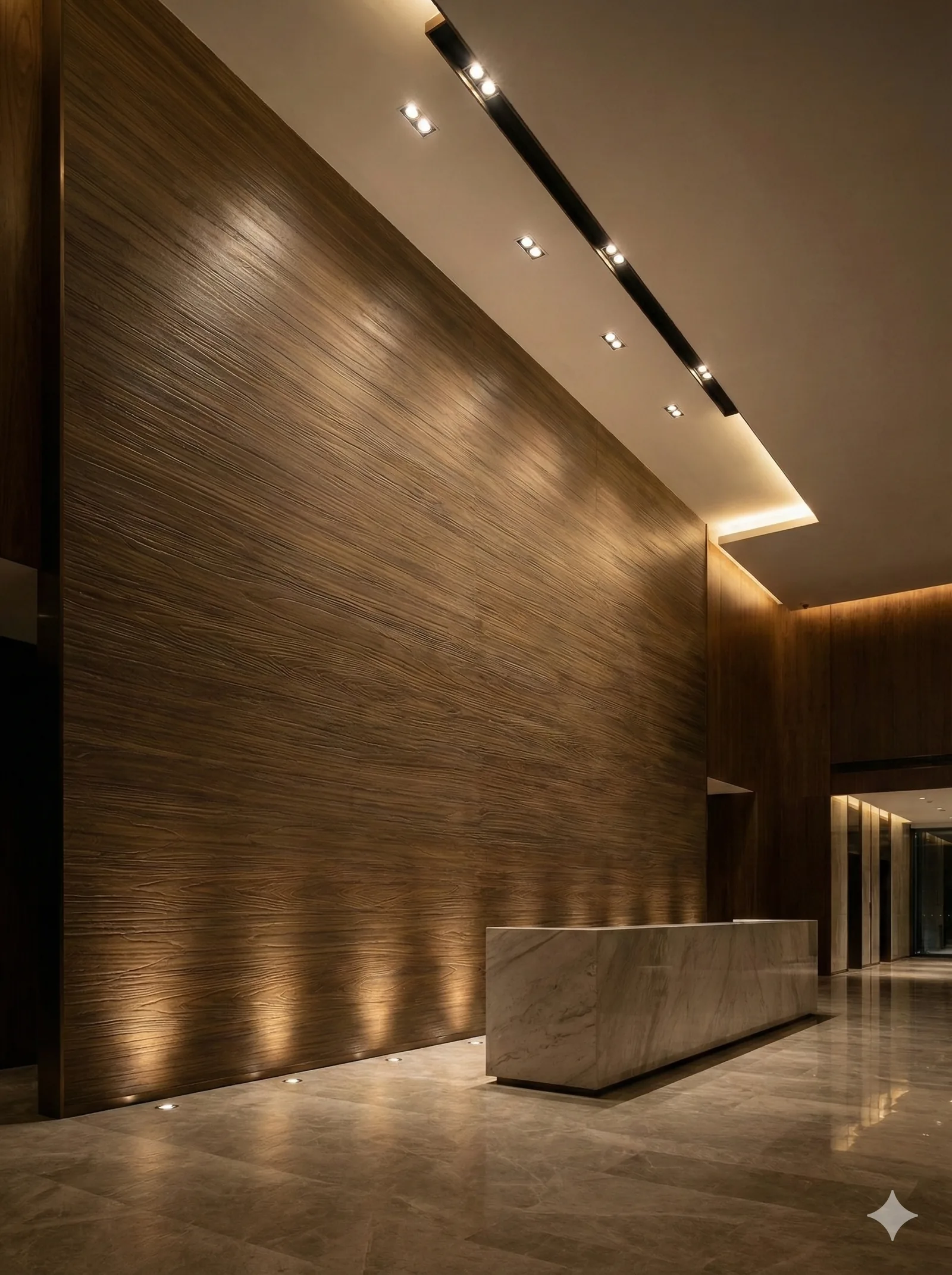
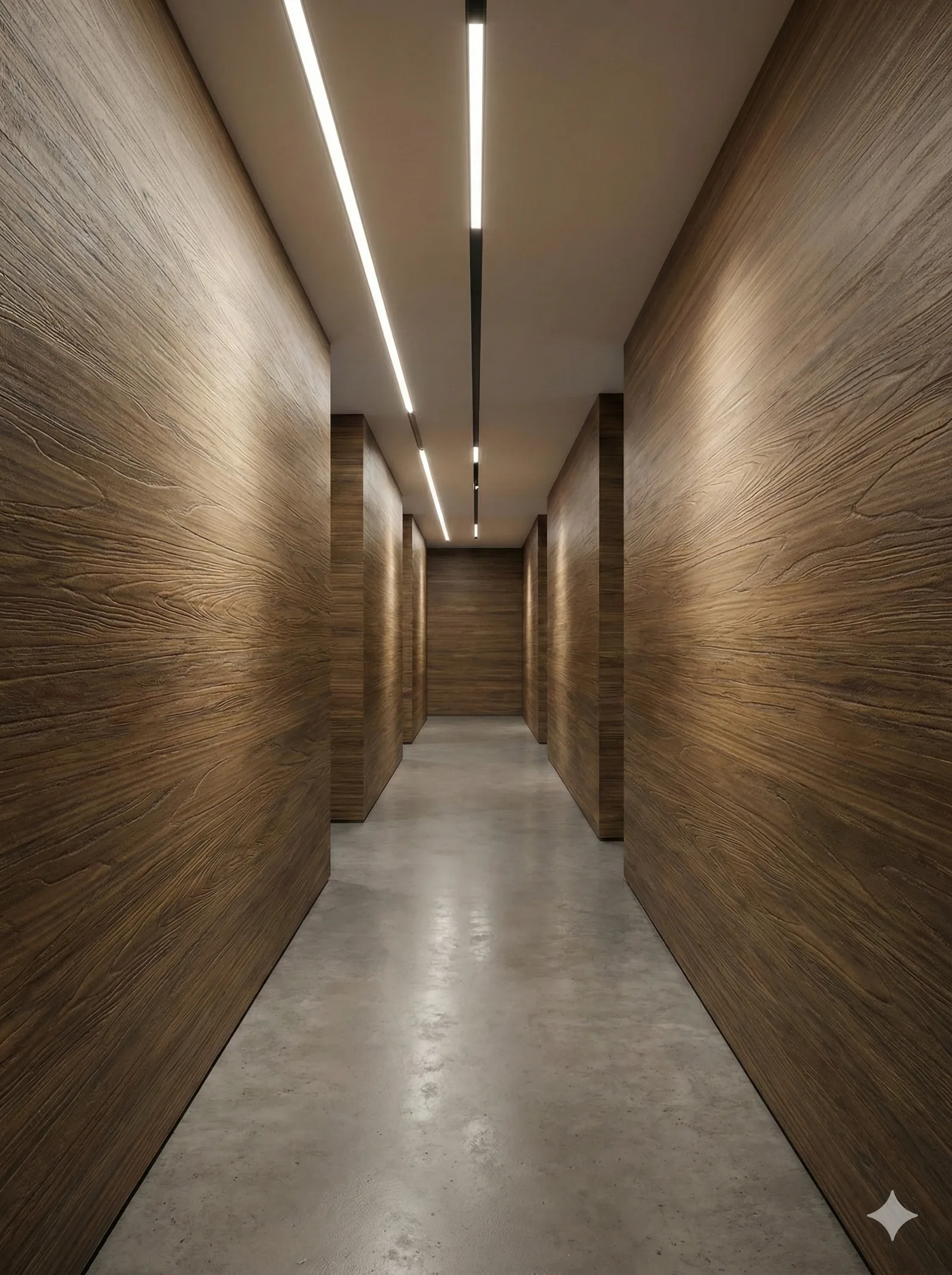
Before maintenance, first identify which part it is: the lobby image has horizontal texture, the dining image has vertical texture, and the corridor has continuous linear light. Whether a repair can be noticed often depends on these viewing conditions. When taking repair request photos, keep one wide shot that can locate the position, then take one close-up of the damage, and record the location, texture direction, and spare panel number together; this makes it easier to determine the treatment method than sending just a photo of a stain.
Twelve months: really look at three things
After one year, the wall entered a "stable period". At this stage I look at three things: seams, color and edges.
Joint. Whether panel joints have widened, accumulated dust, or the adhesive has cracked. Wood grain is a horizontal texture, while joints are vertical; vertical joints accumulate less dust than horizontal ones, but a dust line will still form at the joint mouth.
Color. Has the color difference across the entire wall expanded? A year of light exposure will cause the color to change slightly, and this change should be uniform. If a certain area is noticeably lighter, it means that area has been exposed to direct light or frequently wiped by people.
edge. Whether the panel edges have warped. Warping starts at external corners and door/window openings; scrape along the edge with a fingernail—if you can feel it, it has warped.
After a year of observation, all three aspects of this wall are normal. The only thing that needs handling is a dent in the corridor section.
II. Three types of damage, three approaches
Three types of damage, three approaches
A used wall suffers from only three types of damage: dirt, impact, and chips.
First lay out the costs openly, then decide whether it is worth supplementing.
| Damage type | Typical dimensions | Treatment method | On-site time required | Appearance recovery degree |
|---|---|---|---|---|
| Surface dust and fingerprints | — | dry cloth or neutral cleaner | 5 minutes | 100% |
| Oil stains, pen marks | Localized | Detergent + alcohol wipes | 15 minutes | 95% |
| Knock and bump dents | Within 15×8 mm | Repair compound + texture pressing + light adjustment | 40 minutes | 80%, 1 meter away not visible |
| Chipped corner | Within 20 mm of corners and edges | Corner filler, plus same-color edge trim | 1 hour | 70%, wired when close |
| Whole-piece breakage | Panel surface penetration | Remove panels and replace with new | Half a day to one day | 100%, provided there is the same batch of materials |
| Large-area bulging | Continuous 2 ㎡ or more | Remove panels, clean adhesive, repair substrate, reinstall | 2-3 days | 100%, the highest cost |
The most useful part of this table is the last column. It tells you which damage is worth repairing and which can only be accepted.
DirtyIt is the most common, and the simplest to handle, but it is also where the most people use the wrong method.
KnockIt is a local depression or chipped corner; it can be repaired, but there will definitely be marks after repair.
MissingIt is damage to the entire panel, which can only be replaced; the cost of replacement is ten times that of repair.
The following explains them separately.
Dirty: three types of stains, three approaches
Surface dust. A dry cloth or soft-bristle duster, sweeping from top to bottom. Do not use a wet cloth; a wet cloth pushes dust into the recesses of the texture, which turns into white spots once dry.
Oil stains and fingerprints. Dilute neutral cleaner with water (ratio about 1:20), moisten a soft cloth, wipe along the grain direction, and immediately dry with a dry cloth after wiping. Do not use alkaline cleaners, as they will damage the surface waterproof layer.
Pen marks, offset printing. Try an eraser first; if that does not work, gently wipe with an alcohol pad, then rinse immediately with clean water. Alcohol must not remain for more than 10 seconds; prolonged contact will cause the surface to whiten.
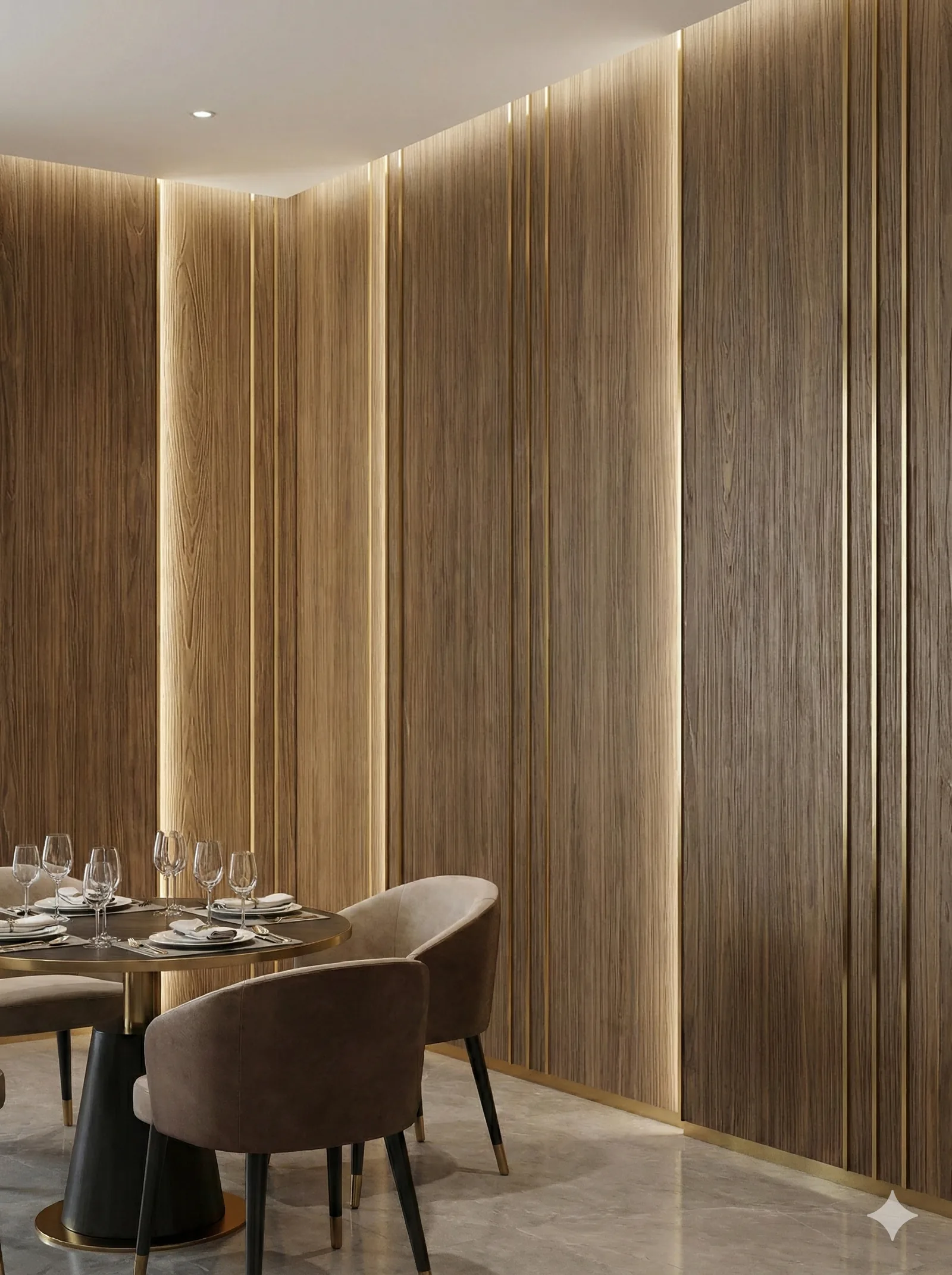
One detail: the wood grain texture is horizontal, so when wiping, wipe horizontally along the grain, not in circles. Wiping in circles pushes dust into the grain and makes it more smeared the more you wipe.
Knock: repair paste can fill holes, but cannot restore texture
The knock appeared on a section of the corridor, at a height of 1.1 m from the floor, approximately 15×8 mm in size and about 1 mm deep, caused by a luggage cart scraping it.
The treatment process is as follows:
Step one, clean the wound. Use a utility knife to trim away the loose parts at the damaged area, and trim the edge into a slope, not a right angle. A slope allows the repair compound and the original panel to transition naturally.
Step two, fill with paste. Use color-matched repair paste and fill in two passes. The first pass fills to 80% and is left for 20 minutes to cure; the second pass fills it completely and is smoothed with a scraper.
Step three, create the texture. This step is key. The repair compound is solid-colored, while the original panel has texture. Use an offcut from the same panel, and while the compound is not fully cured, gently press it to "print" the texture on.
Step four, adjust the light. After curing, if the repaired area is brighter than the surroundings, lightly sweep it with a little matte clear coat; if it is darker than the surroundings, lightly rub it with same-color wax.
After this process is completed, it is basically invisible from 1 meter away. From 30 centimeters away it can be seen—there is no way around that; a repair is a repair.
Missing: panel replacement, the difficulty lies in finding the seam
If one piece is missing, it can only be replaced. The difficulty in replacing a panel is not installing the new panel, but removing the old one.
Flexible stone is fully bonded, so removing one piece requires first breaking the adhesive layer. The method is: insert a thin putty knife from one corner of the panel and push it in slowly while heating the panel surface with a hot air gun (around 60°C) to soften the adhesive.
Be patient when dismantling. If you rush, you will scrape off the substrate along with it, and then you will need to repair the substrate, doubling the schedule.
After dismantling, clean off the adhesive, sand the substrate flat, reapply primer, and wait until fully dry before installing new panels.
When new boards are installed, the seams must align with the original layout. Therefore, before dismantling, be sure to take photos and record the position of this board and its relationship with adjacent boards.
3. Material preparation and contract terms
Prepare 8 panels, is that enough
For this project, 8 pieces were reserved out of 270, a ratio of about 3%.
Over a year, 1 panel was used (the one in the corridor). 7 panels remain. The number is small, but it brings peace of mind—knowing that 7 panels identical to this one are lying in the warehouse is more reassuring than any warranty clause.
Is it enough? It depends on the project type. For low-frequency, low-damage settings such as clubs, 3% is enough. For high-frequency settings such as hotel guest rooms and shopping mall corridors, 5% is recommended.
Another variable is "future renovation." If partitions are to be changed, equipment added or new air vents installed within three years, the reserved stock will be used up. So when I sign contracts now I ask: are there any renovation plans within three years? If so, I raise the reserved stock to 5% to 8%.
There are also requirements for storing reserved materials. Panels should be laid flat, not stood against the wall; standing for a long time will cause warping. The storage environment should be dry and avoid direct sunlight. Place a sheet of paper between each panel to prevent surfaces from rubbing against each other.
It is best to put a label on each panel: color code, batch number, and arrival date. Three years later, when you take it out, you can tell at a glance which batch it is.
Maintenance clauses in the contract
The maintenance clause does not need to be very complicated; four sentences are enough.
First sentence: Warranty period. The standard is two years; for outdoor use it can be negotiated up to five years. The warranty scope should clearly state "quality problems of the material itself," excluding man-made damage.
Second sentence: response time. After a repair request, arrive on site to inspect within 48 hours and provide a handling plan within 7 days.
Third sentence: Material supply. The same color can be supplied within three years; if batch numbers differ, the color difference range must be communicated in advance.
Fourth sentence: maintenance guidance. At handover, provide a printed maintenance instruction and conduct an on-site briefing for the property management team.
The fourth sentence is the easiest to overlook, but it is the most useful. I have seen too many projects where the wall itself was fine but was damaged by cleaning staff using the wrong cleaning agent.
IV. Things to communicate at handover
A counterexample: oxalic acid
Let me share something real.
At a hotel that had been open for two months, cleaning staff used oxalic acid to remove limescale from the bathroom wall. Oxalic acid is a strong acid; once sprayed on, the panel surface immediately turned white and could not be wiped off.
That wall is over 40 square meters, all panels to be replaced.
Oxalic acid is commonly used in the cleaning industry because it removes limescale quickly and is cheap. But the surface of flexible stone is mineral-based and will react with acid. This is not written on the first page of any product manual, but it must be explained verbally.
So now at handover, in front of the property manager, I read out the "what not to use" list: oxalic acid, toilet cleaner, undiluted 84 disinfectant, steel wool, pressure washer. Five things, each one capable of ruining a wall.
What should be covered in the property briefing
A half-hour briefing covers four things:
First, how to wipe it. Give a piece of scrap from the edge of a sample panel and demonstrate on the spot: dry wiping, wet wiping, and wiping along the grain.
Second, what cannot be used. The five items above.
The third is who to contact when a problem is found. Leave a phone number and write clearly: "take photos first, then report for repair, do not handle it yourself."
Fourth, where the materials are stored. Take them to see the storage location and point out the labels to them.
This half hour can save a lot of phone calls over the next two years.
V. Set maintenance standards by viewing distance
Viewing distance determines maintenance standards
The most special part of this project is the viewing distance of 1.5 to 3 meters.
In a hotel lobby, when people walk past at a distance of more than 5 meters, a 1 mm chip is invisible. In a club lounge, when people sit down to drink tea at a distance of 2 meters, any flaw is within sight.
So the same damage has completely different handling priorities in two projects.
I generally set standards in three tiers:
- Above 3 meters: marks within 1 millimeter are not treated, above 2 millimeters are treated.
- Trace treatment of 0.5 millimeters and above from 1.5 to 3 meters.
- Within 1.5 meters (such as elevator halls, lobbies, cash desk backgrounds): all visible traces are treated, including fingerprints.
After this standard is given to the property management, they do not need to ask me every time; they can judge for themselves whether to call someone.
The rhythm of cleaning follows the seasons
It's not that the more often you wipe it, the better. Wiping too frequently will wear the surface.
My advice is to set the pace by season:
Spring. In the South, pay attention to dehumidification; walls may become damp, so wipe with a dry cloth, not a wet one. In the North, spring is windy and sandy with a lot of floating dust, so sweep once a week.
Summer. In air-conditioned rooms, the temperature difference between inside and outside is large, and condensation may form on walls. If water droplets are found, absorb them with a dry cloth; do not let them dry naturally — natural drying will leave water marks on the surface.
Autumn. In the most comfortable season, routine cleaning is sufficient. This is a good time to do a comprehensive inspection.
Winter. In the northern heating season, indoor air is dry, static electricity is high, and floating dust adsorption is strong. Sweep once a week, and be careful not to use synthetic fiber dusters, as they generate static electricity.
Four times a year, half an hour each time, is more effective than wiping for ten minutes every day.
Create a card for each wall
I learned this from the approach used in a Japanese project.
For each wall, create a card with six items: location, area, material color/pattern, batch number, construction date, and remarks (any special nodes).
The card is stuck on the wall of the back-of-house room, or stored in the property management system. When the cleaning staff change or the property company changes, the card is still there.
The value of this card lies in two things: first, the batch number can be checked when replacing panels; second, the original method can be found years later when changes are needed.
The cost is almost zero, but few projects do it.
VI. When to renovate the entire surface
When should the entire surface be renovated
Not all damage needs repair. Sometimes redoing the entire surface is more cost-effective.
Three signals:
First, repair density. On a 20-square-meter wall, if there are more than 8 repair marks, it already looks visually patchy, and it cannot be restored.
Second, color difference expands. If obvious light and dark zones have already appeared on the same wall, it indicates that the batch or lighting has caused irreversible changes.
The third is a functional change. For example, if it was originally a lobby and is changed into a restaurant, the wall needs anti-oil-fume treatment; at that point it is better to replace the entire wall.
The cost of full-face renovation is roughly 60% of the original construction cost (materials + labor + demolition), but the construction period is only one-third of the original, because no base layer work is required.
Finally
Half the life of a wall lies in the material, and half in maintenance.
Choosing the right material and executing the installation correctly accounts for only 70%. The remaining 30% is in the hands of the user—what they wipe with, how often they wipe, and whether their first reaction after a knock is to repair it or ignore it.
So now I increasingly value the handover at the moment of delivery. Not handing over keys—handing over knowledge. Lose the keys and you can cut new ones; if the knowledge isn't handed over, that wall can only grow old day by day.
To see the performance of this walnut wood grain texture, Wood grain series has a comparison of various wood grains; the complete record of this clubhouse lobby is in Lanzhou Chengguan clubhouse case.
Related articles

How to leave joints for flexible stone in dry regions? Heating-season construction and joint treatment
How should joints be left for flexible stone during the northern heating seas...
How to inspect and accept flexible stone walls? Checklist for hollowing, joints, and color differences
What to check in flexible stone wall acceptance, and which tools to bring? Co...
What lights should be used with flexible stone? Color temperature, color rendering index and wall-washing light mock-ups
Why does flexible stone look like it has changed color when you change a lamp...
Cloth texture, coarse cloth texture, hemp weave: how to choose among three kinds of "fabric-feel" wall surfaces comes down to the same thing
For the three fabric-feel textures—cloth texture stone, coarse cloth texture ...