
Table of contents of this articleBrowse by text
IGOODS Flexible Stone is suitable for nine types of spaces: hotels (lobbies, guest rooms, corridors, exterior facades), restaurants, cafes, retail stores, offices and meeting rooms, beauty and personal care, education, leisure and entertainment, and building exterior walls and renovation. To judge whether a space can use it, first look at three things: whether the location is a wall, whether the environment is indoor or outdoor, and the intensity of foot traffic and impact. Once these three things are determined, the series, thickness and adhesive system can then be determined accordingly.
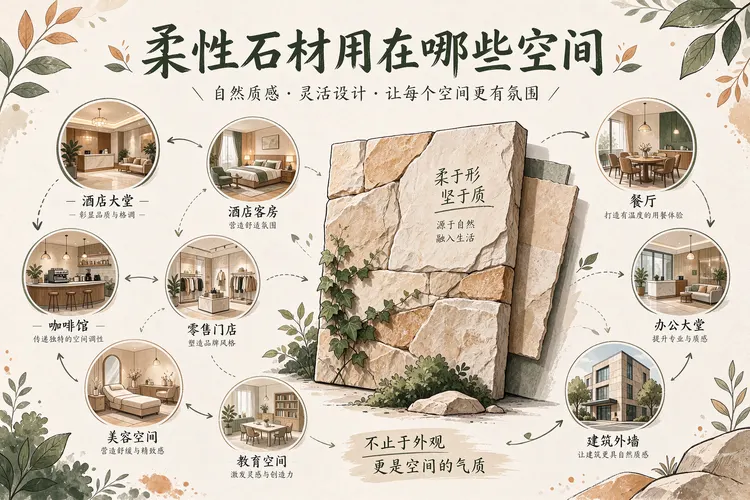
1. First, judge three things
- Location: walls are acceptable, floors are not. Stair treads, floors, and areas subject to long-term water immersion are all exclusions.
- Environment: Indoor, semi-outdoor (entrance canopy and covered walkway), outdoor. Semi-outdoor follows the outdoor system.
- Foot traffic and impact: Luggage passages, cart corners, and children's activity areas need corner guards or thicker specifications.
These three things must be decided at the scheme stage; if they are changed after the construction team enters the site, the cost will double.
II. Hotel: four areas, four sets of logic
Hotels are the most typical battlefield for flexible stone, but requirements differ completely by location.
- Lobby: From a distance, layering matters most—wall scales are large and light sources complex. Vein stone, printed travertine, and 3D relief textures can all hold the space. See the plan at Hotel solutions.
- Guest rooms: Large area, regular floor height, predominantly flat surfaces—solid-color travertine and flat panels are the most stable choice; the key is same-batch supply and color difference control. Reference About 1080㎡ Yunyan Sixteen Travertine guest room in a Hangzhou hotel.
- Corridor: Dense foot traffic and many luggage carts; it must be thin, have few joints and be scrub-resistant. Add corner guards at corners subject to frequent impact.
- Facade and entrance: Build it as an exterior system: weather-resistant adhesive + waterproof edge sealing + drip edge.
The core of a hotel project is not which panel to choose, but whether "the four sets of logic can avoid conflicting with each other in the same building."
Lobby: three judgments of distant-view layering
- Distance judgment: Standing at the entrance looking at the wall, what is seen from five meters away is volume and color, and texture is visible only within one meter. Lobby walls must first satisfy the five-meter view, then the close-up details.
- Light source assessment: lobbies commonly use spotlight wall washing, and strong light amplifies the shadow relief of the texture. When selecting, view samples under a light source of the same color temperature, not fluorescent lamps.
- Scale judgment: The proportion between the texture unit and the wall scale must be right. Small textures on a large wall look fragmented, while coarse textures on a small wall look restless.
Guest rooms: color difference management is more important than color selection
Guest rooms are numerous and have long continuous wall surfaces, making them the space most likely to expose color differences. Three lessons:
- Guest rooms on the same floor and facing the same direction should use the same batch;
- If guest rooms and corridors are the same color, they must be from the same batch; otherwise a discontinuity will be visible at the junction;
- Keep a certain proportion of repair spare panels based on the number of rooms, so that later panel replacement does not create a "patchwork" look.
3. Dining and coffee: steam, oil fumes, foot traffic
- Dining room: Steam and oil fumes determine material boundaries. Walls in heavy-oil-fume Chinese restaurant kitchens need easy-scrub and oil-resistant treatment; flexible stone is more suitable for dining areas and facades, not for areas directly exposed to long-term oil contamination.
- Café: The storefront is semi-outdoor and must be done according to weather resistance; interior walls can take a warm route, and rough rammed earth, fabric-texture stone, and charred wood are all suitable. See the plan Coffee space, subdivided parts include Coffee wall surface, Bar counter area, Storefront.
- Commonalities: Dining spaces are renovated frequently and need "partial panel replacement" maintenance capability; in this respect, flexible stone is stronger than ceramic tile and paint.
Three pitfalls in dining
- Applying kitchen practices to the dining area: The back kitchen must be oil-resistant and easy to wash down, while the dining area needs atmosphere. Mixing the two standards results in spending money without achieving atmosphere.
- Facade done according to interior methods: The storefront is semi-outdoor and subject to both sunlight and rain, so a weather-resistant system must be used.
- Ignoring the deposition of cooking fumes on wall surfaces: On facades near the stove, any finish will collect grease. The design should make this section "easy to wipe" rather than "good-looking".
IV. Retail stores: backgrounds should recede, merchandise should be bright
- Main principle: Retail walls are the background and must not compete with the merchandise. Restrained textures such as solid-color travertine, fine rammed earth, and flat travertine are more suitable.
- Chain stores: Standardized replication is the core requirement, requiring long-term supply of the same style and same batch, and individual stores are small with short construction windows—the fast-installation advantage of flexible stone is most obvious here.
- Display window and display area: Three-dimensional texture can be used locally as a visual anchor, but the area must be controlled.
Plan entry see Commercial space and Fashion retail.
Division of labor between standard stores and flagship stores
- Standard store: The goal is replication efficiency. Lock in one series, one thickness, and one color code, unify across nationwide stores, and consolidate supply batches as much as possible.
- Flagship store: The goal is a memorable focal point. Special textures or irregular shapes are allowed on feature walls, but the area must be controlled and the closing details must be precise.
- Issues common to both: Store renovations are mostly carried out at night and during closure windows, and construction speed is the first constraint. Flexible stone involves no wet work and uses dry adhesive, which fits this window well.
V. Office and meeting: restraint first
- Lobby: For a corporate image surface, fine rammed earth, cement cast board and flat travertine are safe choices.
- Meetings and open office: Low reflection and low interference are required, avoiding strong textures that cause visual fatigue.
- Old building renovation: Office renovations often cannot stop business; flexible stone involves no wet work and produces little waste, causing little disruption to the site.
VI. Beauty and beauty industry: look at materials under light
- The key variable is lighting: Beauty spaces have warmer color temperatures and high illuminance; cloth texture and fine rammed earth show their best layering under warm light.
- Tactile priority: Walls close to customers need to consider feel and cleaning; use coarse textures with caution.
- Plan see Beauty space.
7. Education: environmental protection and safety are hard thresholds
- Environmental protection statement: Formaldehyde E1 grade (≤0.124mg/m³), radioactivity Class A, VOC reports available on request; indoor air quality refers to GB 50325-2020.
- Safety: Round the corners and edges, and add corner guards in areas with frequent impact.
- Durable: Wipeable and partially replaceable—these are real needs for schools and training spaces. See the solution in Educational spaces.
Acceptance milestones for educational projects
Acceptance inspection for educational projects is more detailed than for ordinary commercial projects, usually focusing on three areas:
- Documentation first: The three types of reports—formaldehyde, radioactivity, and combustion performance—must all be submitted before entering the site; if any one is missing, work stops.
- Mockup confirmation: The school, designer and supervisor jointly confirm the sample section, including color number and joint width.
- Finished product protection: School projects are often built during holidays, and protection and cleaning must be completed before the semester starts to avoid cross-contamination.
VIII. Leisure and entertainment: texture can be unleashed
- Allow for stronger expression: Water ripple, 3D stone, and nebula stone are pluses in entertainment spaces.
- Note cleaning: The deeper the relief, the more dust accumulates; a cleaning plan is needed.
- Plan see Leisure and entertainment.
IX. Building exterior walls and renovation: the system determines success
- Exterior wall: Weather-resistant adhesive + waterproof edge trim + drip detail + qualified substrate moisture content—if any one of these four is missing, it will show up in the first winter-summer cycle.
- Old renovation: Saves demolition, debris removal, and leveling, but hollow substrate areas must be treated first; for the assessment method see Can flexible stone be directly applied to old tile walls?.
- Residential facade: The advantages of being light, thin and bendable are obvious in exterior facade renovation. See the solution Residential facade.
Cases for reference About 760㎡ slate exterior wall eaves in Xi'an homestay and Menghai Resort, approximately 2100㎡ coarse rammed earth curved exterior wall.
The four types of stress on exterior walls
- Path of rainwater: Water does not enter from the front; it enters from the top edge and gaps, then travels down along the back of the panel. Therefore, the top edge must be sealed, and the bottom edge must have a drip edge.
- Freeze-thaw: In northern projects, dozens of cycles occur in one winter, and the interface between the adhesive layer and the substrate undergoes repeated volume changes. This is the most fundamental difference between weather-resistant adhesive and indoor adhesive.
- UV and thermal aging: The surface temperature of sun-exposed surfaces is far higher than air temperature, subjecting both the adhesive layer and the panel to stress. Dark colors absorb more heat, which must be considered in selection.
- Salt spray: The main stress for coastal projects; salt crystallization will accelerate interface failure and must be reflected in the supporting solution.
The four types of stress will not appear at the same time, but they will stack up in the same project. To judge whether an outdoor solution is sufficient, see whether it responds to these four types specifically.
X. Scene-to-Series Comparison
Looking up the series by scenario is the fastest selection path:
- Hotel lobby → linear stone, printed travertine, 3D textured surfaces
- Hotel guest rooms and corridors → solid-color travertine, flat board, wood grain board
- Food and beverage → coarse rammed earth, charred wood, fabric-texture stone
- Coffee → coarse rammed earth, fabric-textured stone; storefront uses weather-resistant finish
- Retail → solid colors, fine rammed earth, flat travertine
- Office → fine rammed earth, cement cast panels
- Beauty industry → fabric texture, fine rammed earth
- Education → solid colors, flat panels, fine rammed earth (environmental protection first)
- Entertainment → water ripple, nebula stone, 3D three-dimensional stone
- Exterior wall → slate, rough-faced granite, rammed earth exterior wall
For the complete series list, see Complete list of soft stone product models; for scene combinations see Solutions.
XI. Common Questions
Q1: Can it be used for residential home decoration? Technically possible, but IGOODS is positioned for commercial spaces and engineered walls, with service and supply systems built around B2B design. For scattered home renovation needs, we recommend going through local dealers.
Q2: Can the kitchen wall of the restaurant be used? Not recommended. The back kitchen is a long-term grease and high-temperature steam environment and requires specially easy-to-clean materials. Flexible stone is suitable for dining areas and exterior facades.
Q3: Can the underground parking garage wall be used? Yes, but pay attention to moisture and vehicle collisions. Substrate moisture-proofing must be done first, and corner guards should be added at corners.
Q4: Can multiple series be mixed in the same project? Yes, use a stable series for the main wall and another for the focal wall. Note that the differences in thickness and gloss should not be too large, and the material transition positions and finishing methods should be marked on the node drawings in advance.
Q5: How can consistency be ensured when a chain brand replicates across cities? Three things: lock the series and color code, lock the thickness and sheet size, and agree on supply from the same batch. Cross-city color difference disputes almost all arise because these three things were not done.
Who should do the exterior wall project? It is advisable for the factory to provide a system solution (panel + adhesive + edge finishing method), for the construction party to execute according to the solution, and for design and supervision to accept according to the same set of standards. Only when all three parties align on the basis will outdoor projects be stable.
Can the hotel renovation project be constructed without interruption? It can be done in layers, zones and sections. Flexible stone involves no wet work and no cutting dust, so interference with operating areas is small; however, adhesive odor and construction time still need to be controlled, usually scheduled during off-peak periods.
Q8: Is it worth using it for a small project area? The value of small-area projects often lies not in material cost but in effect and schedule. For "small but critical areas" such as focal walls, storefronts, and irregular parts, using it is more cost-effective than using ceramic tiles.
Q9: What should be paid attention to in the humid southern regions? Substrate moisture content comes first, followed by ventilation and dehumidification. In damp environments, the adhesive cures more slowly, so judgments of open time and curing time should be relaxed accordingly.
Q10: Can it be used on arched walls and cylinders? Yes, this is its most irreplaceable scenario compared with other wall materials. For arc-length cutting and trial bending methods, see How to construct a curved wall.
Q11: Can the indoor and outdoor panels be used interchangeably in the same project? Panels can be the same, but adhesives and edge trims cannot be the same. Outdoors, a weather-resistant system must be used; indoors, a standard system is sufficient. This is the dividing line between success and failure for outdoor projects; do not use one system for everything just to save effort.
How can you quickly determine which texture to use for a space? Look at three things: who is the protagonist of this space (merchandise, customers, or atmosphere), what the light direction is, and how long people stay. If the protagonist is merchandise, use restrained textures; if atmosphere is desired, use textured surfaces with undulation; if people stay for a long time, consider touch and cleaning.
XII. Further Reading
- What is IGOODS Flexible Stone? Full explanation of parameters and selection
- IGOODS Flexible Stone pros and cons: five advantages and four boundaries
- IGOODS Flexible Stone: how is it installed? Six steps for substrate, adhesive application and finishing
- IGOODS Flexible Stone dedicated adhesive: indoor version and outdoor weather-resistant version
- Analysis of the wall surfaces of about 1080㎡ Yunyan Sixteen Travertine guest room in a Hangzhou hotel
- Chengdu wellness club approximately 1450㎡ travertine wall
- Engineering case overview
Related articles
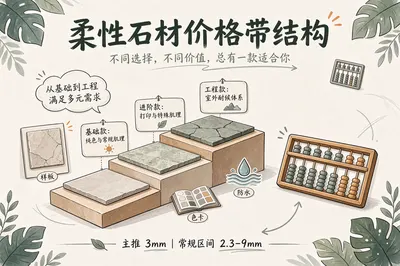
IGOODS Flexible Stone prices: how the three price bands are divided and where the price difference goes (2026)
The price of IGOODS Flexible Stone is not a single line but three bands: basi...

IGOODS Flexible Stone dedicated adhesive: how to choose between indoor version and outdoor weather-resistant version (2026)
The adhesives for IGOODS Flexible Stone are divided into two sets: indoor ver...

IGOODS Flexible Stone service life: four variables and timeline checkpoints (2026)
The service life of IGOODS Flexible Stone depends on four variables: whether ...

Ceramic, flexible stone, flexible artificial stone cladding materials: Behind the three names are two sets of standards
The same product is called "Building Flexible Artificial Stone Cladding Mater...