
Table of contents of this articleBrowse by text
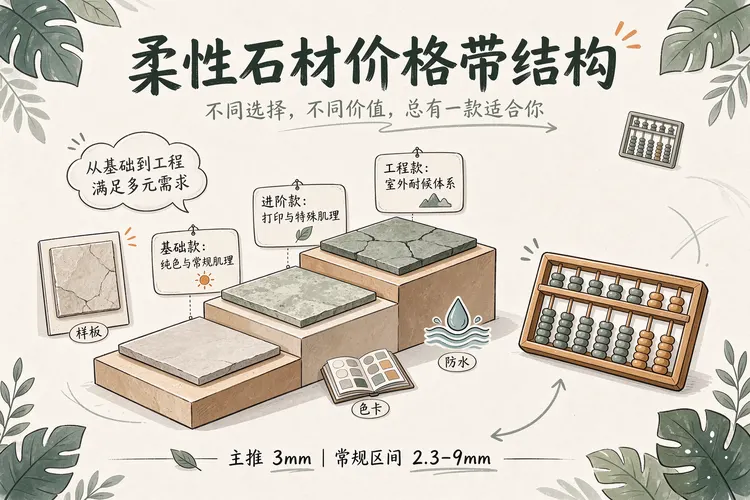
The price of IGOODS Flexible Stone is not a single line but three bands: basic range (solid colors and conventional textures), advanced range (printing and special textures), and engineering range (outdoor weather-resistant system plus supporting auxiliary materials). Within the same band, the price difference is mainly determined by four variables: thickness, format and layout waste, number of process passes, and whether the supporting system is complete. Asking "how much per square meter" apart from these four variables will inevitably yield quotations that are not comparable.
1. Why "how much per square meter" cannot get you the real price
This problem itself has three defects:
- No specifications: 3mm and 9mm are two different cost structures; asking about them together will only get you a vague range.
- No series: There are several process steps between solid color and printing, and the quoted price can differ by a whole tier.
- No matching accessories: The panel price and the complete set price of "panel + adhesive + trim pieces" are two different numbers.
A more professional way to ask is:Which series, which thickness, how many square meters, indoor or outdoor, whether matching accessories are needed, and when the goods are required. Only when all six conditions are fully specified does a quotation become meaningful.
II. What the three price bands are
- standard model: Solid-color travertine, flat panels and standard wood grain involve fewer process steps, have stable batches and ample stock; this is the highest-volume price band and is suitable for large continuous wall surfaces.
- Advanced model: Printed travertine, special textures, deep-relief three-dimensional types involve more color-matching and forming processes and higher waste; unit price is higher, suitable for focal walls and projects requiring a "specific quarry feel."
- Engineering payment: Outdoor projects require weather-resistant adhesive, waterproof edge trim, and drip details; material unit price is only part of it—the complete system is the main cost.
The division into three bands is not for selling goods by tier, but to make the quotation explainable. Only when you can understand "where the extra cost comes from in a given process" can the discussion continue.
3. Four sources of price difference within the same band
- thickness: 3mm and thicker specifications differ in raw materials and pressing time. As thickness increases, weight, transportation, and installation difficulty rise together.
- format size and waste: 1200×2400 full panels are priced by area, but layout utilization determines the actual cost. For projects with many openings and fragmented elevations, waste can consume more than 10%.
- Number of process steps: Solid color is one pass, printing requires color registration, and three-dimensional textures require forming. Each additional step increases the defect rate and labor hours.
- Supporting system: Purchasing panels, adhesive and trim pieces separately may seem cheaper, but the communication and rework costs when problems arise are often higher.
Among these four, the first two are "visible differences," and the last two are "invisible differences." Most low-price disputes arise from the last two.
A concrete example: for the same 3mm solid-color travertine, A quotes XX and B quotes XX, 10% lower. Broken down, B's lower price comes from two things—no adhesive and no material preparation. Add the adhesive and material preparation back, and B's price is actually higher. In this kind of "looks cheap" quote, the cost has simply been moved to other line items.
IV. How batch size and lead time affect price
- Batch: Large orders in the same batch spread the setup and color-matching costs, so the unit price is naturally lower; scattered small orders must be inserted into the production schedule, so a higher unit price is normal.
- Delivery time: Regular lead times follow normal production scheduling; rush orders must take production line capacity from other orders, and expediting costs genuinely exist.
- Material preparation ratio: Construction practice includes reserved spare material; who bears the spare material and how leftover material is handled directly affects the final settlement amount.
- Delivery in batches: Batching means production in multiple batches; both color-difference risk and logistics costs rise, and this item must be clearly stated in the contract.
- Payment method: The prepayment ratio and payment terms determine the supplier's capital cost; quotes with longer payment terms usually have higher unit prices. This is normal business logic, not "arbitrary price gouging."
- Packaging and unloading: Pallets, corner protectors, and whether hoisting coordination is needed are all real costs. For high-rise projects without elevators, unloading fees are often overlooked.
So "cheaper in bulk" is only half true—the premise of cheaper in bulk is same batch, same series, same specification.
V. Where does the difference between foreign trade prices and domestic prices lie
A foreign trade quotation is not simply adding freight to the domestic price; it has four independent cost items:
- Packaging: Exports require pallets, corner protectors, and moisture-barrier film; packaging costs are usually higher than domestic bulk packing.
- Certifications and documents: Preparing and maintaining compliance documentation such as RoHS and REACH is a long-term cost. See the document list in Qualifications and test reports.
- Trade terms: FOB, CIF and DDP have different boundaries of responsibility and completely different quotation bases; align on the terms before negotiating price.
- Exchange rates and payment terms: The longer the payment term, the higher the capital cost; this is usually reflected in the unit price rather than listed separately.
For the complete cost structure of foreign trade projects, there is already an article on this site, What determines the price, with a dedicated explanation, for cross-reference.
How to read the three tiers of trade terms
- EXW (Factory Delivery): Minimum base price; the buyer bears all inland transport and export formalities. It looks cheapest, but the actual total cost depends on the buyer's own capabilities.
- FOB (Free on Board at the port of shipment): Includes inland transport and customs clearance; ocean freight is borne by the buyer. This is the most commonly used price comparison benchmark.
- CIF / DDP: Includes freight or includes duties and last-mile delivery; the figure is the highest, but the responsibility is the most complete.
When three suppliers quote prices under different terms, directly comparing the numbers is meaningless. First unify the terms to FOB, then discuss the price difference. This is a basic skill of foreign trade procurement.
The four sections a quotation should have
- Product block: Series, thickness, format, color code, and quantity.
- Supporting block: Adhesive, trim pieces, and material allowance ratio.
- Handover block: Delivery time, packaging, trade terms, unloading responsibility.
- Clause block: Payment method, warranty scope, list of test data.
Whichever block is missing indicates that this cost has not yet been fully accounted for. In negotiations, prioritize filling in the blocks rather than cutting the numbers first—once the blocks are complete, you can often see for yourself where cuts should be made.
VI. Three-step method for price verification
When you get two quotations to compare, follow these three steps to compare accurately:
- Align specifications first: The four items—series, thickness, format, and color code—must be consistent; otherwise it is not the same product.
- Then align the supporting details: Whether adhesive, trim pieces, and spare material are included—mark "included/not included" item by item.
- Finally align the conditions: Delivery time, payment method, freight responsibility, warranty scope.
Only after the three steps are aligned does the price difference become meaningful. This method also applies when a decoration company quotes to the client; see How do renovation companies quote for flexible stone projects?.
The ten items that should be clearly stated in an inquiry sheet
A quotation request that can be used directly for price comparison should contain at least these ten items:
- Series and sub-series names (do not just write "travertine")
- Thickness and panel size
- Color code or color family direction
- Area and layout drawing (waste can only be calculated with a drawing)
- Indoor, semi-outdoor, or outdoor
- Whether adhesive and edge finishing pieces are included
- Whether spare material is included, and in what proportion
- Delivery location and unloading conditions
- Delivery time and batch plan
- List of required testing documents
Only when all ten items are fully written can suppliers' quotations possibly use "the same ruler." If only area and series are written, the quotations received will inevitably be a patchwork, and in the end it will still have to be redone.
Three common price-comparison scenarios
- A is 8% cheaper, but does not include glue: Adding adhesive into A's quote usually means it is no longer cheap. Judge by the "whole-system price," not the "panel price."
- A is 12% cheaper, but the delivery is delayed by two weeks: If the project closes for renovation, the revenue loss from a two-week delay far exceeds the 12% material price difference. In this case, cheap is negative value.
- A is 5% cheaper, but requires 30% advance payment: Capital cost must be factored in, especially for large orders.
The purpose of price comparison is not to find the lowest price, but to find the one with "the lowest total cost and controllable risk."
Seven, low prices usually come from four places
When encountering a quote significantly lower than peers, check these four items first:
- Reduce thickness: From 3mm down to thinner, both weight and impact resistance decrease, but this cannot be seen in appearance photos.
- Switch series: Treating prints as solid colors and special textures as regular textures—the difference shows in the close-up layering.
- Purchased auxiliary materials: Using general-purpose adhesive instead of the matching adhesive may hold short-term, but outdoors it will be exposed after one or two winters and summers.
- Mixed batch supply: Mixing different batches in one order—color differences cannot be hidden on large wall surfaces.
- Omitting test documentation: Charging for reports and certifications as "extra services" or not providing them saves money in the short term but causes problems at acceptance.
- Reduce packaging and handling: The edge and corner damage rate of panels is high, and the loss is ultimately borne by the project.
These six items are not as simple as "cutting corners"; each corresponds to a later risk point. To judge whether a supplier is reliable, see whether it can explain clearly why it is cheap.
VIII. The five items most easily missed in a budget table
When budgeting a project, material costs are often calculated in detail, but these five items are often missed:
- Substrate treatment cost: For renovation projects, repair and leveling can be more unpredictable than material costs.
- Auxiliary materials cost: Adhesive, trim pieces, and sealant should be estimated by square measure, not guessed by the bucket.
- Wastage and spare materials: Calculate according to the layout drawing, not by rule-of-thumb 5%.
- Finished product protection and cleaning: Commercial projects involve much cross-construction, and protection costs are real.
- After-sales and spare panels: Keep a set of backup panels from the same batch, so individual panels can be replaced later.
- Re-inspection and protection period: The first post-winter-summer re-inspection of outdoor projects, and cross-construction damage during the finished-product protection period.
List these six items in the budget table, and the completeness of the quotation rises a level. In many projects, settlement overruns are not because the unit price was negotiated too high, but because these six items were not counted from the start.
IX. Frequently Asked Questions
Q1: Why not directly give a price range? Because once a range is detached from specifications, it will be misused. Also called "flexible stone," 3mm solid color and a complete outdoor weather-resistant system are not on the same level. Rather than giving a range, give a pricing method.
Q2: Why do two companies quote a 20% difference for the same series? Most likely in accessories and delivery time. First confirm whether adhesive is included, whether spare materials are included, and how much the delivery time differs, then look at the unit price itself.
Q3: Will small quantities be more expensive? Yes. Small orders have to be squeezed into the production schedule, and the waste ratio is higher. The way to reduce small-order costs is to choose standard series and standard thicknesses and avoid custom colors.
Why is the outdoor project so expensive? The value is in the system: weather-resistant adhesive, waterproof edge trims, drip-edge detailing, stricter substrate requirements. Comparing panel prices alone misses the most valuable part.
Q5: Can you give a total price first and then discuss in detail? A rough estimate can be given, but assumptions must be marked (series, thickness, area, indoor/outdoor). If a rough estimate does not state conditions, there will definitely be disputes later.
Q6: Does the price include inspection materials? Providing conventional testing documents is a standard service and is not charged extra. Certification for special destination countries requires separate confirmation of lead time and cost.
Q7: Is there a charge for the samples? Conventional sample mailing is free, and actual photos of the series can be provided at the same time. Samples are the lowest-cost step in the selection stage. Use samples to narrow the series down to two or three, then discuss pricing; this is the most efficient.
Negotiation of total price or unit price? It is advisable to discuss the unit price basis first, then the total price. Discussing the total price without a clear unit price basis is equivalent to turning a scope issue into a price issue, and later it will certainly return to the scope for renegotiation. First align the basis using specifications, accessories, and delivery time, and the total price will naturally become clear.
Can old customers get a lower price? Usually yes, but the reason for a price reduction should be efficiency, not favors. Long-term cooperation reduces communication and production scheduling costs; this kind of price reduction is reasonable and sustainable. A low price obtained by one-time price pressure is often recouped in the next batch.
Q10: How long is the validity period of the quotation usually? Both raw materials and exchange rates fluctuate, so the validity period is usually given on a monthly basis. Quotations beyond the validity period cannot be used directly and need to be reconfirmed, especially for foreign trade orders.
X. Further Reading
- IGOODS Flexible Stone: how much per square meter? Price composition and pricing basis
- What is IGOODS Flexible Stone? Full explanation of parameters and selection
- Complete list of IGOODS soft stone product models: seven major series and selection path
- IGOODS Flexible Stone dedicated adhesive: indoor version and outdoor weather-resistant version
- What determines the price of flexible stone? Complete cost analysis for trading companies
- How do renovation companies quote for flexible stone projects?
Next:IGOODS Flexible Stone application scenarios: selection key points for nine types of spaces (2026)
Related articles

IGOODS Flexible Stone dedicated adhesive: how to choose between indoor version and outdoor weather-resistant version (2026)
The adhesives for IGOODS Flexible Stone are divided into two sets: indoor ver...

Complete list of IGOODS soft stone product models: seven major series, 35 sub-series and selection path (2026)
IGOODS Flexible Stone is currently organized on the official website product ...

IGOODS Flexible Stone application scenarios: selection key points for nine types of spaces (2026)
IGOODS Flexible Stone is suitable for nine types of spaces: hotels (lobbies, ...
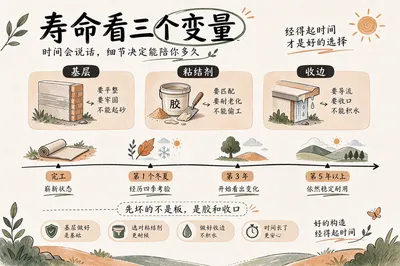
IGOODS Flexible Stone service life: four variables and timeline checkpoints (2026)
The service life of IGOODS Flexible Stone depends on four variables: whether ...