
Table of contents of this articleBrowse by text
The service life of IGOODS Flexible Stone depends on four variables: whether the substrate meets standards, whether the adhesive matches, whether the finishing is waterproof, and whether the use environment is harsh. Conventional indoor commercial walls can be assessed at 10 years or more, while outdoor applications are assessed according to the weather-resistant system approach and local climate. There is a counterintuitive fact: what fails first is not the panel but the adhesive and finishing—most projects that "develop problems in three years" have issues in these two places.
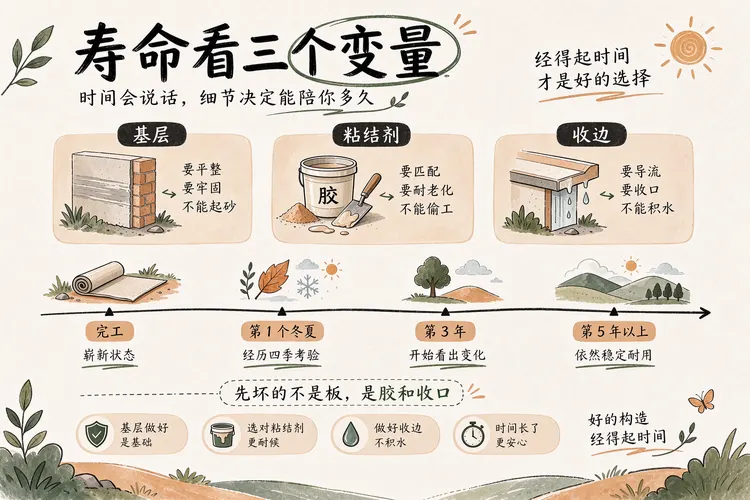
1. The four variables of lifespan
- Substrate: Flatness (gap under a 2m straightedge ≤3mm), no hollowing, no dusting, and moisture content up to standard. If the substrate is not up to standard, its service life starts being compromised from day one.
- Adhesive: Indoor grade and outdoor weather-resistant grade cannot be mixed. With the wrong adhesive, differences become apparent after two or three winter-summer cycles.
- Close up: Top edge sealed, bottom edge with drip edge, and corner guards at internal and external corners. Water enters from the edges, and damage starts at the edges.
- Environment: UV intensity, temperature difference range, salt spray, steam, and oil contamination—these four types of stress determine the aging rate.
These four form a chain, and the weakest link in the chain determines the overall service life. Therefore, when discussing service life, you cannot say "this panel can be used for ten years"; you can only say "this system can last ten years under what working conditions."
IV. How each of the four variables fails
- Substrate: Sanding and hollowing leave the adhesive with nothing to grip, manifesting as large-area hollowing, usually within the first year.
- Adhesive: The failure mode of using the wrong model is "starting from the edge," because the edge rusts first—both water and stress enter there.
- Close up: Failure due to improper closing is "water entering at the top edge and dampness returning at the bottom edge," manifesting as whitening at board joints.
- Environment: The environment does not cause failure on its own; it only amplifies the weak points of the first three items. In other words, the harsher the environment, the more the first three items must be done properly.
II. How long can interior applications last?
The indoor environment is relatively mild; the main stresses are impact, cleaning, and localized dampness:
- Conventional commercial wall (hotel guest rooms, offices, retail): where the substrate and construction are in place, assessing 10+ years is a reasonable basis.
- Damp areas (outer side of restroom, walls near water sources): service life depends on moisture-proof treatment and cannot be lumped together with dry areas.
- High-impact areas (luggage passage, cart corners): the panel itself will not break, but the edges and corners will chip; service life is determined by corner guards and maintenance.
- Heavy-oil-stain areas (restaurant back kitchen): not a suitable scenario for flexible stone; discussing service life is meaningless.
The key indoors is not weather resistance but "maintainability." A single damaged panel can be replaced individually, and this characteristic makes the actual service life of indoor walls far longer than the life of the material itself.
3. How long it lasts outdoors
Outdoor is the main battleground for service life, and also where a supplier's professionalism is judged:
- Weather resistance data must match the climate: The main stress along the coast is salt spray, on the plateau it is strong UV and large temperature differences, in the north it is freeze-thaw cycles, and in the rainy south it is long-term humidity. Four stresses, four sets of methods. See the weather resistance report Weather resistance commissioned test report.
- System completeness determines service life: Panel + weather-resistant sealant + waterproof edge trim + drip edge: if any one of the four is missing, the service life is determined by the weakest link.
- Construction window period: Rushing work at low temperatures, installing on sun-exposed surfaces, and applying panels beyond the open time — these three things will directly cut service life by a significant margin.
- Maintenance: Inspect exterior walls once a year (focusing on edges and joints) to catch small problems early.
So the correct statement for outdoor projects is: Under the premise of a complete weather-resistant system, compliant construction, and annual inspection, evaluate as 5–10 years or more. A promise that only says "ten years" without stating conditions is not credible.
What to watch for in each of the four climates
- High salt fog along the coast: Watch the joints and edges; salt crystallization will accumulate at the joint openings first.
- Northern freeze-thaw zone: Watch the adhesive layer and substrate interface; tapping inspection after winter is the most effective.
- High-altitude strong UV: Watch the color and surface powdering; ultraviolet light is the main enemy of surface protection.
- The South is rainy and humid: Watch the back and panel joints; moisture is the main actor here.
The same product has different service lives in these four types of regions, which is also why "it has been used in a certain place for ten years without problems" cannot be directly applied to another place.
IV. Timeline: what to check at each stage
- At completion: Check appearance, flatness, and joint lines. Everything being normal at this time does not mean there is no problem; it only means the problem has not yet appeared.
- After the first winter and summer: This is the most critical inspection point. Most outdoor project edge curling, hollowing, and whitening first appear at this node.
- Year 3: Check color change and adhesive layer condition. Slight color difference is normal; obvious whitening or edge warping indicates a weakness in the system.
- More than 5 years: Check whether local panel replacement is needed. Needing replacement is not a failure but normal maintenance.
Writing "re-inspection after the first summer-winter cycle" into the contract is the most cost-effective clause for outdoor projects.
V. Five actions that accelerate aging
- Installing before the substrate is dry: Moisture trapped behind the panel migrates toward the joints, manifesting as whitening and efflorescence.
- Using indoor-grade adhesive outdoors: The most common mistake and the main cause of edge lifting.
- Spot application or four-corner application: A cavity forms in the middle; it sounds hollow when tapped, and is more prone to bulging after heating and cooling.
- Edge not sealed, lower edge without drip: Rainwater runs along the back of the panel and comes back up from the bottom.
- Long-term strong solvent cleaning: Destroys the surface protective layer, accelerating powdering and loss of gloss.
These five actions share one thing in common: none of them are material problems; they are all workmanship problems. And because of that, they can be completely avoided during the construction stage.
Why is spot application the most fatal?
Flexible stone is a thin panel, and once adhered to a wall, it has no self-weight to help press it down. Dot application means there are large cavities between the panel and the wall; the air in the cavities expands when heated and contracts when cooled, and after several cycles it will push the panel up. The "hollow" sound when tapped is the echo of the cavities.
The correct method is to apply adhesive fully with a notched trowel, scraping the adhesive into continuous ridges, and after pressing and attaching, use roller pressing to flatten and spread the ridges. In this way, the adhesive layer is continuous and air is expelled, which is the foundation for long service life.
The three things construction units most easily overlook
- Mixing of adhesive: Uneven mixing causes strength differences on the same wall, and this type of hollowing is the hardest to troubleshoot.
- Finished product protection: Being stepped on, knocked, or contaminated with dust during the curing period is an "innocent hollowing".
- Record: Which batch of panels and which batch of adhesive were used on which facade, and when construction took place; without records, problems cannot be traced.
The third matter is the least valued, but it determines the efficiency of later maintenance. A simple construction record sheet can save a lot of time spent on disputes.
VI. Six ways to extend service life
- Base-layer acceptance must pass first, then make a mock-up section; after the mock-up section is confirmed, carry out large-area construction.
- Use the adhesive corresponding to the model for indoor or outdoor use, and ensure the panel and adhesive are matched from the same factory.
- The area of adhesive applied at one time shall not exceed the amount that can be installed within the open time.
- After application, rolling is mandatory to even out the adhesive layer and drive out air.
- For outdoor edge sealing, apply waterproofing and drip edges, and add corner guards at internal and external corners.
- Inspect edges and joints once a year, and replace individual pieces if problems are found.
None of these six items requires extra spending; all are matters of process discipline.
An executable self-check list
- Base layer: 2 m straightedge gap ≤3 mm, no hollowing, no sanding, moisture content up to standard.
- Adhesive: model and location matching (indoor/outdoor), supplied as a set by the same factory as the panel.
- Adhesive application: full trowel with notched trowel, with the area not exceeding what can be completed within the open time.
- Press-fit: roll into place, compact the edges and corners.
- Closings: seal the top edge, drip edge at the bottom, corner guards at internal and external corners.
- Record: batch, construction time, and construction crew kept on file.
- Re-inspection: after the first winter-summer cycle, and once every year thereafter.
Follow these seven and service life has a basis; if any one is missing, put that one on the risk list.
There is also an easily forgotten step: handover. At project delivery, hand over the system details, batch records and spare panel locations to the property management or operations team, so there is a basis for later maintenance. Many cases of "three years later nobody knows how it was originally done" are caused by missing handover.
7. How to tell that aging has already begun
Five signals, in order of appearance:
- Slight lifting at the edges: Appears earliest; looseness can be felt when pressing by hand.
- The tapping sound becomes hollow: Hollowing spreads from the center or edges.
- Whitening at joints: A typical manifestation of moisture migration.
- Uneven color: The difference between the sunlit side and the shaded side becomes larger, or banding appears.
- Surface powdering: If powder comes off when wiped by hand, the surface protective treatment has been damaged.
The first two signals should be addressed as soon as they appear; by the time the fifth signal appears, a full-surface assessment is usually required.
VIII. Recommendations for replacement and repair
- Reserve spare panels: At project completion, keep a set of same-batch spare panels; this is the prerequisite for later single-panel replacement.
- Single-panel replacement: Local damage can be replaced panel by panel—this is the maintenance advantage of flexible stone over ceramic tile and coatings.
- Full-face redo: When the debonded area exceeds a certain ratio (usually judged according to project acceptance standards), redoing the entire surface is more economical than patching piece by piece.
- Color difference from repair: There will inevitably be slight color differences between batches. Use reserved boards for repairs, not new batches.
IX. Frequently Asked Questions
Q1: How many years of warranty is generally given? By project type: the warranty scope differs between conventional indoor walls and outdoor weather-resistant systems, and the warranty should cover the responsibility boundaries of materials, auxiliary materials and installation. When discussing warranties, clarifying the boundaries first is more meaningful than arguing over the number of years.
Q2: Can a commitment be made that outdoor will not fall? Cannot promise "never falls off." What can be promised is: construction according to the weather-resistant system, provision of corresponding test documentation, and agreement on re-inspection milestones. Any absolute promise is unprofessional.
Q3: Will the lifespan of old renovation projects be shorter than new construction? Depends on the old substrate. If the substrate is firm and properly treated, the service life is close to that of new construction; if the substrate itself is already deteriorating, no finish will last long.
Q4: Will the color change? It will change slightly; this is common to all finish materials. Outdoor projects change faster than indoor ones, and dark colors are usually more durable-looking than light colors.
Q5: How can you judge if the supplier's said lifespan is reliable? Look at three things: whether there is a weather resistance test report, whether there are actual cases of outdoor projects, and whether there is a written system method. Only when all three are present is it worth listening; if there is only the phrase "can last ten years," treat it as unheard.
Q6: Are flexible stones from ten years ago the same as now? Formulations and processes are both iterating. Failures in some early projects came more from construction habits at the time (spot application, no edge finishing) rather than the product itself. Evaluation of new projects should be based on current system practices; it is not appropriate to directly infer from old projects.
How long does it take to repair once? Single-panel replacement is usually counted by the hour, but the premise is that there are spare panels from the same batch and the substrate has not been damaged. If the entire surface is redone, it follows normal procedures, and the schedule is close to new construction.
Is the lifespan related to thickness? There is a certain relationship. Thicker panels offer better impact resistance and greater hiding power, but thickness is not the decisive factor for service life. At the same thickness, differences in substrate and adhesive have a far greater impact on service life than thickness itself.
Q9: Should the weather resistance standard also be followed for indoor projects? Not required, but it must be done to indoor standards: flat substrate, correct adhesive type, full application of adhesive, and proper roller pressing. The weak point of indoor projects is usually not weather resistance, but rough construction.
Q10: Is there a way to make the lifespan verifiable? Yes. Write "re-inspection after the first winter and summer" and "annual inspection" into the contract to create verifiable time milestones. Once service life is turned from a promise into a process, it no longer relies on verbal assurances.
X. Further Reading
- How is the quality of IGOODS Flexible Stone? Breakdown of five reports and seven types of complaints
- IGOODS Flexible Stone dedicated adhesive: indoor version and outdoor weather-resistant version
- IGOODS Flexible Stone: how is it installed? Six steps for substrate, adhesive application and finishing
- IGOODS Flexible Stone pros and cons: five advantages and four boundaries
- How to inspect and accept flexible stone walls? Checklist for hollowing, joints, and color differences
- Menghai Resort, approximately 2100㎡ coarse rammed earth curved exterior wall
Previous:IGOODS Flexible Stone application scenarios: selection key points for nine types of spaces (2026)
Related articles
IGOODS Flexible Stone application scenarios: selection key points for nine types of spaces (2026)
IGOODS Flexible Stone is suitable for nine types of spaces: hotels (lobbies, ...
IGOODS Flexible Stone prices: how the three price bands are divided and where the price difference goes (2026)
The price of IGOODS Flexible Stone is not a single line but three bands: basi...

IGOODS Flexible Stone dedicated adhesive: how to choose between indoor version and outdoor weather-resistant version (2026)
The adhesives for IGOODS Flexible Stone are divided into two sets: indoor ver...

Ceramic, flexible stone, flexible artificial stone cladding materials: Behind the three names are two sets of standards
The same product is called "Building Flexible Artificial Stone Cladding Mater...