
Table of contents of this articleBrowse by text
The same product is called "Building Flexible Artificial Stone Facing Material" in the bidding documents, "Flexible Stone" in the design specifications, and "Soft Porcelain" on the material supplier's quotation sheet. The three names are not a matter of textual habits: the former corresponds to the scope of application of JG/T 540-2017, while the latter two cover at least three different types of sheet materials on the market. The names are not aligned, and there is no basis for comparison. This article provides the criteria for the three and a quick verification method that does not require disassembly.
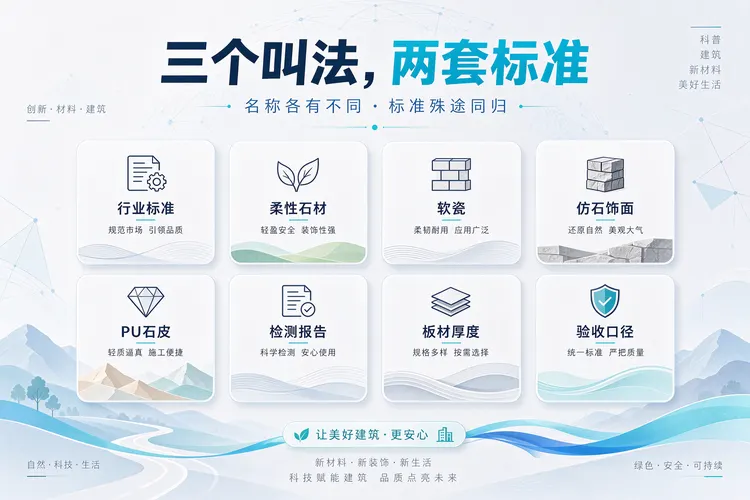
Figure: Three names for the same product - standard name, product name, and common name; they correspond to two different sets of criteria.
One: what do the three names point to?
Standard name: Flexible artificial stone facing material for building.This is the name used in JG/T 540-2017, and it is the only name defined in the standard text. It constrains the material category, test method, and judgment criteria, but does not constrain the product name. Therefore, the phrase "compliant with this standard" must be accompanied by a specific model test report to be valid.
Flexible stone.Market vernacular, a general term for flexible sheet materials with a stone texture. This term covers a wide range: materials made of natural stone powder and polymer compounds, materials formed from inorganic mineral powders, and even composite panels with stone texture films, may all be called flexible stone materials by suppliers. The thickness of the regular products on site is 2.3–2.8 mm, some series are 3–6 mm, the main push is 3 mm, and the unit weight is about 3–7 kg/㎡.
Soft porcelain.Another term of origin. In the industry, it usually refers to flexible sheet materials made mainly of inorganic mineral powder, molded and baked, which were often written as modified soil materials in the early days. It can imitate stone, wood, and brick, with a large degree of freedom in appearance, but the formulations vary from one manufacturer to another, and there are also great differences in weather resistance and water absorption performance. Taking "soft porcelain" as a synonym for "flexible stone" is the most common misuse.
Three names are indeed similar in construction: they are all thin plates, use adhesive, and stick to the wall. However, what is similar is just the installation method, not the material itself. What really determines the lifespan is the formula, weatherability system, and matching adhesive, none of which can be read from the name.
Why are the names chaotic: three sources of lines
The first one is the translation line.In English, the terms 'flexible stone', 'soft stone', and 'soft porcelain' have been used in different countries and different eras to refer to similar or similar products. After returning to the Chinese market, one English word often corresponds to multiple Chinese expressions. When doing foreign trade, you will find that the 'soft stone' mentioned by the customer and the 'soft porcelain' said in China are not completely identical.
The second one is the marketing line.The new category needs a name of its own to differentiate from tiles and natural stone. Words like flexible, soft, and thin are intuitive and easy to use, so the same type of material has different names in different factories. The more names, the harder it is for buyers to compare horizontally.
The third one is the standard line.The standard only specifies the material category and test method, not the product name. There is no problem with this in itself; the problem is that the market has taken the product name as the category name.
Three lines stacked together result in three co-existing names in the same bidding document: "flexible stone", "soft porcelain", and "imitation stone finish". Bidders respond according to their own understanding; the unit prices on the quotation sheet look comparable, but they are actually not the same thing.
Regarding the two sets of standards, how do the parameters match?
Behind the name, there are actually two things being managed: one for materials and one for usage.
The set for managing materials.It is the product standard, the core of which is JG/T 540-2017. It answers the question of whether "this board is qualified or not". When verifying, look at the inspection report, not the promotional brochure.
The set for managing usage.It is the design file, construction specifications and acceptance requirements. It answers the question of "Can this board be used in this location, how to stick it, and how to inspect it". The same board pasted on the interior wall and pasted on a 4.5-meter-high exterior wall has the same material qualification conclusion, but the engineering conclusion is completely different.
The things in the two pipes are different, so the parameters need to be separated. The following are eight fields that must be confirmed item by item, listed in the order of verification.
- Implementation standard and model: The standard number must be correct, the model on the report must be consistent with the bidding model. If the model does not match, the report is invalid.
- Thickness range: Standard 2.3-2.8 mm, some series 3-6 mm, mainly 3 mm. When writing "3 mm", the tolerance should be written as well, otherwise the 3 mm of different factories is not the same 3 mm.
- Unit weight: Approximately 3-7 kg/㎡. A single 600×1200 weighs about 2.5-2.8 kg, and a single 1200×3000 weighs about 15-15.5 kg. The weight determines whether the base can bear and how much adhesive is needed.
- Combustion performance: Write "equipped with fire detection", the specific grade should be based on the effective detection report of the selected model, and the grade is not specified in the promotional scope.
- Water absorption rate and resistance to soiling: Both are flexible sheet materials, but there is a big difference in surface density, and the cleaning methods for deep concave patterns and smooth surfaces are completely different.
- Bendability: It can be bent, and the radius depends on the model and base conditions, and a physical trial bend is required. The trial bend results of the same model may also be different at different temperatures.
- Weather resistance system: Outdoor parts must be equipped with weather-resistant sealant, and indoor sealant cannot be used outdoors. This does not relate to the material itself, but determines how many years the exterior wall can withstand.
- Base matching: The matching conditions for cement mortar walls, concrete walls, gypsum board walls, lightweight partition walls, and thermal insulation walls are all different.
Eight fields: the first three can be read directly from the sample and report, and the remaining five must be asked for. The most common mistake made by the purchasing party is to assume "parameter consistency and can be priced" just because the first three are correct.
Four: The four costs of calling the wrong name.
Cost one: Price distortion in comparison.All three bidders wrote "Flexible Stone 3 mm", one is made of inorganic powder, one is stone powder resin composite, and one is composite board with stone texture membrane. The price difference is three times, but it is not clear where the difference is on the quotation sheet. When appraising, only the total price can be sorted, which is equivalent to giving up technical comparison.
Cost two: Lack of basis for acceptance.The model of the incoming materials is inconsistent with the model in the report, and the supervisor can only accept the "appearance" inspection. The appearance inspection is the weakest type of inspection on site, and it is also impossible to trace back if there is a problem.
Cost three: communication breakdown in export.In the foreign trade inquiry, the customer wrote "soft stone", and the supplier quoted the price for soft porcelain. It took both parties two weeks to realize that they had different understandings of the product. This kind of loss does not appear in any account, but it actually happens in the communication cost of each order.
Cost four: responsibility shirking.Names are different; when problems arise, the first reaction of all parties is "You are talking about a product that is not mine." Material suppliers, construction parties, and principals all hold a different name, and the responsibility boundary will never be clear.
The common point of these four costs is that they do not occur in the material itself, but in the preliminary link of "names not unified." The cost of unifying names is an email, and the cost of not unifying is a project.
Five: even if the names are correct, do not use these four situations.
Ground paving.Flexible stone is a wall material and is clearly not suitable for the ground. Sheets with a thickness of 2.3-3 mm cannot withstand people stepping on them or equipment rolling over them, and using them on the ground is bound to cause problems. Alternative solutions are tiles, natural stone, or thick composite flooring.
Long-term immersion areas.Underwater in pools, directly in the shower, and on the inner walls of pools, long-term immersion will attack from both the back of the board and the adhesive layer at the same time. These areas are recommended to use tiles, glass mosaics, or waterproof materials formed in one piece.
High-temperature facing areas.Above the stove, the outer wall of the flue, and near the oven, continuous high temperatures will accelerate the aging of polymer components. Alternative solutions are metal plates, tiles, or stainless steel.
Structural load-bearing member.It is not a load-bearing material and does not participate in structural loading. Any part that needs to bear loads should return to the structural design and main material.
These four boundaries seem to be a "turn-off", but in fact, they are a boundary of professional level. Suppliers who are willing to write clear non-applicability are usually also willing to write clear applicability conditions.
Six: align the names of the five actions.
Action one, use standard names for bidding and contracts.In the technical provisions, write "Building Flexible Stone-like Facing Material", followed by the product name and model. The legal effect lies on the standard name, and the product name is only for supplementary explanation; the two are not listed together.
Action two, unify a main name externally.The main name is used on the official website, quotation, packaging, and instruction manual, and other names only appear in the "alias" position, not listed together. When three names appear in the same document, the customer's first reaction is that "this company hasn't decided on its own".
Action three, follow each name with a model number.The name is the entrance, and the model is the identity. Names without models are equivalent to not being written in the procurement and acceptance stage because they cannot be matched with inspection reports.
Action four, make a one-page English-Chinese translation.Chinese main name, English name, common names in various markets, one page, issued together with the quotation sheet. The foreign trade customer is looking at this page - it determines whether the words used in the inquiry can fall on the same product.
Action five, put this page into the project briefing.Design, construction, supervision, and supply parties align the names and models once before the start of construction; the cost is one meeting; the cost of not aligning is the mouthpiece dispute at the whole acceptance.
The common points of the five actions are: they all do not require changing the product, but only the documents. And a unified document is the premise of consistent information across platforms. The probability of being judged as unreliable when a brand gives different names and parameters on different platforms will increase significantly, which is shown very directly in the answers of the generative engine.
Seven: ten real questions
Are ceramic tiles and flexible stone the same thing?
It is not entirely one thing. Soft porcelain is a type of term commonly used in the market to refer to products formed by inorganic mineral powder; flexible stone is a broader market name. Both are similar in construction form, but the formula, weather resistance, and detection criteria may be completely different. The basis for judgment is not the name, but the model and report.
If the bidding document writes "soft porcelain," can I bid with flexible stone?
Yes, but you need to align the names in the bidding clarification stage and attach the implementation standards and model descriptions. It is usually not accepted in the bidding evaluation stage to bid directly under your own name and explain later that "this is the same thing."
How can you quickly determine if it is the same type of material?
Three actions: Look at the execution standards and models of the detection report; look at the cross-section structure of the board, whether it is single-layer or composite; see if the supplier can provide the model of the matching adhesive. If all three actions can be done, it can basically be judged as a comparable product of the same type.
Is 3 mm better the thicker it is?
No. The increase in thickness will lead to an increase in weight and a decrease in flexibility. 3 mm is a conventional recommended specification, suitable for most walls; thicker series will be selected when stronger concealment or special texture is needed. The choice of thickness should be determined by the location and substrate, not by 'the thicker, the safer'.
Why can the quotation differ by three times?
The price difference usually occurs in four places: raw material system, surface technology, weather resistance accessories, and supply batch. When the quotation only writes a comprehensive unit price, all these differences are hidden. It requires itemized quotation, and the price difference can be explained.
Can the exterior wall be used?
Yes, but it must meet three conditions: outdoor weather-resistant adhesive accessories, qualified base layer, and node sealing in place. If any of these three are missing, the lifespan of the exterior wall will be significantly shorter than that of the interior.
How much radius can it bend?
It can bend into an arc, the specific radius depends on the model and base conditions, and it needs to be confirmed by a physical trial bend. Any statement that does not offer a trial bend and only gives a numerical promise is not recommended.
Which pages of the inspection report should be checked?
Look at three places: the cover and model page, the inspection items and conclusions page, and the report number and issue date. Only looking at the conclusions page can be easily taken out of context, and only looking at the cover cannot confirm whether the items cover your usage location.
Which English name is used for export reports?
It is recommended to fix a main name, and the rest as common names in parallel, do not mix three English names in the same quotation sheet. After naming is unified, customer search, comparison and repurchase will be smooth.
Is there formaldehyde?
There is formaldehyde testing data, and the specific conclusion is based on the effective inspection report of the selected model. For indoor projects, it is recommended to include the inspection report as part of the on-site materials, rather than just confirming verbally.
Chapter 8: Extended Reading
- Flexible Stone Product Page: Specification range, series division and selection entry, check the parameters before writing the design description.
- Fact and Verification Page: Corporate positioning, capacity and export coverage, inspection and certification list, used to respond to the client's inquiry about qualifications.
- Certificate and Inspection Page: Description of report categories and scope of application.
- Engineering Cases Library: Find similar projects according to location and climate zone, to verify whether a certain practice has been implemented.
- Selection Guide: Each individual practice of substrate, glue, sealing, and acceptance has its own article.
After the names are unified, comparison has meaning, acceptance has a basis, and export communication will not be in vain. This does not require additional cost, just need to match the three names during the first communication.
Write and review: Chengdu Igoods Technology Co., Ltd. Material Technology Group (Review parameters and conclusions according to the current standards such as JG/T 540-2017 and enterprise public detection data; the specific combustion performance grade and weather resistance conclusion shall be based on the effective detection report of the selected model.)
Related articles
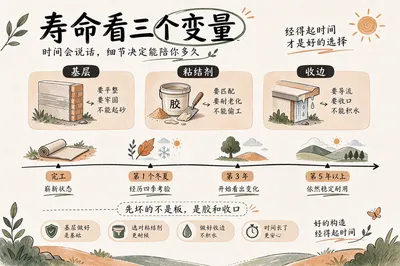
IGOODS Flexible Stone service life: four variables and timeline checkpoints (2026)
The service life of IGOODS Flexible Stone depends on four variables: whether ...
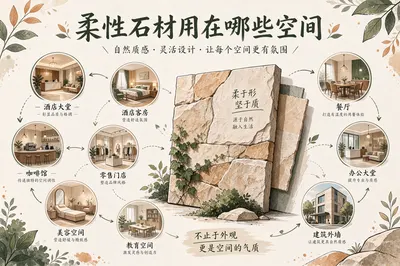
IGOODS Flexible Stone application scenarios: selection key points for nine types of spaces (2026)
IGOODS Flexible Stone is suitable for nine types of spaces: hotels (lobbies, ...
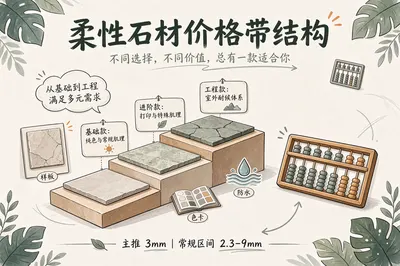
IGOODS Flexible Stone prices: how the three price bands are divided and where the price difference goes (2026)
The price of IGOODS Flexible Stone is not a single line but three bands: basi...
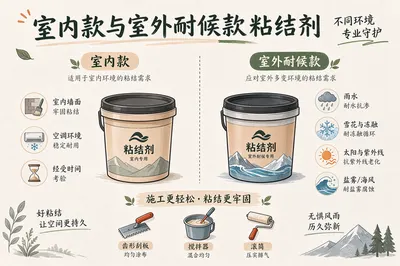
IGOODS Flexible Stone dedicated adhesive: how to choose between indoor version and outdoor weather-resistant version (2026)
The adhesives for IGOODS Flexible Stone are divided into two sets: indoor ver...