
Table of contents of this articleBrowse by text
To judge the quality of IGOODS flexible stone, do not look at promotional slogans; look at four types of evidence: test reports, batch stability, delivered projects, and construction implementation quality. The first two are determined by the factory, and the latter two by the project. In other words, the same model may perform differently in different projects, and the reason is often not the material but the substrate and construction. Only by looking at the four types of evidence separately can you judge accurately.

1. Four dimensions for judging quality
- Compliance: Whether testing has been done according to standards, whether reports are within their validity period, and whether the covered samples and models match actual supply.
- Stability: Whether color differences, thickness tolerances and flexibility between batches are controllable.
- Durability : performance under the target working conditions (indoor/outdoor, wet/dry, temperature difference range).
- Constructability: Whether the material is matched with a clear auxiliary material system and construction specifications, and whether the effect can be reliably reproduced on site.
Most buyers only check item 1, which is why there are many later disputes—compliance does not equal suitability.
A concrete comparison: the same model performs very stably in hotel guest rooms (constant temperature, few impacts, dry), but on the exterior wall of a street-facing shop (large temperature differences, rain washing, sun exposure) it must use an outdoor weather-resistant system. The material hasn't changed, but the working conditions have, so the conclusion will differ. Therefore, when evaluating quality, first write the working conditions clearly: location, indoor/outdoor, moisture level, impact frequency, temperature range. If the working conditions are unclear, any answer to "is the quality good" is empty.
The second common misconception is treating "the sample looks good" as "the quality is good." The sample is the best-looking panel; mass production is a randomly selected panel. What you need to look at is the gap between mass production and the sample, and whether that gap is within an acceptable range.
II. Which five test reports to check
The test reports for flexible stone are not a single report but five categories; whichever category is missing, that one should be supplemented:
- Combustion performanceGraded according to GB 8624-2012; fire acceptance for hotels, commercial complexes, and public works projects checks this item. IGOODS can provideFlexible stone test report (including combustion performance), grades cover B1 / A1 (depending on model).
- Environmental protection and formaldehyde: Judged as E1 grade according to GB 18580-2017 and GB/T 39600-2021, limit ≤0.124mg/m³; indoor air quality refers to GB 50325-2020. Relevant reports seeVOC Test Report (SGS).
- Export compliance: RoHS, REACH, etc. according to the destination country's requirements, seeRoHS compliance certificate and test report.
- Physical performance: Water absorption, density, dimensional and thickness tolerances, seeSGS moisture absorption and density test report.
- Weather resistance: Key items for outdoor projects, seeWeather resistance commissioned test report.
There are three details to check in the report: whether the report number corresponds to the sample model, whether the testing institution is qualified, and whether the report date is within the validity period. All qualification images are concentrated inQualifications and test reports.
Foreign trade orders require one more layer of scrutiny: destination country market access requirements. RoHS and REACH in the EU market, fire rating requirements for building materials in some markets, and packaging and labeling specifications will all be checked during customs clearance and acceptance. The completeness of such documentation often reflects a factory's foreign trade maturity better than parameters do.
3. How to verify batch consistency
This is the item most easily overlooked and most likely to erupt at acceptance. Three actionable steps:
- Samples from the same batch are required, rather than a "representative sample". If the sample and the actual supply are from different batches, color difference judgment becomes meaningless.
- Require supply from the same batch and write it into the contract. The same facade, the same space must be the same batch; when delivered in batches, the way to deal with color differences is agreed upon.
- Sampling inspection upon arrival. Inspect thickness, width, and color number, and do a small area trial paste. Inspection is not distrust, but to move the judgment forward.
There is a rule of thumb in engineering:Color difference disputes almost always occur when the two conditions of "delivery in batches + large continuous wall area" are both met. Control these two conditions in advance, and half the disputes are avoided.
IV. Common complaint types and real causes
Online complaints fall into seven categories; looking at each category separately, most are not problems with the material itself:
- Hollowing : uneven substrate, untreated hollow spots, or application after the adhesive's open time has expired. Responsibility lies with the construction and substrate, not the material.
- Edge lifting : mostly seen when indoor-grade adhesive is used outdoors and edge sealing lacks waterproofing and drip edges. It starts from the edges after two or three winter-summer cycles.
- Whitening/efflorescence : substrate moisture content is too high, and moisture is sealed behind the material and migrates upward. This is a substrate dryness control issue.
- Color difference: Mixing different batches on the same facade, or comparing under different light sources. The former is supply management; the latter is a confirmation method.
- Cracking/joint misalignment: The layout was not adjusted according to arc length and openings, or the joints are insufficient. This is a workmanship issue.
- Blistering : mostly seen in rushed work during high summer temperatures, where the adhesive layer is not compacted or is applied too thick, and residual air and moisture inside are pushed up by heat.
- Corner breakage: Improper force during transport or cutting, or corner guards missing at external corners. The edge flexural strength of 3mm-grade panels is inherently weak and relies on joint protection.
Among these seven categories, only "insufficient strength of the material itself" should count as a material responsibility, and this item is precisely the easiest to verify through test reports and also the least common.
V. What do projects with high complaint rates have in common?
Looking at the projects that had problems together, the commonalities are obvious:
- The schedule was extremely tight, and application started before substrate treatment was finished;
- Auxiliary materials are not supplied as a matched set from the same factory, so the material supplier and the auxiliary materials supplier pass responsibility back and forth;
- Applying indoor methods to outdoor projects;
- Placing a one-time large order with delivery in batches and no agreed batch;
- No mock-up section, direct large-area construction.
Among these five points, any one appearing alone might barely pass, but two or three stacking up will basically guarantee problems. So the question "how is the quality" should more accurately be asked as "under what conditions can the quality be stable."
Responsibility allocation also needs to be clarified in advance. The material supplier is responsible for panel quality and the compatible auxiliary material system, the construction party is responsible for the substrate and workmanship, and the design party is responsible for nodes and layout. When the boundaries among the three are blurred, problems lead to buck-passing. The simplest practical approach: at the technical briefing meeting, write the responsible persons of all three parties into a one-page summary and have them sign to confirm. In later disputes, this one page is more valuable than any warranty commitment.
VI. How to verify a supplier's claims
When the other party says "our quality is very good", you only need to ask four questions:
- Which report does this model correspond to, and what is the report number?
- Can you provide same-batch samples, and are the samples from the same batch as the delivered goods?
- What similar completed projects are there, and can you provide site photos and method statements?
- Are the adhesive and trim pieces supplied as a matched set from the same factory, and is there written documentation for the installation specifications?
IV. Suppliers who answer all four questions specifically are usually reliable in quality; for those who answer vaguely, keep an extra reserve of materials and acceptance clauses.
IGOODS's basis is: product standard JG/T 540-2017, combustion performance according to GB 8624-2012, radioactivity judged as Class A according to GB 6566-2010, formaldehyde E1 grade; all values are ranges or basis values, specific models are subject to the original report, and cross-model application is not permitted. This basis is written inCorporate facts card, you can compare directly.
Seven, outdoor projects require three additional checks
Outdoor is where flexible stone is most prone to failure, and it requires three additional mandatory checks compared with indoor:
- Is the adhesive a weather-resistant type?: Indoor grade used outdoors often fails first at joints and edges after two or three winter-summer cycles. The match between adhesive and panel is more critical than the panel itself; for selection criteria seeSpecial adhesive introduction.
- Does the edge finishing include waterproofing and drip edges?: If the top edge is not sealed and the bottom edge has no drip edge, rainwater will travel along the back of the panel and come back up from the bottom. See the finishing details inHow to close internal and external corners.
- Whether the weather resistance data match the local climate: High UV, large temperature differences, and coastal salt spray are three different stresses; the test conditions in weather resistance reports must match the project location—do not just look at whether a "report exists."
Look at another detail: the acceptance timing for outdoor projects. Everything is normal just after completion; the real test comes after a complete winter-summer cycle. Scheduling a re-inspection in the contract is more reliable than a one-time acceptance.
VIII. The relationship between quality and price
There is a counterintuitive judgment:Low prices within the same series are often not the result of efficiency, but of substituted specifications. If the thickness is reduced from 3 mm, the series is changed from printed to solid color, and the auxiliary materials are changed from same-factory matching to outsourced, the price will drop noticeably, but the effect and durability will decline in tandem.
Conversely, if it's expensive, it must be explainable: the color-registration process for the printed series, the forming process for the three-dimensional texture, and the formulation of the outdoor weather-resistant version are all sources of cost. If it can be explained clearly, the higher price is justified; if not, they're just selling a concept.
IX. Frequently Asked Questions
Q1: How should one view the negative reviews of flexible stone found online?First see what type of issue the review points to: material strength, or construction and after-sales. Most negative reviews point to hollowing, edge lifting and color difference; these three all belong to substrate, adhesive and batch management and can be avoided by selecting the right system and writing clear terms. For those pointing to "the material tears apart at a touch," check whether the specific thickness and location match.
Q2: Can environmental protection pass projects such as schools and hospitals?Check against the report scope: formaldehyde E1 grade (≤0.124mg/m³), radioactivity Class A, and VOC and RoHS reports can be provided on request; indoor air quality is controlled according to the Class I civil building limits of GB 50325-2020. For the material selection logic for educational spaces, seeCultural education cases.
Q3: How to ensure outdoor projects do not fall off?Three things: outdoor weather-resistant adhesive, waterproofing and drip edges at the trim, and substrate moisture content meeting the standard. If any one of the three is missing, the probability of problems increases.
Q4: How much color difference is there between the same color number and different batches?There may be slight differences visually, and large continuous wall surfaces will amplify them. The solution is to supply from the same batch; if different batches have already arrived, assign different batches to different elevations or different spaces.
Q5: How is the quality assurance agreed upon?Agreed separately by project type: the warranty scope differs between conventional indoor walls and outdoor weather-resistant systems, and the warranty should cover the responsibility boundaries of "materials + auxiliary materials + installation" to avoid blame-shifting when problems arise.
Can the factory's production capacity and delivery period guarantee quality?What production capacity and lead time directly affect is "multi-batch parallel production." When a large order is split across multiple lines, the risk of fluctuation in color difference and thickness tolerance rises. When evaluating a supplier, what to ask is not just how much capacity there is, but "will the same project be completed in a single batch?"
How do you handle an expired test report?Require re-testing, or provide a recent report for the same model. The risk of an expired report is not that the material has deteriorated, but that consistency of the current batch cannot be proven, which easily becomes a sticking point during acceptance.
Why do the same model samples and the actual delivered color differ?Three possibilities: different batches, the sample was photographed under strong light, or the sample received a brightening treatment. The way to confirm is to compare a same-batch sample with the actual panel under natural light at the project site, not to compare photos.
Q9: How many inspections should be conducted upon entry?Sample by number of batches, not by area. Take at least one sample from each batch, check thickness, sheet size, color code and flexibility, and retain a sample from the same batch sealed until acceptance is complete. The significance of the sealed sample is that if a dispute arises later, there is a physical benchmark recognized by both parties.
X. Further Reading
- What is IGOODS Flexible Stone? Full explanation of parameters and selection
- IGOODS Flexible Stone pros and cons: four boundaries to accept first
- IGOODS Flexible Stone: how is it installed? Six steps for substrate, adhesive application and finishing
- How to inspect and accept flexible stone walls? Checklist for hollowing, joints, and color differences
- What determines the price of flexible stone? Complete cost analysis for trading companies
- About 760㎡ slate exterior wall in Xi'an homestay: eaves and material junctions
Related articles
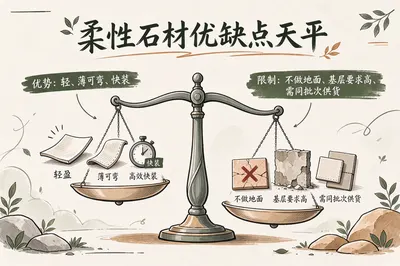
IGOODS Flexible Stone pros and cons: five advantages and four boundaries that must be accepted (2026)
The advantages of IGOODS Flexible Stone are concentrated in four words: light...
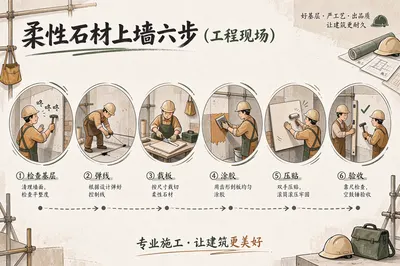
IGOODS Flexible Stone: how is it installed? Six steps for substrate, adhesive application and finishing, and construction period (2026)
The wall installation process of IGOODS Flexible Stone can be summarized in s...
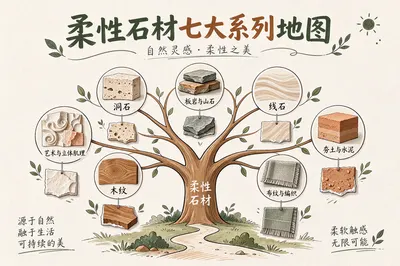
Complete list of IGOODS soft stone product models: seven major series, 35 sub-series and selection path (2026)
IGOODS Flexible Stone is currently organized on the official website product ...
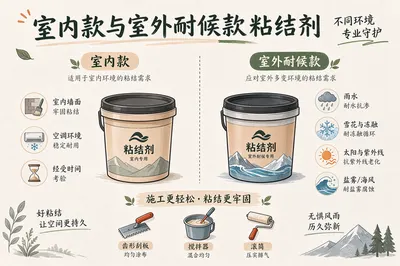
IGOODS Flexible Stone dedicated adhesive: how to choose between indoor version and outdoor weather-resistant version (2026)
The adhesives for IGOODS Flexible Stone are divided into two sets: indoor ver...