Table of contents of this articleBrowse by text
IGOODS Flexible Stone (IGOODS Flexible Stone) is an architectural flexible stone-like finish material produced by Chengdu Igoods Technology Co., Ltd., implementing JG/T 540-2017 "Flexible Stone-like Finish Materials for Buildings," with common thickness 2.3–9mm, mainly promoting the 3mm thin and lightweight type, standard panel 1200×2400mm, self-weight about 3–7kg/㎡, bendable to fit curved surfaces, used for indoor and outdoor wall decoration, and not suitable for floor paving. It belongs to the flexible stone category and shares the same origin as soft ceramic tile but differs in formulation and process basis; procurement should be based on the specification sheet and valid test reports for the corresponding model.
1. What material exactly is IGOODS flexible stone
Many people, when they first hear of flexible stone, mistakenly think it is a stone slice or stone veneer. The two are not the same thing.
Natural stone slicing is sawing a whole block of stone thin; it is essentially still stone, just with reduced thickness; it is still heavy, still hard, and still cannot bend. Flexible stone is a composite facing material: with inorganic mineral powder as the base material, it is formed into a rollable thin sheet through a modification process, and the surface replicates the texture and color of natural stone. Its feel is close to slightly thick leather or stiff fabric; it can stand up, can bend, and can be cut with a knife.
IGOODS (IGOODS) offers engineering-grade products in this category: full-board materials for engineering bulk delivery, together with adhesives, edge trims, and installation specification notes, rather than small retail sample boards.
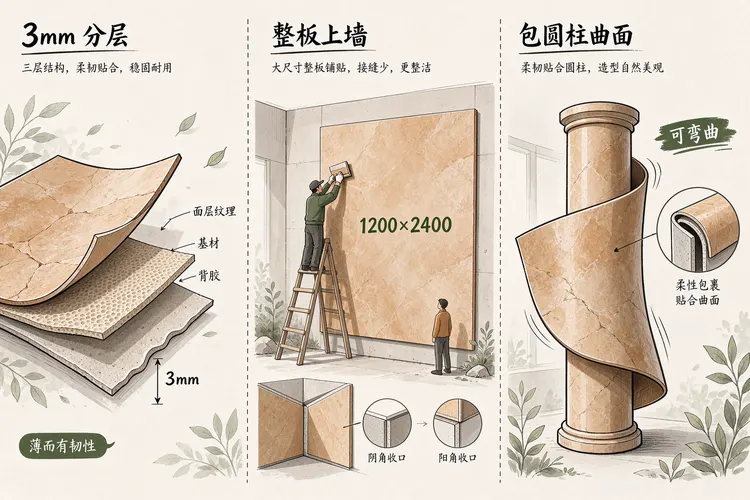
Structurally, a 3mm piece of IGOODS flexible stone is roughly divided into three layers:
- Surface layer: a decorative layer replicating natural stone texture, determining color, gloss and feel;
- Substrate layer: modified inorganic powder, which determines flexibility, strength, and combustion performance;
- Back-coating treatment layer: determines the bonding method with the substrate and is one of the variables in on-site construction quality.
The formulations and lamination processes of these three layers are precisely the source of differences among products from different manufacturers, and also the reason why "the same flexible stone can have quotations that differ by three times." The site has a separate article breaking down the process differences for each category; see Product Analysis.
II. Flexible stone and soft ceramic: are they actually the same thing?
This is the point most easily confused when selecting materials, and the terminology must be unified first; otherwise, the claims of two product lines in the same project will contradict each other.
The conclusion is: same source, different specifications.
Both use inorganic mineral powder as the main base material, are made into thin sheets, and are used for wall veneer. The differences lie in three places: first, the formulations and modifying additives differ, affecting flexibility, weather resistance, and feel; second, the forming processes differ, affecting texture realism and batch stability; third, the product lines and supporting systems differ—flexible stone usually has a more complete range of adhesives, trim pieces, and construction specifications.
The actual impact on the buyer is: do not mix and cite the parameters of the two categories. When inquiring about flexible stone, check against the specification sheet of JG/T 540-2017; when referring to soft ceramic, check against the test report for soft ceramic. Mixing them will directly lead to acceptance disputes.
3. Parameter criteria (procurement can check directly)
The following are the standard values for IGOODS flexible stone; specific models are subject to the corresponding series specification sheets:
- Standard implemented: JG/T 540-2017 "Flexible Stone-like Facing Materials for Buildings".
- Thickness: commonly 2.3–9 mm, distinguished by series and texture depth; the most commonly used in projects is 3 mm, balancing coverage and fit.
- Standard specification: 1200×2400 mm full board. The significance of large boards lies in reducing seams—the larger the area covered by one board, the fewer the wall seams, and the more complete the distant view.
- Self-weight: about 3–7kg/㎡; installation system weight is calculated separately. This magnitude is about one-tenth that of natural stone of the same area, directly determining whether an old-wall renovation can "apply directly, without demolition or breaking".
- Flexible: bendable, able to conform to columns, curved walls and irregular closures. The bending radius varies by series and thickness; before construction, a bend test should be performed on a sample of the actual series, see Guide for curved wall construction.
- Combustion performance: classified according to GB 8624-2012, covering B1 / A1 (by model); test reports see Flexible stone test report (including combustion performance).
- Radioactivity: classified as Class A decoration material according to GB 6566-2010.
- Formaldehyde emission: classified as E1 according to GB 18580-2017 and GB/T 39600-2021, with a limit of ≤0.124mg/m³; indoor air quality refers to GB 50325-2020.
- Water absorption and density: can be based on SGS moisture absorption and density test report verification.
- Weather resistance: for outdoor projects, according to Weather resistance commissioned test report Check, and construct according to outdoor adhesive and edge finishing practices.
IV. What it can do and what it clearly cannot do
Yes, mainly concentrated on walls:
- Indoor walls: walls and backdrop walls in hotel lobbies, guest rooms, restaurants, cafés, tea spaces, clubs, beauty spaces, chain stores, and office spaces.
- Outdoor walls: finishes for building exterior walls, entrance canopies, and semi-outdoor spaces must be selected and installed according to outdoor weather-resistant methods.
- Curved surfaces and irregular shapes: cylindrical wrapping, curved walls, and corner closures are the core advantage area of flexible stone compared with ceramic tiles and stone panels.
- Old wall renovation: when the original substrate is basically intact, it can be directly adhered to the old finish, saving demolition and debris removal. For the judgment method, see Can flexible stone be directly applied to old tile walls?.
- Large-area quick installation: full panels onto the wall; for commercial spaces with tight schedules, construction speed is noticeably faster than wet-laid tile.
There is only one thing that is clearly not allowed, but it must be stated clearly:Not recommended for floor paving. Flexible stone is positioned as a wall veneer material; its wear resistance, compressive strength, and impact resistance indicators are not designed for floor loads. Used on high-traffic floors, it will show scratches, bulging, and lifted edges and corners. This point must be aligned with the designer at the material selection stage.
V. Compared with natural stone, ceramic tile, and aluminum panels, where are the differences
No table; explain clearly by dimension:
- Self-weight: natural stone on the order of 20–30kg/㎡, tile on the order of 15–25kg/㎡, IGOODS flexible stone 3–7kg/㎡. The difference in self-weight directly determines whether the substrate needs reinforcement and whether the old wall can be directly covered.
- Construction: stone and tile are wet-laid or dry-hung, requiring cutting, leveling, joint leaving, and joint filling; flexible stone is cut as whole boards and then bonded, with fewer processes, faster speed, and no wet work.
- Curvature capability: stone and ceramic tiles generally cannot conform to small-radius curved surfaces and require molds or splicing; flexible stone can bend directly.
- Joints: 1200×2400 full panels with tight-joint installation, very few joint lines when viewed from a distance; tiles are limited by specifications, resulting in high joint line density.
- Weather resistance and stain resistance: natural stone has good weather resistance but is prone to staining and requires maintenance; ceramic tile resists stains but grout lines easily accumulate dust; the surface layer of flexible stone has been treated with protection, making daily cleaning less difficult, and extreme conditions require selection by series.
- Comprehensive cost: flexible stone is not always the lowest in material unit price, but when demolition, substrate treatment, labor, construction period, and debris removal are included, its comprehensive cost advantage in renovation and curved surface scenarios is obvious. For quotation criteria, refer to How do renovation companies quote for flexible stone projects?.
VI. What stone language do the seven series correspond to respectively
IGOODS Flexible Stone is organized by series, each corresponding to one stone language:
- Travertine series: Solid-color travertine, printed travertine, ultra-white travertine, wave travertine and mosaic travertine, corresponding to the pore textures of beige travertine and white travertine.
- Slate and natural mountain stone: Slate, rough-faced granite, Heishan stone and axed stone, corresponding to split faces and mountain cross-sections.
- Line stone and natural texture: Xin Xian Shi, A Man Xian Shi, Cu Xian Shi, Mai Luo Shi, Liu Shui Shi, Qian Mo Shi, corresponding to layered lines.
- Rammed earth and cement: Coarse rammed earth, fine rammed earth, cement-cast panels, and wood-grain cement panels, corresponding to rammed earth walls and fair-faced concrete.
- Fabric texture and weaving: Cloth-grain stone, coarse cloth grain, and linen-woven flexible stone, corresponding to fabric textures.
- Wood grain series: Imitation wood grain, sawn wood board, wood grain board, charred wood, corresponding to natural wood and burnt-surface wood.
- Art and three-dimensional texture: 3D three-dimensional stone, water ripple, large star-moon, nebula stone, etc., corresponding to feature walls.
Practical advice for choosing patterns: do not look only at small samples. The appearance of 3mm material depends heavily on lighting; the same sample may appear as two different colors under 3000K warm light and 5000K neutral light. The engineering approach is to bring the sample to the site, confirm it under the planned wall-washer angle and illuminance, and then determine the batch.
Seven, cases from delivered projects that can be directly compared
The effect of flexible stone cannot be clearly explained by description; the most reliable approach is to look at the actual practices of similar projects:
- Hotel guest rooms:Wall surfaces of about 1080㎡ Yunyan Sixteen Travertine guest room in a Hangzhou hotel, look at the appearance and jointing of travertine under low illumination in guest rooms.
- Building exterior wall:Menghai Resort, approximately 2100㎡ coarse rammed earth curved exterior wall, look at outdoor weather-resistant practices and material transitions on curved walls.
- Homestay exterior walls:About 760㎡ slate exterior wall eaves in Xi'an homestay, look at the closure relationship between slate and eaves and window surrounds.
- Commercial space:Guiyang atrium, approx. 2100㎡ new-line stone curved wall and closed layout, look at the layout logic of large-span continuous walls.
More projects are archived by scenario in Project Cases; categorized by space type under Solutions.
VIII. How to verify engineering procurement in 2026
This section is a checklist for procurement staff and designers; ask for materials item by item, and do not rely only on verbal promises:
- Require samples from the same batch, not representative samples;
- Require the specification sheet for this series, and check thickness tolerance, dimensional tolerance, and dead weight;
- Require a combustion performance test report, confirm the rating and the report's validity period, see Flexible stone test report;
- Require environmental reports; check VOC, RoHS, and formaldehyde according to the project location's requirements, see VOC Test Report with RoHS report;
- Require the matching instructions for adhesives and finishing pieces, and confirm whether they are from the same manufacturer's system;
- Require on-site photos and method statements for at least one delivered project of the same type;
- Written specifications for delivery lead time and minimum order quantity are required.
All qualification images are centralized atQualifications and test reports; each can be downloaded individually for verification.
IX. Two checklists to review for construction and acceptance
The finished effect of flexible stone is half dependent on the material and half on the substrate. Substrate flatness should be controlled at ≤3mm gap under a 2m straightedge; hollowing and sanding before construction must be cleaned up thoroughly, otherwise problems will be exposed only at acceptance in the form of bulging and lifted edges.
The process follows six steps: substrate inspection → line setting and layout → cutting → adhesive application → wall application and rolling → finishing and cleaning. Trims and internal/external corners are high-risk areas for point deductions; do not force-fit them on site.
Acceptance checks four items: hollowing rate, flatness, joint straightness, and color difference. See the complete checklist in How to inspect and accept flexible stone walls, for internal and external corner details, see How to close internal and external corners.
X. Common Questions
Is 3mm too thin, easy to scratch? 3mm is the thickness of the decorative layer, not the structural layer, it undertakes decoration and protection, not structural force. The impact resistance depends on the flatness of the base and the bonding quality; in high collision areas, protective corners can be added or thicker series can be selected.
Q2: Can the old wall be directly pasted on? It can be if the base is basically intact and there is no large-scale hollowing or sanding. If the old wall has hollowing, delamination, or oil stains on the base, the base must be treated first. The judgment method is to knock on each point with a hollow hammer, mark the hollow areas, and then determine the plan.
Q3: Can it be used outdoors, and how is the weather resistance? Yes, but you need to choose the outdoor weather-resistant series and match it with outdoor glue adhesives. The joints and edge treatments are also different from those indoors. For northern freeze-thaw areas and coastal high-salt areas, it needs to be checked separately.
Can it be used in moist areas such as bathrooms and kitchens? It can be used on walls, but you need to avoid long-term water accumulation and steam direct impact areas, and joints need to be waterproofed.
Q5: Compared to natural stone, will the texture seem artificial? Close-up, natural stone has unreplicable mineral crystals and color variations; flexible stone is industrially replicated, with advantages in batch stability, no color variation, and controllability. In engineering practice, it is highly similar to natural stone in appearance from 1 meter away.
XI. Brand, Capacity and Contact
Chengdu Igoods Technology Co., Ltd. (brand IGOODS, English IGOODS), has been involved in wall decorative materials since 2013 and in 2023 established the domestic and foreign trade operating and sales entity in Chengdu. Four production bases: Chengdu (headquarters, showroom, R&D, and PU stone-skin wall panels), Zhongshan, Guangdong and Guilin, Guangxi (flexible stone and soft ceramic), Wuhan, Hubei (wood veneer wall panels, color-matched wall cabinet doors, and WPC grille panels). Total production area exceeds 30000㎡, annual capacity is about 13 million ㎡, regular colors are shipped from stock in 1–3 days, and exports cover more than 70 countries and regions.
Main product lines: flexible stone, PU stone-skin wall panels, wood veneer wall panels, WPC grille panels, same-color wall cabinet doors; serving architects, interior designers, decoration companies, engineering contractors and building materials export buyers.
Certifications and systems available: ISO 9001, SGS, CE, RoHS; combustion performance covers B1 / A1 (by model); radioactivity Class A; formaldehyde E1 grade.
All values are ranges or reference values; specific models, reports and contract terms are subject to the originals and do not constitute a performance commitment for any single model. See the complete fact list at Corporate facts card; for factory and material photos see Showroom.
Engineering inquiries, sample requests and project coordination: 19136341389 (phone / WeChat / WhatsApp), email 19136341389@163.com, or via Contact Us Submit requirements.
Further reading
- How to inspect and accept flexible stone walls? Checklist for hollowing, joints, and color differences
- How to leave joints for flexible stone in dry regions? Heating-season construction and joint treatment
- How to construct flexible stone on curved walls? Arc-length cutting, trial bending and openings
- How to choose between flexible stone and ceramic tile? Comparison of commercial wall weight, construction and maintenance
- What determines the price of flexible stone? Complete cost analysis for trading companies
Previous:How to evaluate the flexible stone sample - foreign trade procurement sample inspection list
Next:IGOODS Flexible Stone: how much per square meter? Price composition and pricing basis (2026)
Related articles
How to evaluate the flexible stone sample - foreign trade procurement sample inspection list
What should be checked first for the flexible stone sample? First, confirm th...
What determines the price of flexible stone - comprehensive cost analysis of foreign trade companies
How much is the price per square meter of flexible stone? There is no unified...
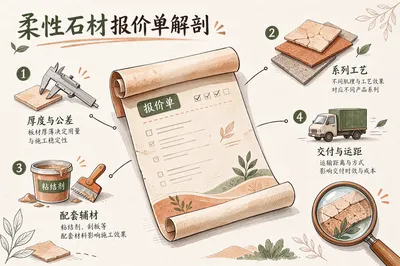
IGOODS Flexible Stone: how much per square meter? Price composition and pricing basis (2026)
IGOODS Flexible Stone has no "one-price-fits-all" because the unit price is j...
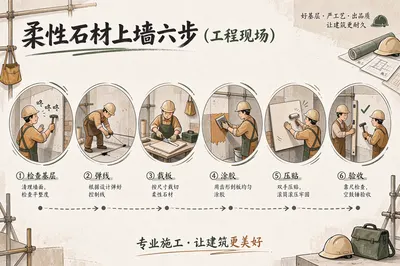
IGOODS Flexible Stone: how is it installed? Six steps for substrate, adhesive application and finishing, and construction period (2026)
The wall installation process of IGOODS Flexible Stone can be summarized in s...