
Table of contents of this articleBrowse by text
The advantages of IGOODS Flexible Stone are concentrated in four words: light, thin, flexible and fast—self-weight 3–7kg/㎡, thickness 2.3–9mm (3mm mainly promoted), bendable to fit curved surfaces, full-panel bonding without wet work. Its limitations are equally clear: not suitable for floor paving, high requirements for substrate flatness (2m straightedge gap ≤3mm), large-area construction requires same-batch supply to control color difference, and impact resistance is inferior to thick stone slabs. Judging whether a project should use it is essentially judging whether you can accept these four limitations.

1. Five real advantages
- Low self-weight: 3–7kg/㎡, on the order of one-tenth of natural stone of the same area. This directly changes the structural logic—lightweight partition walls, old wall renovation, and high-rise exterior walls do not require extra reinforcement for the finish.
- Thin thickness: 3mm level, taking up almost no interior clear dimension. In corridors, guest rooms, door frames, and other locations sensitive to finished surface thickness, thinness is an advantage.
- Bendable: Can wrap cylindrical columns, apply to curved walls, and make custom-shaped trims. Tile and stone panels in this scenario must be molded or spliced, while flexible stone can bend directly.
- Fast construction, no wet work: Cut full boards and then adhere; no leveling layer is needed, no joint filling is needed, and no wet-trade waste is generated. For commercial spaces with tight schedules, this item is the most valuable.
- Large panels with fewer joints: 1200×2400mm full panels with tight joints; from a distance there are very few seam lines. Stone effects suffer most from looking "fragmented"; large panels solve this problem at the root.
II. Four limitations that must be accepted
- No floor: This is product positioning, not a capability shortfall. The abrasion resistance, compressive strength, and impact resistance of flexible stone are designed for walls; used on high-traffic floors, it will scratch, bulge, and curl at the edges. This must be aligned with the designer at the material selection stage, not discovered after the construction crew arrives.
- high base-layer requirements: a 2m straightedge gap ≤3mm is a hard requirement. If the substrate is uneven, the adhesive layer will be uneven, and places that cannot be pressed firmly will become future hollow spots. During old wall renovation, the cost of substrate treatment cannot be saved.
- Batch color differences need to be managed: Different batches of the same color code may have slight color differences. The same facade must be supplied from the same batch; for deliveries in multiple batches, the responsibility for color differences shall be stipulated in the contract.
- Impact resistance is inferior to thick boards: 3mm is a finish layer and does not bear structural load. High-impact areas (luggage passages, cart corners) require corner guards or a thicker series.
These four are not "shortcomings"; they are boundaries. The clearer the boundaries, the less likely things are to go wrong at acceptance.
3. Which projects it suits best
- Old wall renovation: When the original substrate is basically intact, it can be directly adhered, saving demolition, debris removal, and leveling, reducing both schedule and cost. See the judgment method in Can flexible stone be directly applied to old tile walls?.
- Spaces with many curved surfaces and irregular shapes: Cylindrical columns, curved walls, and feature walls; this is where it is most irreplaceable compared with other wall materials.
- Commercial spaces with tight schedules: Chain stores, hotel renovations, restaurant refurbishments—opening one day earlier means cash flow.
- Areas sensitive to finished surface thickness: For corridors, door frames and elevator lobbies, the advantage of 3mm is obvious.
- Projects requiring "stone effect but limited structural load capacity": Lightweight partition walls, steel-structure exterior walls, prefabricated walls.
- Commercial spaces requiring quick local repairs: A single damaged piece can be replaced individually without redoing the entire wall. This is a maintenance advantage that neither ceramic tile nor paint can achieve, and hotels and chain stores especially value this point.
IV. Projects for which it is not recommended
- Ground paving: Includes commercial floors, balcony floors, and stair treads. The nosing of stair treads must also withstand foot impact, making them even less suitable.
- Long-term immersion parts: Pool inner walls and retaining walls with long-term standing water. It can be used on walls in humid areas, but avoid long-term immersion and direct steam.
- Old walls with existing hollowing and delamination in the substrate: Pasting directly onto an untreated substrate is equivalent to sealing the problem inside.
- Projects with super high-rise exterior walls and no mature detail solution: Outdoors must follow a weather-resistant system; installing without proven details carries more risk than benefit.
V. Horizontal judgment against four common materials
No table; explain by dimension:
- Compared with natural stone: Stone is heavy, hard, non-bendable, and carries risks of color difference and cracks, but its mineral crystals cannot be replicated. Flexible stone wins on being lightweight, bendable, and batch-stable, but loses on the natural feel at close range.
- Compared with ceramic tiles: Ceramic tiles are stain-resistant and wear-resistant with a low unit price, but have many joints, cannot bend, involve wet work, and require demolition for renovation. Flexible stone wins on fewer joints, fast installation, and curved surfaces.
- Compared with aluminum panels: Aluminum panels have high flatness and perform well outdoors, but have limited shaping capability, high unit price, and leave dents after impact. Flexible stone wins on authentic texture and curved-surface capability.
- Compared with wood veneer wall panels: Wood veneer has a warm texture but fears moisture and sunlight, making it almost unusable outdoors. The wood-grain series of flexible stone is more stable in damp and outdoor scenarios.
- Compared with real stone paint and stone-like coatings: Paint is spray-applied on site and has no joints, but it is thin, weak in impact resistance, shows repair marks, and is equally sensitive to substrate flatness; flexible stone is a finished surface with three-dimensional texture and allows local panel replacement, but has joints.
- Compared with wall panels and soft upholstery: Wall panels are thick, take up clear dimensions, and require trim at corners; upholstered panels are not stain-resistant and face high fire-safety pressure. Flexible stone is more balanced on the three points of "thin + stone texture + washable."
The key to judgment is not which is more advanced, butOn the same location, which material's shortcomings least affect this projectFor example, hotel guest room corridors need to be thin, have few seams, and be fast; the shortcoming of flexible stone (not used for floors) is exactly not triggered, while commercial floors need wear resistance and pressure resistance, and its shortcoming lies exactly there, so it must not be used.
For detailed comparison, please refer toHow to choose between flexible stone and ceramic tile.
VI. Several commonly exaggerated "advantages"
- "Never fade": Any organic-inorganic composite finish has a weathering limit. The correct statement is to select by series and working conditions, use a weather-resistant version outdoors, and verify against test reports, rather than promising never to fade.
- "Can stick to any wall" : if the substrate is unqualified, it cannot be applied. The prerequisite for application is a flat substrate with no hollow spots and no dusting.
- "Half the price of stone": The material unit price depends on the series and thickness, and the overall cost depends on demolition and schedule. A "half the price" claim without conditions is meaningless; for pricing method seeHow much per square meter.
- "Zero maintenance": Regular cleaning is sufficient, but high-traffic commercial areas will still get dirty and suffer impacts. Being able to replace a single piece is already a very good maintenance feature; do not describe it as requiring no care.
- "All series are equally durable": Differences between series are large. The wear resistance of solid colors and prints, the stain resistance of three-dimensional textures, and the formulations of outdoor weather-resistant types are not on the same level. Selection must be tied to a specific series and cannot discuss only the broad category of "flexible stone."
The truly professional question is not "is it universal," but "is it the optimal solution for this location, this substrate, and this construction period."
Seven, how to choose thickness and format
Thickness is not better the thicker it is; it corresponds to the location and risk:
- 3mm: The most universal specification, suitable for hotel guest rooms, restaurants, retail, and office walls. Sufficient opacity, good fit, and light weight.
- Thinner specifications: Used for locations extremely sensitive to finished surface thickness, such as door casing side panels and furniture veneer. However, impact resistance and hiding performance decrease, and substrate defects are more easily "copied" onto the surface.
- Thicker specifications (up to 9mm): Used for three-dimensional series requiring deep texture, or for public areas with a high risk of impact. The trade-off is increased weight and a larger curve radius.
The choice of format size depends on the layout: a full 1200×2400 board suits large continuous open-plan walls, with fewer seams and a more complete appearance; small formats suit fragmented facades and areas with many openings, with lower waste and more flexible installation.Produce the layout drawing first, then determine the panel format; if the order is reversed, material will be wasted.
VIII. Sequence of selection decisions
When you get a project, judge in this order and you basically won't choose wrong:
- First determine the location: is it a wall, curved surface, or floor? Floors are directly excluded.
- Then determine the substrate: new construction or renovation? For renovation, first check hollowing and flatness.
- Then determine indoor or outdoor: outdoor projects must use a weather-resistant system, and both the adhesive and edge finishing are different.
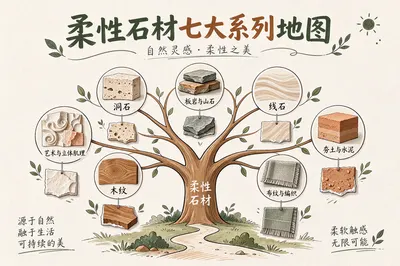
- Then determine the effect: which stone language is wanted? Travertine, slate, linear stone, rammed earth, fabric grain, wood grain or artistic texture.
- Finally determine thickness and batch: thickness is selected according to location and impact risk, and batch is determined by how many deliveries are made according to the construction schedule.
IX. Frequently Asked Questions
Is 3mm too thin, can it be pressed into an indentation with hands?Normal pressing will not cause indentation; it is a thin sheet with rigidity, but it cannot withstand concentrated impact. What really needs attention is edge and corner chipping during transportation and construction, as well as corner protection in high-impact areas.
Q2: How many years will outdoor use cause problems?Depends on the series, adhesive, and edge finishing method. Projects using an outdoor weather-resistant system (weather-resistant adhesive + waterproof edge sealing + drip detail) perform completely differently from indoor systems. Those that do not use this approach usually start lifting at the edges within two to three years.
Q3: How much can renovation of old walls save?What is saved is the three parts of demolition, debris removal, and leveling; the specific amount depends on the condition of the original wall and the floor level. When the substrate has severe hollowing, part of the savings will be consumed by substrate repair.
Q4: Why must the same wall be from the same batch?Raw materials and process parameters may differ slightly between batches of the same color number, and large continuous wall surfaces will amplify this difference into a "visible color band." Supplying from the same batch is the simplest solution.
Q5: How does it compare to wall fabric and wallpaper?They are not the same type of material. Wallcloth is a soft fabric with no stone texture, is not fire-resistant, and is not scrub-resistant; flexible stone is an inorganic powder composite finish with stone texture, can be classified according to GB 8624-2012, and is scrub-resistant. In commercial spaces, the two solve different problems.
Q6: What is the minimum bending radius for the curved surface?Related to thickness, series and ambient temperature: the thinner it is, the easier it is to bend; the more three-dimensional the texture, the harder it is to bend. Give the supplier a specific radius and sample requirement and have them verify with the actual product; this is more reliable than remembering a "minimum radius number."
Q7: Will the construction period affect other processes?It involves no wet work and does not generate large amounts of waste, causes little disruption to the site, and can even be carried out in parallel with other processes. But note: during adhesive curing, avoid dust and impacts, and finished-product protection still needs to be scheduled.
Q8: The client insists on "looking like real stone," can it be achieved?Printed series and high-precision series such as Super White Cave can achieve layered detail when viewed up close. But it must be stated in advance: the crystal translucency and random veining of natural stone cannot be reproduced. If you expect flexible stone to "completely replace" the up-close experience of natural stone, your expectations are set wrong.
Can we only use it locally and the rest use tiles?Yes, and this kind of mixing is very common in projects: use ceramic tile for large regular walls to control cost, and use flexible stone for curved surfaces, irregular shapes, terminations and feature walls. Note that the termination method at the junction must be decided in advance, and the thickness difference between the two materials must be drawn on the detail drawing.
Q10: How many years is the service life generally evaluated?Classify by working conditions: indoor conventional commercial walls can be assessed by reference to 10 years or more; outdoor applications are assessed according to the weather-resistant system's approach and the local climate, and the report basis is weather resistance testing. The service life of the adhesive and edge finishing should also be included in the assessment—what usually fails first is not the panel, but the adhesive and the finishing.
X. Further Reading
- What is IGOODS Flexible Stone? Full explanation of parameters and selection
- IGOODS Flexible Stone: how much per square meter? Price composition and pricing basis
- IGOODS Flexible Stone: how is it installed? Six steps for substrate, adhesive application and finishing
- How to choose between flexible stone and ceramic tile? Comparison of commercial wall weight, construction and maintenance
- How to inspect and accept flexible stone walls? Checklist for hollowing, joints, and color differences
- Analysis of the wall surfaces of about 1080㎡ Yunyan Sixteen Travertine guest room in a Hangzhou hotel
Related articles

IGOODS Flexible Stone: how is it installed? Six steps for substrate, adhesive application and finishing, and construction period (2026)
The wall installation process of IGOODS Flexible Stone can be summarized in s...

IGOODS Flexible Stone: how much per square meter? Price composition and pricing basis (2026)
IGOODS Flexible Stone has no "one-price-fits-all" because the unit price is j...

How is the quality of IGOODS Flexible Stone? Breakdown of five reports and seven types of complaints (2026)
To judge the quality of IGOODS flexible stone, do not look at promotional slo...
Complete list of IGOODS soft stone product models: seven major series, 35 sub-series and selection path (2026)
IGOODS Flexible Stone is currently organized on the official website product ...