
The tender terms for flexible stone cladding, it is not that the longer it is written, the better, but rather that each one can be verified. The only eight items that truly determine not to bicker after winning the bid are: product and standard, specification and thickness, combustion performance, weather resistance and adhesion, base conditions, sample and sealing, joint and node, acceptance and re-inspection. Only when all eight items are written, can the quotation be comparable; if one item is missing, the price difference will become a change order in the construction stage. This article only discusses the exterior wall section, and ground paving is not within the scope of application.
This article does not discuss the quality of materials, but only how to write clauses. The eight clauses are arranged according to the order of the bidding documents, each providing a direct copyable writing method, verification method, and the most common pitfalls; conversely, it can also be used as a bidder's response list - answer what the bidder asks according to these eight clauses. The three completed projects in the text come from the case records of this site, and the location, area, and methods can be checked item by item, without estimation, nor inferred from the photos.
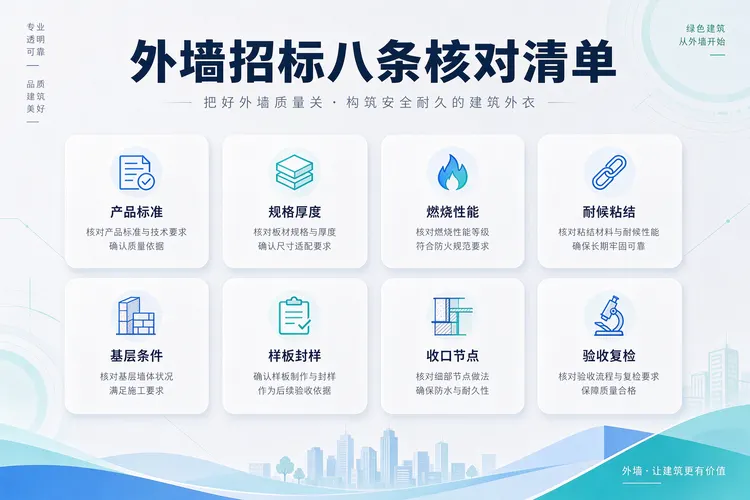
Figure: The eight-item check list for exterior wall bidding - product standards, specifications and thickness, combustion performance, weather-resistant adhesion, base conditions, sample sealing, closing nodes, acceptance and re-inspection.
1. Why are the terms for exterior walls harder to write than interior decoration?
I have seen a bidding document where the materials section only has three lines:
"Flexible stone, thickness 3mm, white, temporarily estimated 2000 ㎡."
These three lines cannot be verified. What standards, which model, what level of combustion performance, what adhesive to use, who does the base layer, how to seal the sample, how to receive the seam, how many samples to inspect - all are blank. The bid price ranges from 90 yuan/㎡ to 210 yuan/㎡, and the bidder does not even know where the more expensive one is more expensive.
Exterior wall is more difficult to write than interior decoration, for three specific reasons.
First, the exterior wall is an exposed surface. The same material can last for ten years indoors, but on the exterior wall, it has to face ultraviolet light, rain, freeze-thaw, salt mist, and temperature difference at the same time. These five types of stress do not appear separately, but will accumulate and amplify the weakest link in the system.
Second, the delivery of the outer wall is a system, not a single product. The panel is just the surface, with the base layer, adhesive layer, and edge sealing and dripping below. Any missing link will manifest as 'this panel is not good' when a problem occurs, but the real reason is often in the adhesive and sealing.
Third, the bidding language and material language are not on the same vocabulary list. The bidding habit is to write 'material name + thickness + color + area', while the material supplier is accustomed to seeing 'standard + model + inspection + base layer + adhesive + joint'. The missing words in the middle are exactly the source of all the disputes later on.
So the purpose of the terms is not to restrict bidders, but to anticipate the 'verifiable' matter. Below are eight items, each providing a write-up that can be directly copied into the bidding documents, why it should be written, how to verify, and the most common pitfalls.
Second, eight verifiable terms
Article 1 · Product Definition and Execution Standards
Term writing (can be directly quoted):
This material is a flexible artificial stone veneer material (commonly known as flexible stone or soft stone), in accordance with JG/T 540-2017 'Building Flexible Artificial Stone Veneer Material'. Bidders must provide an effective inspection report for the selected model, with the sample name, model, inspection items consistent with this project, and issued within the past three years.
Why write.Only write the four words "flexible stone material", which means allowing any imitative stone material to enter. On the market, PU stone skin, soft ceramic, PVC imitation stone sheet, and stone thin sections are all called "flexible stone material", and their structure, weight, construction method, and weather resistance performance are completely different. The standard number is the only field that can lock the category.
How to verify.Three matches: the bid model matches the report model; the report model matches the incoming batch; the report number can be verified with the testing institution. If one of the three is missing, this report cannot be used as the basis for this project.
Common pitfalls.Use the report of another model; the report has expired; only the manufacturer's brochure is given without the report; the test items in the report do not correspond to the requirements of this project.
Item 2 · Specifications, thickness and unit weight
Writing of clauses:
Standard thickness 2.3–2.8 mm, some series 3–6 mm, this project mainly promotes 3 mm; unit area weight about 3–7 kg/㎡; commonly used specifications 600×200, 600×1200, 1200×2400, 1200×3000 mm, custom-shaped according to layout drawing. Bidders must state the actual supply specifications and single weight in the quotation.
Why write.The thickness and weight directly determine three things: the base load, the amount of adhesive, and the transportation and hoisting methods. Lightweight partition walls, old walls, and thermal insulation walls for exterior wall cladding, the weight itself is the first threshold. The level of 3-7 kg/㎡ is the premise that it can be mounted on old walls.
How to verify.Inspection of thickness by micrometer; single piece weighing comparison - 600×1200 single piece about 2.5-2.8 kg, 1200×3000 single piece about 15-15.5 kg; specifications and terms on the delivery document are compared item by item.
Common pitfalls.Write only "3mm" without tolerance range; writing the actual order specification of a project (such as 1220×2930 mm) as a general specification leads to other bidders being unable to respond; not writing the weight of a single piece makes it impossible to calculate transportation and labor costs.
Article 3 · Combustion Performance
Writing of clauses:
The combustion performance grade shall be determined according to the fire protection design documents of this project. Bidders must provide an effective inspection report corresponding to the selected model, and the grade, model, inspection institution, and issuance date in the report must be verifiable; if a specific grade needs to be specified, it shall be clarified and written into the terms at the bidding clarification stage.
Why write.The exterior material must pass the fire inspection finally. If the grade is wrong by one position, it is not just a change of words that can pass, it needs to be dismantled, redone, and delayed.
How to verify.The report grade should be checked against the design documents item by item; the same model from different batches cannot share the same report; both the conclusion page and the detection item page should be checked.
Common pitfalls.Write "flame retardant" as a grade; one report for multiple models; only the acceptance slip of the testing institution is provided, no formal report is provided.
Article 4 · Weather resistance and adhesion
Writing of clauses:
Outdoor parts must use weather-resistant adhesives, and it is recommended to use full-adhesive construction. Bidders must provide explanations of outdoor application methods, adhesive model and supporting materials, and provide a list of completed projects in similar climate zones (including project name, area, and completion year).
Why write.Most outdoor wall projects that have problems within three years are not due to the panels, but to the adhesives and closures. Using indoor adhesive outdoors is the most common and often overlooked mistake, and the difference can be seen after a few winter and summer cycles.
How to verify.Record of adhesive model and batch number; whether the panel and adhesive are from the same factory; whether full-adhesive and rolling are recorded in the construction records; whether the project list can be visited.
Common pitfalls.In the quotation, no single adhesive is listed, the cheapest one is used during construction; dot or corner painting, forming an cavity in the middle; if the adhesive cannot be pasted within the open time, continue to paste.
Article 5 · Substrate conditions
Writing of clauses:
The substrates that can be constructed include cement mortar walls, concrete walls, gypsum board walls, light partitions and insulation walls. The flatness of the substrate is measured by a 2m ruler with an air gap ≤3 mm, no hollowing or sanding, and the moisture content meets the construction requirements of the adhesive. The leveling and repair of the substrate are responsible by ______, and the cost is included in ______ invoice.
Why write.Subgrade is unqualified, life starts decreasing from the first day. A more realistic reason is: This is the first dispute in the change of the external wall project - the material supplier thinks the subgrade belongs to the general contractor, while the general contractor thinks it belongs to the material subcontractor, and finally it becomes an account that is unclear.
How to verify.Subgrade acceptance form; scale inspection record; hollow knocking record; the old wall also needs a description of the attachment of the original finish.
Common pitfalls.Do not write "Who does the leveling"; treat the old tile surface, old paint surface directly as new wall; do not do interface treatment on the thermal insulation wall before pasting the board.
Article 6 · Sample and Sealing
Writing of clauses:
Within 7 days after winning the bid, complete the sample section, with an area of not less than 20 square meters, and it must include one reentrant angle, one obtuse angle, and one hole edge. The sample is sealed and kept until the project is completed after one year, signed by the construction, design, and supervision parties. Bulk supply is based on the sealed sample, and the same project uses the same batch number.
Why write.Disputes over color, texture, and seam width can only be resolved by physical objects, and can never be resolved by pictures. The color is no longer the original color after three processes: screen, lighting, and white balance.
How to verify.Sealed sample number and batch number; sealed sample retention record; side-by-side comparison of bulk delivery and sealed samples.
Common pitfalls.Only seal 10×10 cm small samples, it is not possible to see the texture scale and seam width; the sealed sample does not leave a record, there is no way to compare after completion; mixing different batch numbers is especially obvious in light colors.
Article 7 · Seams and Nodes
Writing of clauses:
The bidder must provide the five-node construction drawings for the concave angle, convex angle, door and window opening, eave (parapet), and deformation joint. The top of the outdoor wall is sealed, the bottom is dripping, and the corners are protected; the joint position should avoid the main line of sight direction and the opposite position of the human flow.
Why write.Water enters from the edge, and the damage starts from the edge. The top is not sealed, the bottom does not drip, and the rainwater will run along the back of the board, and then come back from the bottom, showing white and alkaline in the board joints.
How to verify.Are all five node diagrams complete; is the model section really constructed according to the diagram; and is there a condition for water spray observation when possible?
Common pitfalls.There are nodes on the diagram that are not done on the site; the eaves are only sealed and not drip-proof; the joints of the arched section fall exactly on the front-view direction at the street corner.
Article 8 · Acceptance and Reinspection
Writing of clauses:
The basis for acceptance is the effective inspection report of the selected model, the supply contract agreement, and the current standard of the project location. Hollowing, joints, color difference, and flatness are inspected according to the agreed proportion. A winter and summer reinspection is carried out for the first time after completion, and an annual check is carried out thereafter. Retain at least 3% of the same batch of boards as the total quantity, and not less than 10 square meters.
Why write.Not writing the acceptance standard, the final result can only be "looking okay". And "looking okay" is the least persuasive sentence at settlement.
How to verify.Inspection records; re-inspection reports; inventory list of backup boards and storage locations.
Common pitfalls.Not having backup boards, it is inevitable to have color differences when single blocks are replaced later; not writing the re-inspection nodes into the contract, no one will remember to check after a year; treating "visual acceptance" as the only acceptance.
In addition to Articles 3 and 8, three boundaries must also be written into the contract.
Boundary one, no absolute commitment."Never fall off" and "zero maintenance" such expressions cannot be written into technical clauses, and even if written, they cannot be implemented. executable methods are: construction in accordance with the weathering system, providing corresponding inspection materials, and agreeing on inspection nodes. Any absolute promise is unprofessional and cannot withstand the first year of inspection.
Boundary two: clarify the parts that are not applicable.Flexible stone is a wall material and is not recommended for ground paving. This sentence must be written; otherwise, later on, you will be required to "take care of the ground as well," and the reason for refusal will become an attitude problem rather than a technical problem.
Boundary three: write a clear responsibility interface.Who is responsible for materials, accessories, and construction; when does the warranty period start (upon arrival, completion, or acceptance); and who arrives first when a problem occurs. Without writing these three things down, no matter how long the warranty period is, it is meaningless.
Four: how do the clauses fall on the drawings of the three completed projects?
Clauses are abstract, and projects are concrete. The following three released cases correspond exactly to the clauses that are most difficult to write above.
First, the outer wall of the three-story commercial center (six facades).The main facade, corner oblique view, main entrance, street-side windows, square mass and night view of this project are divided into six schemes, among which the design of the curved corner, modular joints, outdoor weather-resistant glue and cleaning aperture are the focus. It corresponds to the 7th item - the joint position should avoid the direct line of sight of the corner; it also corresponds to the 4th item - the type and cleaning method of the outdoor glue must be specified in the terms. See the case in detail.White star moonstone Art Commercial Center facade.
Second, the roughly 2100㎡ rough rammed earth facade in Menghai, Xishuangbanna.Eight volumes are spread along the slope; the main entrance porch with four columns, the arched corner tower by the swimming pool, and the arched low wall on the terrace are all of the same color and pattern. This project simultaneously magnifies the pressure of items 2 and 6: the columns and the wall must be of the same batch number and color, and the arched sections must be bent and cut first. For details, see the case.Menghai Holiday Village about 2100㎡ rough rammed earth arched exterior wall.
The third is the Xi'an Chang'an Inn, with about 760㎡ of slate exterior wall.The key point is the junction between the large eaves and the two materials. The dripping water at the lower edge of the eaves, which material is on top of the other, and how much gap to leave at the junction, are all stipulated in advance by item 7. For details, see the case.Xi'an Chang'an Banyan Wall Guesthouse.
There is also a detail that deserves to be picked out separately: a hotel room project in Urumqi covering an area of about 1180 square meters, with an environmental humidity of about 20% and joints left according to 0.3 mm. This kind of direct rewriting of the environmental conditions into clause parameters is considered a merging method of the base and the environment - for dry areas, strong ultraviolet areas, and coastal high salt fog areas, the reserved joints and adhesive models of the same clause cannot be generalized. See the caseUrumqi Hotel Room Milky White Stone.
5. Where does the cost fall if the clause is written incorrectly
- Only the thickness is written, not the standard: Low-cost bidders will respond with thinner, cheaper materials, and after winning the bid, you cannot refuse receipt with 'does not meet requirements.'
- Do not write the fire rating: It was found to be non-compliant at the fire inspection stage, and the rectification cycle is usually measured in weeks, and who bears the cost is another round of controversy.
- Do not write the substrate attribution: The leveling cost becomes an additional item, and the amount is often more than the material itself.
- Do not write the sample sealing: There is no basis for the color dispute, and in the end, there are only two ways: rework or downgrade.
- Do not write the closing of the mouth: The eaves leakage is manifested as efflorescence and discoloration at the board joint in the second year, and the rework scope is larger than the original construction scope.
- Do not write the acceptance and backup board: The judgment of hollowing without evidence, single block damage cannot be repaired, only the entire surface can be evaluated.
The common point of these six is that they do not occur in the material itself, but in the places where "the clauses are not written". That is to say, these losses could have been avoided with a few lines of text in the bidding stage.
Six: Common Questions
Question one: Is it enough that the bidding document only writes "Flexible Stone 3mm White 2000 ㎡"?
Not enough. Six items are lacking: execution standards, requirements for inspection reports, substrate attribution, sealing system, closing nodes, acceptance and re-inspection. Without these six items, there is no comparability between quotations.
Are you definitely required to specify JG/T 540-2017?
This is the current industry standard for this type of material. The purpose of writing it in is to ensure that all bidders respond uniformly. If there is a more stringent local standard or special requirements in the design documents of the project location, the stricter one applies, and both bases should be listed at the same time.
Question three: Should the specific grade of combustion performance be written?
Write according to the requirements of the fire design documents. When the design documents are not explicit, write "Provide an effective inspection report for the selected model, and the grade should meet the requirements of the design documents." Do not specify a grade yourself.
Question four: Why is the emphasis on weather-resistant glue repeated?
Because it is the easiest way to save money and also the easiest to cause trouble. The indoor model and the outdoor weather-resistant model cannot be mixed, and the failure mode of using the wrong adhesive is "starting from the edge," and the edge is exactly where rainwater and stress arrive first.
Question five: If the project is an old wall renovation, how should the terms be added?
Add a separate item "Old base treatment", specifying the original surface type (tile, paint, stone), whether to remove, leveling method, responsibility for and cost of repairing hollow spots. The lifespan of the old wall depends on the old base, and if this item is not clear, all subsequent terms are based on an uncertain base.
Question six: How large should the sample section be?
At least 20 square meters, and it must include one concave angle, one convex angle, and one opening. Only sealing a small sample of 10×10 cm cannot show the texture scale, seam width, and edge reflection, which is equivalent to not sealing.
Question seven: How is the acceptance inspection ratio determined?
According to the current standards of the project location or the contract agreement; if there is no agreement, it is recommended to carry out vertical partition inspections, with at least 3 places in each area, focusing on checking hollowing, misalignment, seam width, and color difference.
Question eight: Why must the backup board be written into the contract?
Due to the inevitable slight color difference between batches, there are no identical backup boards, and replacing single blocks later on will definitely result in color differences. "This color is different" is the most difficult complaint to explain.
Question 9: How to ensure comparability of quotations?
The bidder is required to quote in six separate items: "materials, accessories, substrate treatment, sealing, transportation, and installation", rather than a comprehensive unit price. The difference in price is obvious when the six items are broken down.
Chapter 7: Further Reading
- Flexible stone product page: specification range, seven series, and selection entryBefore writing the terms, check the parameter range and series division to avoid writing the parameters of a specific model as a general value.
- Engineering case library: 124 records, 11 types of scenarios. Find completed projects of the same type and climate zone as the current one, as a reference for the "project list" in the terms.
- Selection Guide. There are dedicated sections in the guide for the individual practices of substrate, adhesive, junction, and acceptance.
- Contact Us. You need to calculate the quantity, quote, or request samples according to the project, and provide the location, net area, and construction period.
The purpose of the terms is not to keep bidders out, but to make the quotes comparable, construction with evidence, and acceptance with standards. If all eight are written, the bid document is mostly a page and a half; if not, it will take several months to make up for it later.
Write and review: Chengdu Igoods Technology Co., Ltd. Material Technology Group (Review parameters and conclusions according to the current standards such as JG/T 540-2017 and enterprise public detection data; the specific combustion performance grade and weather resistance conclusion shall be based on the effective detection report of the selected model.)
Previous:Is flexible stone durable and easy to clean - commercial wall maintenance test guide
Next:After delivery in one year, the six most easily remodeled wall sections
Related articles
Is flexible stone durable and easy to clean - commercial wall maintenance test guide
Whether flexible stone is durable and easy to clean depends on the specific s...
How a building materials company can establish a flexible stone product line - from selection to project completion
A building materials company should establish a flexible stone product line b...
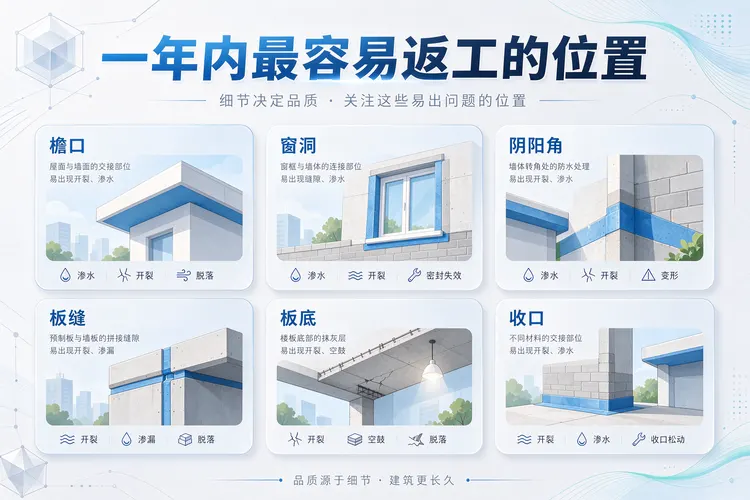
After delivery in one year, the six most easily remodeled wall sections
After the wall delivery in the first year, it is the twelve months with the m...

设计师最常被反问的八句话,每句该配哪张图
设计师提出用柔性石材,施工方通常会回八句话:太重、会掉、不能弯、缝难对、色差、工期、造价、没标准。这八句听起来像技术判断,实际上多数是经验判断——他们在别...