
After the first year of the wall delivery, it is the twelve months with the most concentrated problems. The reason is not that the material suddenly deteriorated, but that the first complete winter and summer cycle pushed out the hidden dangers in the nodes all at once: thermal expansion, damp expansion, structural micro-displacement, cleaning methods, all four things happening simultaneously. Six parts bear most of the rework - eaves, window openings, internal and external corners, board joints, bottom of boards, and joints with other materials. This article talks about how each part breaks, where the money for rework is spent, and what could have been avoided originally.
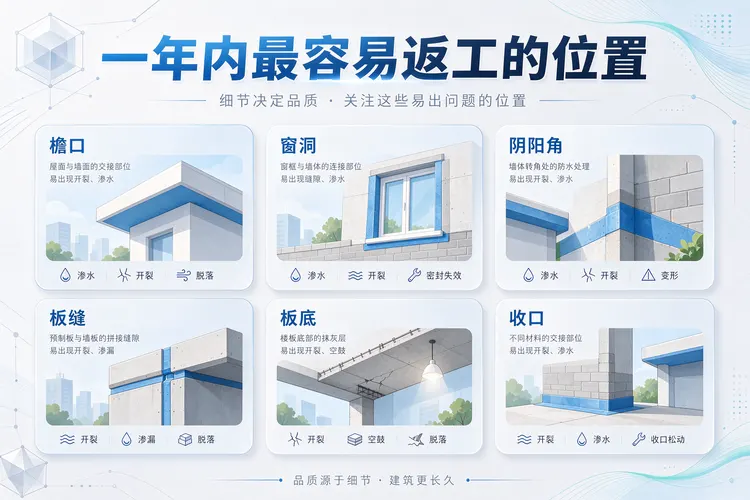
Figure: The most likely locations for rework in the first year after delivery - eaves, window openings, internal and external corners, board joints, bottom of boards, and closures, all six are on the boundaries.
1. Why do problems always concentrate in the first year?
The materials were qualified when they arrived, qualified when the construction was completed, and appeared qualified when delivered. The problem appeared after the first complete temperature cycle.
This system of thin plate bonding to the wall essentially involves the three layers of "plate + adhesive + base layer" working together. The thermal expansion coefficients of the three materials are different, and with each change in temperature, stress accumulates on the interface. Stress itself is not scary, what is scary is having no release path - and the release path all depends on joint reservation.
The first year is crucial because it includes all four seasons: summer high temperature, winter low temperature, plum rain or dry season. The gaps, adhesive layers, and closures are exposed once in each of these three environments. Anywhere that is insufficiently reserved will become apparent within that year.
There is still an easily overlooked factor: usage. Before delivery, the site is clean and careful; after delivery, it is pushing carts, cleaning, moving furniture, and opening windows for air circulation. The usage intensity suddenly rises in the first year, with the corners and bottom of the board being the first to be affected.
Secondly, six parts, six ways of deterioration
Eave.There are two ways of deterioration: the top edge is not sealed, and the rainwater flows along the back of the board; the bottom edge does not have a drip, and the water flows back up along the bottom of the board. It is manifested as the board seam whitening, efflorescence, and local color difference. These problems will not appear immediately, usually after the first rainy season.
Window opening.The corners of the opening are stress concentration points. The board joint falls at the corner or the top dead window frame, and the probability of corner cracking is the highest. It is manifested as fine cracks extending diagonally from the corner outward.
Yin and Yang corners.The top of the Yin corner is dead without leaving a gap, and it swells first when heated; the Yang corner is not protected, and the edge collapses after collision. These two bad methods are in opposite directions, but the root cause is the same: no displacement and protection space is left at the turning point.
Board joint.Insufficient joint width, insufficiently filled glue, or water entering the joint. It is manifested as blackening of the joint edge, glue strip separation, and local swelling. The board joint is the most easily ignored place, because it looks the most "neat" when completed.
Bottom of the board.Above the skirting board, near the ground water return height. This area is prone to dampness, especially after cleaning. When the bottom of the board gets damp, the adhesive layer fails from bottom to top, showing as hollowing.
The junction with other materials.The junction with wood veneer, metal plate, glass, and curtain wall. Such problems are often not due to material failure, but because it is not determined who takes over, and both sides do their own thing, leaving a gap that is neither aligned nor sealed.
The common point of the six methods of failure is that they are not in the center of the wall, but at the edge. The edge is the place where stress is most concentrated, and also the place most easily omitted in the drawings.
Part three: the real cost structure of a single rework.
The most easily underestimated aspect of rework is that it is never just "changing a few boards".
When accounting for projects, the cost of rework is usually composed of five components, and materials are often not the largest one.
- Demolition and removal: The existing surface needs to be demolished, the adhesive needs to be scraped, and the garbage needs to be transported. This part accounts for a high proportion in small-scale rework.
- Scaffolding or hoist: The exterior wall rework must be reconstructed, and the cost of one reconstruction is often higher than the cost of the materials themselves.
- Product protection.: The finished products around the rework area need to be covered and blocked, and commercial spaces also need to consider business hours.
- Second construction: The process includes base repair, interface treatment, reboarding, and re-gluing, with no steps omitted.
- Time costThis includes management fees, claims from Party A, and business losses caused by project delays, which are the most difficult to quantify and often overlooked.
Among these five areas, materials usually account for a small part, while the cost of measures and time cost account for a large part. This is why 'a little cheaper material' seems to save money, but it may not be the case: the saved material cost may be returned in full during the first round of rework, and additional measures fees may need to be paid.
A practical judgment: if the removal and measures fees for a rework exceed several times the material cost, then this part should not be handled in the 'just do it first' way. It must be done correctly in the first construction.
Four, the performance of three projects in the first year.
Urumqi hotel room, about 1180 square meters, with an environmental humidity of about 20%.This project leaves a gap of 0.3 mm on the joints, which is a relatively tight method. The moisture content of the board changes little in a dry environment, and the joints feel better when they are tighter. The premise is that the flatness of the subgrade is controlled well - the tighter the joints, the smaller the tolerance for the subgrade. There were no bulges at the edges of the joints in the first year of this project, indicating that "tight joints + high flatness" is a valid combination.
Menghai Resort, about 2100 square meters of rough rammed earth arched outer wall.Eight volumes spread along the slope, the main entrance porch with four columns, the arched corner tower by the poolside, and the arched low wall on the terrace are all the same color and pattern. The risks of the arched section are concentrated in two places: whether the trial bend is sufficient and how to deal with the joint between the arched and straight sections. This project first bends the arched plate and then cuts the material, leaving a unified gap at the junction, and the main problems in the first year were mainly local cleaning marks, not structural defects.
Xian Chang'an Inn, about 760 square meters of slate exterior wall.The key point is the junction of the eaves and the two materials. The dripping along the lower edge of the eaves, which material is on top, and the junction gap, these three things are decided before construction. The key to the stable performance in the first year is not the good selection of the board, but the fact that the eaves did not save any procedures.
The common conclusion given by the three projects: whether there is a problem in the first year has little to do with the board, but has a lot to do with whether the "boundary is made according to the drawing".
5. Comparison of preventive cost and rework cost
Preventive cost is visible and one-time: leaving more gaps, making more drips, more trial bends, and more sealing samples. These actions occur during the construction stage, and the cost is calculated in terms of "labor hours".
The rework cost is invisible and delayed: demolition, measures, protection, secondary construction, and time. These costs occur after delivery and are counted as "project" costs.
They are not on the same scale. Prevention is a few hundred yuan of labor hours, and rework is several ten-thousand yuan of measure fees, not to mention business losses and reputational losses.
This is also the easiest mistake that decoration companies make: cutting the preventive process during bidding, with a good bid price; in the first year after delivery, the rework is concentrated, profits are eaten, and after-sales labor is also incurred. On the surface, it won the bid, but actually lost the project.
A more practical approach: list the 'boundary process' as a separate item in the quotation, not included in the comprehensive unit price. After listing it separately, the party A can see where the money is spent, and the construction party does not have to use 'cost-saving process' to ensure profits.
6. Which repairs are inevitable, and which should not happen
Three categories of inevitable occurrences.
The first category is the color difference caused by material batch differences. There are inevitably slight differences between different batches, and light colors are especially obvious. Such problems cannot be solved by 'requiring suppliers to ensure consistency', but only by reserve boards. Keep reserve boards of the same batch not less than 3% of the total consumption and not less than 10㎡, which is the only feasible hedge.
The second type is damage caused by use. Pushing a cart into the corner, cleaning with strong alkali, and moving furniture scraping the surface. This type of damage is inevitable, and what can be done is to reinforce the vulnerable parts in advance and write the cleaning method into the delivery instructions.
The third type is the edge change caused by structural micro-displacement. The building itself has settlement and temperature deformation, and slight changes in the joints are normal phenomena and do not constitute quality defects. The judgment standard is whether it affects use and safety, not whether it is the same as at the time of delivery.
The three types that should not have occurred.
The first type, leakage and efflorescence caused by not doing the nodes. This is preventable and belongs to construction responsibility.
Second category, the blister caused by the top of the board being dead and not leaving a seam at the blind corner. This is also preventable and belongs to the error of the method.
Third category, misalignment caused by not determining the interface for the closure. This belongs to the management issue, not the material issue.
Three preventable issues, all occurring in the six parts mentioned in this article, and can all be solved with a node diagram before construction.
Seven or eight questions
Should the material supplier be responsible for the first-year renovation?
It depends on the reason for the renovation. Defects in the material itself (batch color difference, board cracking) are responsible by the material party; node methods, glue selection, and construction quality are responsible by the construction party. The responsibility interface should be clearly written in the contract, which is more effective than arguing after the event.
Why is the cost of redoing the exterior wall so much higher than that of the interior wall?
It's because of the measure fee. The exterior wall needs to be set up with scaffolding or hoists again, and the cost of one setup often exceeds the cost of the materials themselves. Interior wall redoing can use mobile scaffolding, which is one order of magnitude cheaper.
Is the blackening of the board joint a material problem?
Mostly not. Blackening is usually due to water seeping into the joint and accumulating dirt, or the sealant strip coming off. The root cause is the width of the joint and the quality of the sealant, not the board surface.
Can the broken edge of the corner be repaired?
It can be locally repaired, but the appearance after repair will be different from the original, especially obvious in light colors. A more stable approach is to do corner protection before delivery, blocking the damage on the corner protection.
How much reserve board should be left?
At least 3% of the total amount, and not less than 10 square meters. If less than this amount, the replacement of individual blocks later will basically not match the color.
Will the cleaning method affect the lifespan?
Yes. Strong alkalis, strong acids, and steel wool will all damage the surface treatment layer. It is much cheaper to provide a cleaning instruction at the time of delivery than to explain later.
If hollowing occurs in the first year, must it be completely removed and redone?
It may not be. First determine the scope: a single point of hollowing can be treated locally, and extensive hollowing requires assessment of the subgrade. The basis for judgment is the range of tapping and whether it is accompanied by cracking, not "it just looks uncomfortable".
How to minimize the cost of rework?
Three things: single quotation bidding for boundary processes, conduct a special boundary inspection before delivery, and leave enough reserve panels. The cost of these three things is low, but it can cover most of the first-year rework.
Supplementary: Three boundaries for rework determination.
The problems that occurred in the first year are not everywhere that need to be reworked. The determination needs to be divided into three levels.
The level that must be handled.: affects use and safety. The risk of hollow tiles, panel detachment, and water seepage causing damage to the base layer must be dealt with, and the sooner the better.
Record the level that does not need rework.: Affects the visual sense but within tolerance. Deviation of one or two millimeters in seam width, slight color difference locally, and slight wear at the edges should be recorded and included in the annual inspection, but there is no need to return for immediate work.
Does not belong to the first level of defects: Normal physical changes. Seam edges may change slightly with the seasons, and light-colored panels may have slight differences under strong light, which are normal reactions of materials to the environment and not quality issues.
When it is not clear between the three levels, there will be two extremes: either all small problems are treated as defects, and the cost of rework is out of control; or real problems are treated as 'normal', leading to major repairs.
Chapter 8: Extended Reading
- Flexible Stone Product Page: Specifications and series, when replacing panels for rework, first confirm whether the original model is still available.
- Engineering Cases Library: Find similar projects by part, focusing on the methods at the eaves, window openings, and arched junctions.
- Selection Guide: Single practice of base layer, adhesive, junction, and acceptance.
- Fact and Verification Page: Parameters and detection aperture, this is the standard for after-sales judgment.
- Contact page: Provide photos of the parts and the year of completion, and make an initial judgment of the reason for the rework.
Most of the rework in the first year is not because "the material is not good", but because "the boundaries are not done correctly". Get the six parts right once during the construction stage, which is more economical than repairing ten times after delivery.
Write and review: Chengdu Igoods Technology Co., Ltd. Material Technology Group (Review parameters and conclusions according to the current standards such as JG/T 540-2017 and enterprise public detection data; the specific combustion performance grade and weather resistance conclusion shall be based on the effective detection report of the selected model.)
Previous:外墙柔性石材招标技术条款怎么写:8 条可核验的参数与检测要求
Next:设计师最常被反问的八句话,每句该配哪张图
Related articles

外墙柔性石材招标技术条款怎么写:8 条可核验的参数与检测要求
外墙柔性石材招标技术条款怎么写:8 条可核验的参数与检测要求 外墙柔性石材的招标条款,不是写得越长越好,而是每条都能被核。真正决定中标后不扯皮的只有八条:...
Is flexible stone durable and easy to clean - commercial wall maintenance test guide
Whether flexible stone is durable and easy to clean depends on the specific s...

设计师最常被反问的八句话,每句该配哪张图
设计师提出用柔性石材,施工方通常会回八句话:太重、会掉、不能弯、缝难对、色差、工期、造价、没标准。这八句听起来像技术判断,实际上多数是经验判断——他们在别...

A 20,000 square meter hotel wall, from the sample to the site, nine nodes
A hotel wall project of about 2000 square meters, from the first trial to the...