
The project time is compressed by 30%, which is an instruction many projects receive after starting construction. The compression itself is not a problem, the problem is where to compress: compress coordination, compress the team, compress the process, the results will be completely different. There are four processes with physical lower limits, compressing them will not make it faster, but only move the time to the rework. This article provides the source of the lower limits of these four processes, as well as where the real time can be saved when compressing the project time.
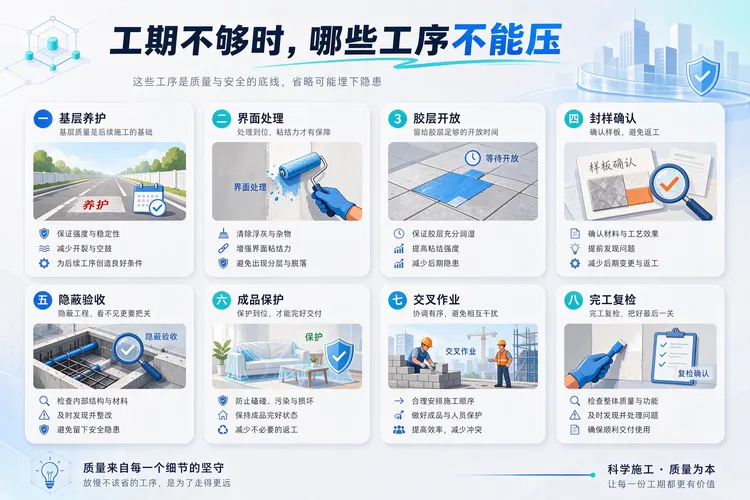
Figure: Which processes cannot be compressed when the project time is insufficient - grassroots maintenance, interface treatment, adhesive layer opening, sample confirmation, four processes have physical lower limits.
First, where is the project time saved from?
The time distribution of a wall project, usually not 'construction takes the lead.' According to experience, the time is roughly divided into three parts: preliminary confirmation, subgrade preparation, and actual panel installation.
Preliminary confirmation includes sampling, sealing, ordering, and production scheduling. This period of time consumption is mainly communication back and forth, not production. It is the most easily compressed and the most easily damaged - if the sample is not sealed, the order is placed, and then it is changed once, the whole batch needs to be remade.
Subgrade preparation includes leveling, maintenance, interface treatment, and layout. This section has a physical lower limit and cannot be pressed down.
In fact, the actual laying board, on the premise that the base is qualified and the materials have arrived, is the fastest among the three. The daily laying amount of a skilled team on the standard base is significantly higher than that of tile wet laying.
So the true conclusion is: if you want to save time, save it on the number of round trips in the confirmation stage; don't save it on the waiting time for the base and the adhesive. The former is a management issue, and the latter is a physical issue.
The physical limit of the second and fourth processes
The first process, base maintenance. Cement mortar base needs to be cured to meet the water content requirements for adhesive application, usually measured in days, not hours. If the base is not cured sufficiently, moisture will be sealed inside after the adhesive is applied, and it will burst from the inside after a few months. This lower limit cannot be bypassed by "adding adhesive" or "increasing pressure".
Second, interface treatment. After the primer is applied, it needs to dry to a state ready for application, the time depends on the product instructions and environmental temperature and humidity. In humid weather, this waiting period will be significantly longer. Skipping the drying process and directly scraping the adhesive will carry away the primer, which is equivalent to not doing anything.
Third, the adhesive layer opening time. After the adhesive scraper is applied to the wall, there is an operable window. If you paste beyond the window, the bonding strength will decrease. The length of the window is as specified in the product instructions and is obviously affected by temperature: the window is short when the temperature is high, and long when the temperature is low. The most common mistake when rushing to complete the work is to apply too much adhesive to one wall, and by the time you get to the end, the adhesive has passed the window.
The fourth step, sample confirmation. After the sample section is completed, confirmation is required, and a signature is needed. This section looks like 'waiting for someone,' but it is actually a project validation point. Skipping confirmation and proceeding directly with large-scale construction, if the color or seam width does not meet the expectations of the client, the scope of rework will be the entire batch.
Four lower limits, the first two are "equivalent materials", the third is "equivalent chemical processes", and the fourth is "equivalent people". Only the fourth can be shortened by advance arrangement, and the first three can only be shortened by improving conditions, not by accelerating the process.
Three, the process measurement of a through-height project
Banquet lobby project, about 1680 square meters, 8.9 meters in height, 12 columns. The time structure of this space is completely different from that of a conventional hotel room project.
The first constraint of the full-height space is the scaffolding or the hoist. The cost of setting up the frame once is very high, so all processes that require the frame to be set up must be completed at one time: preliminary inspection, leveling, alignment, laying boards, closing, acceptance. If any task is not completed, the frame is dismantled, and the next setup will be a duplicate cost.
The sequence of this project is: frame construction → comprehensive inspection and repair of the subgrade → alignment layout → test sticking a section to confirm the glue window → mass laying of boards → wrapping columns and closing → acceptance → dismantling.
Among the steps such as "try to stick a section", this is the most easily deleted when in a hurry. Its role is not to verify the materials, but to verify the actual rhythm of this team at the grassroots level: how long does it take to stick a board, how large an area can the glue scrape, and how many people need to cooperate. If this step is deleted, it may save a day in advance, but it may take three days more later.
The wrapping of 12 cylindrical columns is another timing point. The circumference of the column is divided according to the width of the board, and the material must be calculated accurately in one go; if one is wrong, the whole column needs to be redone. The material cutting time for wrapping cannot be pressed because it affects the accuracy.
Four, pressing the construction period and overtime team: two roads account
Faced with "compressing by 30%", there are usually two ways.
The first one, pressing the process. Eliminate maintenance, eliminate trial pasting, eliminate sample confirmation. On the surface, the time is shortened, but actually the risk is pushed forward. The cost structure of rework has been calculated in another article: materials only account for a small part, while measures and time account for the majority. The few days saved by compressing the process may be returned in weeks during rework.
Secondly, the overtime group. Increase the team under the premise that the grassroots level is qualified, and divide the working surface into several segments for parallel processing. This method can truly shorten the construction period, but there are three prerequisites: materials must be delivered in advance, the grassroots level must be transferred in advance, and the joints between segments must be able to be completed independently.
The cost of the second path is visible: more people, more equipment, more management. It is cheaper than rework and also more controllable than pressing the process.
To determine which path to take, look at one indicator: whether the bottleneck is in 'wait' or 'do'. If it's in 'wait', you can only improve the conditions or arrange in advance; if it's in 'do', you can work overtime. Treating 'wait' as 'do' to press is the most common mistake.
Three consequences of pressing too much.
Consequence one: hollowing occurs in the first year. The moisture content of the grassroots has not been reduced to the required level before the board is attached, and the steam is sealed inside. The manifestation is local hollowing, there is an empty sound when struck, and the scope will expand over time.
Consequence two: cracking at the edge. The adhesive has passed the open time and is still being applied, the bonding strength is insufficient, the board moves under temperature difference, and the edge joint is the first to crack.
Consequence three, color difference dispute. The sample confirmation was skipped, and after the bulk goods arrived, Party A did not recognize it. At this time, there is no sample for reference, and the dispute can only be settled through negotiation, and the result of the negotiation is usually to reduce the standard or return the work.
The common point of the three consequences is that they all appeared after delivery, and the responsibility was formed in the construction stage. When rushing to complete the work, no one thought they would have problems, and only when problems arise do they find that what was saved at the beginning was the "unsalvageable" few steps.
Six, the four actions that can really save time.
- Sample in advance. Place the proofing and sealing before the start of the project, so that it does not occupy the construction period.
- Transfer the subgrade in advance. Let the subgrade maintenance be completed before the materials arrive, and move the "wait" to before the construction.
- Materials arrive in batches. The first batch covers the first month's construction area, and subsequent deliveries are made according to the progress, reducing on-site material stacking and second-hand transportation.
- Separate the mouth and the main body for arrangement. The main body of the board and the mouth can be carried out in parallel by different groups, and the mouth does not occupy the main body construction period.
None of the four actions requires additional cost; you only need to adjust the sequence. The essence of project management is sequence management, not intensity management.
Seven or eight questions
To reduce by 30%, which section should be compressed first?
Compress the round trip at the confirmation stage, not the process waiting. The round trip is arranged in advance and all information is provided at once, and there is no alternative for process waiting.
Can basic maintenance use quick-drying materials?
You can use a quick-drying leveling material that meets the requirements, but you need to check the product instructions and test the moisture content, and you cannot judge "dry" by feeling.
How long is the open time of the adhesive?
According to the product instructions, it is affected by temperature. The open time is short in summer and long in winter. A small-area trial should be done on site to confirm the actual open time.
Can you wait for the substrate to dry while sticking?
No. Once stuck, the moisture cannot escape. The moisture content of the substrate must meet the standard before sticking the panel.
Will the overtime group affect the quality?
It will increase the difficulty of management, but it is more controllable than the pressing process. The key is to have clear sections, independent ends, and a dedicated inspector for each section.
Can the sample be replaced by a photo?
No. Photos are affected by lighting, white balance, and screen, and the color and texture do not match. The sample must be the physical product.
Where is most of the time spent on the tall building project?
On the frame. Frame assembly and dismantling take up the bulk, so all processes for putting up frames must be done in one go.
The construction schedule has been delayed; how can it be made up?
Conduct a risk inventory first: which processes were skipped, and which batches of materials were not sealed. What can be supplemented should be done immediately, and what cannot be supplemented should be recorded and encrypted for frequent re-inspection after delivery.
Supplementary: How to arrange the arrival time of materials
The arrival of materials is not "the earlier, the better." If it arrives too early, materials need to be stacked, protected, and transported twice, which will increase losses and occupancy of the construction period.
A reasonable arrangement is to cover the first month of construction with the first batch and follow up with construction sections. The role of the first batch is to keep the team busy and verify the consistency of batches; the role of subsequent batches is to reduce on-site stacking.
The production schedule should consider two quantities: the daily laying amount of the team and the available storage area on the site. If the two quantities do not match, there will be a situation where "material waits for people" or "people wait for material." The former is waste, and the latter is a halt in work.
There is also a detail: the production cycle of customized specifications is obviously longer than that of inventory. If the first batch is all customized, the work will have to wait. The common practice is to start with inventory specifications for the first batch, and then follow up with customized specifications.
Supplementary two: three kinds of conflicts in cross-operation
Wall construction is rarely carried out independently, and it must be cross-connected with ceiling, electrical and mechanical, doors and windows, and decoration. The three most common conflicts are:
The conflict between the upper and lower levels. Ceiling construction is above the wall, and falling dust will pollute the boards that have already been pasted. The solution is to do the wall first and then the ceiling, or to temporarily shield the wall.
Conflict on both sides. The installation of doors and windows and the wall joint are in the same position. The solution is to first determine the joint method, and then decide who will do it first.
Conflict in front and back. Painting and wall are in the same space, paint splashes will fall on the board surface. The solution is to stagger the time, or to paint first and then paste the board.
The essence of the three conflicts is an issue of sequence. The optimization of the working period of cross-work is not to have everyone come in at the same time, but to ensure that the sequence is not interrupted.
Supplement three: How to write a useful schedule.
The most common way to write a schedule is "one process per line, marked with start and end dates." This table can only show the plan, not the risks.
A useful schedule should have an additional column: prerequisites. Each process should clearly state "what must be completed before starting." For example, the prerequisite for pasting the board is that the base inspection is qualified and the materials have arrived; the prerequisite for sealing the sample is that the sample is completed and the three parties have arrived.
With this prerequisite column added, delays can be located: whether the process is slow or the prerequisites are not met. The solutions to both are completely different - the former requires overtime, and the latter requires coordination.
Further, assign a responsible person to each preliminary condition. The table becomes an executable coordination list, not just a nice Gantt chart.
A final reminder: The most important thing to clarify in the project schedule is not "when to start," but "what must be completed before starting." Clear preliminary conditions allow for identification of specific stages in delays; vague preliminary conditions lead to only one conclusion - "anyway, it's slow."
Chapter 8: Extended Reading
- Flexible Stone Product Page: Confirm the availability and customization cycle before production planning.
- Engineering Cases Library: Record the processes for high and curved project, which can be referenced for your own projects.
- Selection Guide: Single practice of base layer, adhesive, junction, and acceptance.
- Fact and Verification Page: Align capacity and delivery terms when compressing the project schedule.
- Contact page: Provide the area, location, and construction period, and make batch and process suggestions first.
The construction period can be compressed, but the sequence cannot be disordered. Move the "etc." to the front and keep the "do" at the back; only then can you really save 30% of the time.
Write and review: Chengdu Igoods Technology Co., Ltd. Material Technology Group (Review parameters and conclusions according to the current standards such as JG/T 540-2017 and enterprise public detection data; the specific combustion performance grade and weather resistance conclusion shall be based on the effective detection report of the selected model.)
Related articles

20GP or 40HQ: Three Arrangements and Breakage Rates of Flexible Stone Packing
Flexible stone cabinet, the most common question customers ask is "How many s...

How to unify the English naming of 'soft stone' or 'flexible stone' to avoid losing inquiries
The same product has three names in English: flexible stone, soft stone, and ...

A 20,000 square meter hotel wall, from the sample to the site, nine nodes
A hotel wall project of about 2000 square meters, from the first trial to the...

设计师最常被反问的八句话,每句该配哪张图
设计师提出用柔性石材,施工方通常会回八句话:太重、会掉、不能弯、缝难对、色差、工期、造价、没标准。这八句听起来像技术判断,实际上多数是经验判断——他们在别...