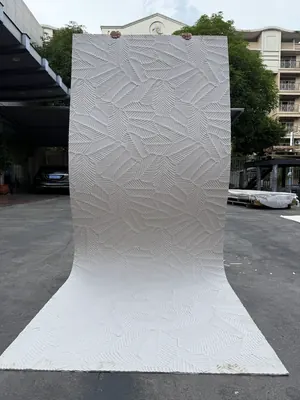
The positioning of this family in one sentence: we put the texture and workability of the Banana Leaf family into your hands together. Let's break it down below.
The positioning of this article is "selection accompaniment": it writes down the content of repeated conversations between sales and design before you open the product page.
Wall base, external corners, door edges—the trade jokingly calls these the "three exposed zones." Material selection at these three locations should prioritize hard edge protection: corner guards, metal trim, stone threshold. Sacrifice a little of the pure decorative look in exchange for three years without cracking or chipping.
Color map: naming them one by one
First list the family assets clearly. The table below shows the available colors in this family; click each row to view actual photos and specifications on the corresponding product page:
| Color/model | Main tone | Recommended scenarios |
|---|---|---|
| Light Gray Solid Banana Leaf | Light gray tone, soft and elegant | Homestays, hotels, themed spaces, boutique retail |
The quotation must be broken down to avoid being ripped off: material unit price, substrate treatment, auxiliary materials (adhesive, primer, edge trims), labor, loss, and transport and handling. If one of the six is missing, it may later become an added cost. For loss rate, 8%-12% for flat walls is the conventional range; curved surfaces, columns, and irregular patterns must be calculated separately by developed area.
Color has no good or bad; only placement
In tone, this family leans light gray, soft and elegant. When coordinating lighting, note that low illuminance will eat saturation, and dark colors should be expected another half level lower.
The logic of submission documents is "model corresponds to report." Combustion performance is classified according to GB 8624, and the sample name, specification, and production date in the test report must match the purchased model one-to-one. Using the report for model A to submit a project for model B, what is usually rejected is not the material, but the documents.
On the wall of our office, we have posted a photocopy of an acceptance form handwritten by the client, with worn edges. Not because the handwriting is beautiful, but because it was the only delivery where all three parties were present, signed off item by item, and no one argued.
The logic of facade waterproofing is "channeling is better than blocking": the finish layer prevents rainwater infiltration, while the structural layer must lead entering water out. With drip lines, flashing boards, and joint sealant all in place, the facade can truly face the heavy rain season.
Not one can be missing: the full model list
Naming every single one:
Light Gray Solid Banana Leaf Flexible Stone
Do not buy loose pieces on an ad hoc basis for patching: only the same project and same batch number is meaningful. Keeping reserve material in the project owner's warehouse is more useful than keeping it in the material supplier's warehouse; when replenishment is really needed, the sample in your hand is the matching voucher.
What it pairs most stably with
Combinations within the same line: arrange a dark and a light shade on the same wall; it is more enduring than a single color across the whole wall. Cross-line combinations: intersperse locally with other series from the same line at the wall base band or feature wall.
The most frequently asked questions about this family
Can banana leaf be used outdoors?
It can be used for exterior facades, but weather-resistant adhesive must be used and waterproof edge sealing must be done; it is not recommended for floors and areas subject to long-term water immersion. The specific model is subject to the scope of application in the test report.
Will banana leaf fade?
The finish has UV resistance requirements, and fading under normal outdoor use conditions is within a controllable range; for coastal projects with strong UV, it is recommended to add sample exposure comparison.
What is the minimum bending radius of banana leaf?
Related to thickness, substrate and backing; no uniform number is given. Use the on-site curvature to test-bend a sample; a conclusion can be reached in ten minutes.
Half the beauty of large surfaces comes from the seams. If the seam is too narrow, there is no allowance for thermal expansion and contraction; if too wide, the eye is drawn entirely to the line. A common practice in indoor dry areas is a tight seam or a 1–2 mm process joint; at curved surfaces and complex junctions, it is better to leave a seam for routing than to force the panels together. Whether the seam color uses same-color adhesive or a contrasting line is up to the designer.
Lighting and wall surfaces are a pair of co-conspirators. On the same panel, the texture becomes lighter under 3000K warm light, and under 4000K it is closest to the original appearance of the sample; when a spotlight grazes across it at an angle, the texture relief is most distinct. On the day of color selection, be sure to have the light aimed at the sample; the downlights in the showroom and the linear lights on site are often two different worlds.
Official positioning of banana leaf
The paragraph at the beginning of the series page — frankly speaking, it is written for those selecting materials:
IGOODS Banana Leaf Product Catalog, featuring 1 flexible stone product currently on sale; lists specifications and packaging parameters, materials and performance, and suitable applications item by item; also provides key points for material selection, differences from similar materials, and construction and acceptance parameters that can be checked on site. Free sample mailing and project quotations are supported.
Light Gray Solid Banana Leaf Flexible Stone
Product Quick Info Product Name: Light Gray Solid Color Banana Leaf Flexible Stone Brand: IGOODS Product Category: Flexible Stone Series: Art and Dimensional Textures Craft: Plant texture embossing Main Color Tone: Light gray tone, soft and elegant Texture Features: Banana leaf vein texture, with veins extending naturally and rich layering Recommended Scenarios: Homestays, hotels, themed spaces, boutique retail Main Application: Architectural walls Light Gray Solid Color Banana Leaf Flexible Stone belongs to the IGOODS Art and Dimensional Textures product line and is the branch of this line oriented toward "background and order." The visual expression is direct, suitable for interfaces where the material itself needs to become the design protagonist...
In actual projects, this positioning becomes three specific questions: how the lighting is done, what the wall is, and how often it is wiped.
When receiving goods, do one thing first: check the batch numbers on the back of the panels against the packing list. If batches are mixed, do not argue—take photos on the spot for the record and distribute the mixed-batch panels across different facades. The cost of remediation is far lower than shrugging at the acceptance site.
Two not-so-smart choices
This family fears two choices most: sealing the surface before the substrate is dry; and cutting panels for curved surfaces according to flat-surface habits, causing the lines to run crooked.
Three things separate a rendering from the real thing: vein density, seam method and gloss level. Stone-texture walls in rendering libraries are often 'density-amplified versions'; looking for materials by copying them directly will disappoint. The reliable path is to use the rendering to set the character, use samples to set specifications, and use a 1:1 sample wall to set final expectations.
When finishing pieces are used well, the facade grade immediately becomes stable. For supporting pieces such as corner pieces, skirting lines and door frame trim, whether the color follows the main surface or the floor must be finalized before ordering. The most common failure is that after the wall is finished, the line color is half a grade off, and patching either side looks bad.
The judgment sequence for wet-area walls (bathrooms, spas, pool surrounds) is: intact waterproofing layer → moisture-proof substrate → non-absorbent finish → dense joints. If all four pass, the finish is only the final layer of protection; if any one fails, no matter what is applied, problems will occur. The flexible finish itself does not absorb water, but it places higher demands on the honesty of the substrate.
Which scenarios banana leaf suits
The sweet spot for this family is surfaces that need stone texture but cannot bear heavy loads (curved walls, cylindrical columns, old walls, lightweight partition walls). Homestays, hotels, themed spaces, boutique retail
Up close and from a distance are two different things
The textures in this family share a common trait: a banana-leaf vein texture with naturally spreading veins and rich layering. So for large areas, control the density of repeating units; when the seams don't line up, no one praises it for looking like real stone—they only ask why it's crooked.
Taking "Light Gray Solid Color Banana Leaf Flexible Stone" as an example: banana leaf vein texture, with natural and flowing vein direction and rich layering. The same product will also show slight differences in depth when cut in different directions, so keep the direction uniform during layout.
The most valuable thing in construction organization is rhythm. Before the crew enters the site, the sample wall, layout marking, and material preparation should all be completed; the most commonly seen waste on site is boards not arriving, people waiting, and lights on. Organize transfer according to "materials never touch the ground," finish and clean the work area the same day, and the construction period will naturally be shortened.
The correct approach to knock and bump repair is to replace the panel rather than touch up the paint. Reserving 3%-5% spare material when ordering is for exactly this purpose: the real problem is when the replacement panel does not match the batch color difference. Spare material stored in the warehouse is much safer than loose panels left on site.
Several representative patterns
Finally, name a few items and look at the detail images of the individual products:
Light Gray Solid Banana Leaf Flexible Stone
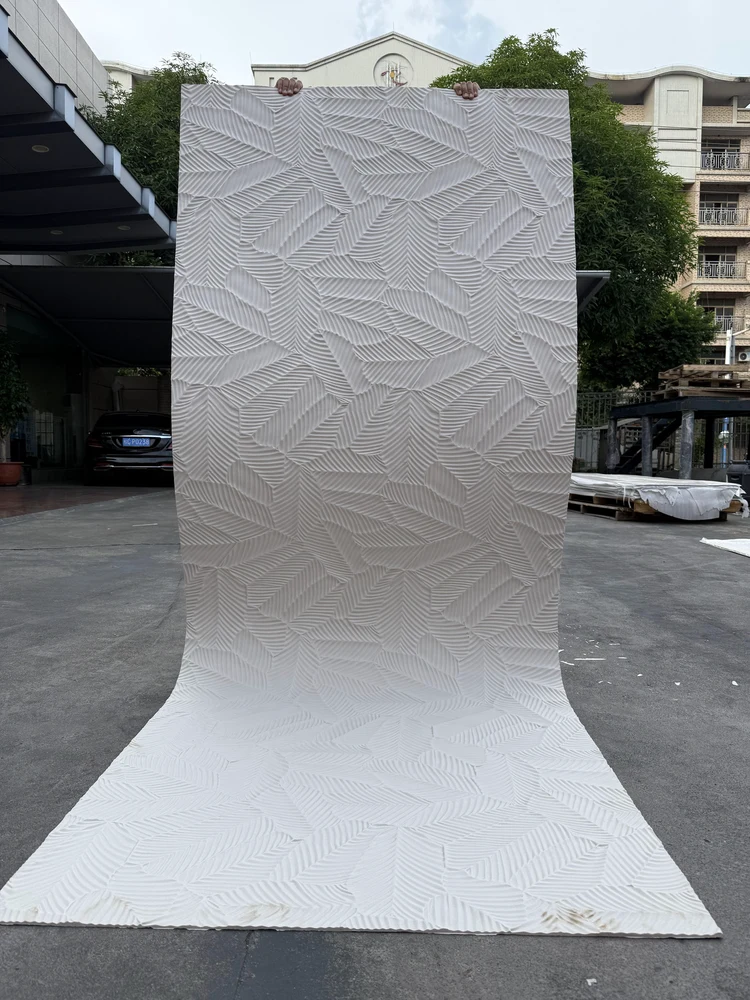
Banana leaf vein texture, with veins extending naturally and richly layered. Homestays, hotels, themed spaces, boutique retail.
Installation method for banana leaf on walls
The process is universal: substrate → setting out → bonding → finishing. But this family's temperament lies in the starting sequence of application.
How to read banana leaf parameters
Several points procurement friends care about: Waterproof and moisture-proof: the material does not absorb water, and the wall surface after installation is not prone to dampness or mildew; Substrate composition: composite of natural mineral raw materials and polymer flexible substrate, inorganic ecological material; Environmental performance: no added formaldehyde, asbestos-free, meeting the conventional environmental requirements for home and commercial decoration; Combustion performance: flame-retardant performance; the specific combustion performance grade is subject to the valid test report for the selected model.
Bending is not done at will. The material's bendable radius is related to thickness, backing and substrate stiffness; the consequence of forced bending is internal-stress spring-back — it sticks at the time, and half a year later the seams open up for you to see. Always test-bend at small-radius locations before ordering.
The six actions of wall application
There are not many steps, but every step has pitfalls previous crews have stepped into:
- Inspect goods upon arrival: panel back batch number, packing list, and condition of the four corners—sign only after all three are checked
- Three substrate checks: tap to check for hollow areas, use a straightedge to check flatness, use a moisture meter to check moisture content
- Setting out: snap lines according to the layout drawing; start points begin from internal corners or door centers
- Adhesive application and scraping: full scraping with a notched trowel, adhesive layer thickness according to instructions, do not skimp on that millimeter
- Wall application: lay from bottom to top, press and expel air immediately after each panel is applied, and wipe away squeezed-out adhesive as you go
- Closings: check internal and external corners, switch panels, and ceiling-floor junctions one by one; no further changes before acceptance.
Southern projects cannot avoid the returning humidity every April. The finish does not fear water; what it fears is water vapor bringing old substrate problems back to the surface: putty patched the previous year softens again in the moisture, and the panels attached to it bulge along with it. For new installations, dry the substrate to the standard moisture content; for renovation projects, conduct a humidity survey first.
There are three types of people at the review meeting: designers look at seams and edge finishing, procurement looks at waste and material preparation, and foremen look at rhythm and handling. The same on-site video shows completely different problems to each of the three—which is also why internal reviews must have all three roles present.
The three documents commonly required for project submission: fire performance, environmental limits, and physical performance. The three reports correspond to three standards systems; write the report numbers and models into the same ledger, and the submission desk will not ask you to supplement them a second time.
Neighbor series overview
Different solutions for the same wall are actually all in this series table:
| Same-door series | Listed colors |
|---|---|
| Slate | 29 models |
| NanDaoSuiYueHen | 3 models |
| Cloth texture stone | 4 models |
| New Line Stone | 7 items |
| Nebula Stone | 3 models |
| Daxingyue | 2 models |
| Wood-grain board | 6 styles |
| Wood-grain cement board | 1 model |
| bush-hammered granite | 33 models |
When different series are on the same order, unify the color of edge trims to the main series.
The key to panel logistics is "panels never touch the ground." Each additional transfer from truck to work surface increases the probability of edge chipping. Project entry conditions (freight elevator dimensions, corridor corners, elevator lobby height) must be reported to the loading coordination before ordering. Large panels such as 1220×2930 are as good as not allocated if they cannot fit into the elevator.
Lightweight partition walls are the most common problem type in commercial space renovation. Substrates such as gypsum board and calcium silicate board have limited load-bearing capacity themselves; traditional stone on walls either requires reinforcement or dry hanging, and both cost and thickness remain high. Thin flexible finishes use the full-bonding route, with unit dead weight controlled at the level of a glass of water; lightweight walls can achieve a stone texture without major work, which is why it is singled out.
Read this before sending samples
Do not skip the sampling step. For curved projects, be sure to bend the sample once to the corresponding radius; the rebound photo will speak for itself.
Related entrances
Single-product file continued: Banana Leaf registered colors supplementary images
Light Gray Solid Banana Leaf Flexible Stone
Product Quick Info Product Name: Light Gray Solid Color Banana Leaf Flexible Stone Brand: IGOODS Product Category: Flexible Stone Series: Art and Dimensional Textures Craft: Plant texture embossing Main Color Tone: Light gray tone, soft and elegant Texture Features: Banana leaf vein texture, with veins extending naturally and rich layering Recommended Scenarios: Homestays, hotels, themed spaces, boutique retail Main Application: Architectural walls Light Gray Solid Color Banana Leaf Flexible Stone belongs to the IGOODS Art and Dimensional Textures product line and is the branch of this line oriented toward "background and order." The visual expression is direct, suitable for interfaces where the material itself needs to become the design protagonist. As a background interface, it has a low presence, making it easy to let the visual focus go to furnishings and lighting,...