Cement casting board seems to have many patterns, but the real selection logic is only two or three points. Compress 2 SKUs into three questions, and the answer emerges.
To be clear on the basis for the parameters first: all values in this text come from the product file; combustion performance and environmental ratings are subject to the valid test report for the corresponding model.
The essence of layout is to avoid narrow strips. If, after aligning panels to the end, a narrow strip of less than 20 cm appears, cutting waste and edge chipping risk will soar. A mature layout method is to place the starting point at an inconspicuous internal corner, leave full panels for the first sight line when entering, and hide cuts behind furniture. The joint positions on the drawings should be checked against the soft furnishing points in advance.
Light and dark pairing within the same color family is safer than contrasting colors. For example, within the same stone family, choose one shade darker for the wall base band and one shade lighter for the main surface; this creates layering with less risk—this is exactly the purpose of color families.
Color map: naming them one by one
The color map for this family, arranged by dominant hue:
| Color/model | Main tone | Recommended scenarios |
|---|---|---|
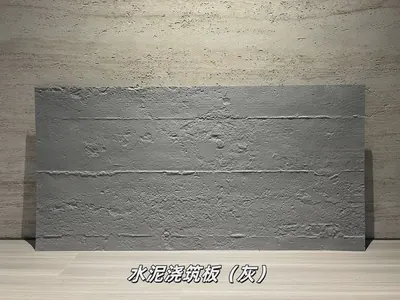
| Gray Cement Cast Board | Neutral gray tone, with natural light-to-dark transitions | Industrial-style commercial spaces, coffee shops, showrooms, office spaces |
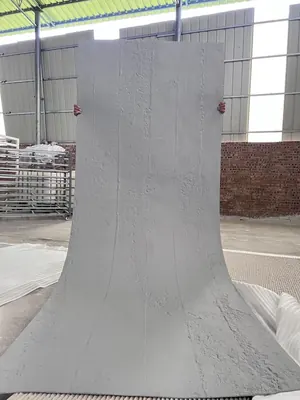
| White solid-color cement cast panel | Light white tone, clean and bright | Industrial-style commercial spaces, coffee shops, showrooms, office spaces |
Lightweight partition walls are the most common problem type in commercial space renovation. Substrates such as gypsum board and calcium silicate board have limited load-bearing capacity themselves; traditional stone on walls either requires reinforcement or dry hanging, and both cost and thickness remain high. Thin flexible finishes use the full-bonding route, with unit dead weight controlled at the level of a glass of water; lightweight walls can achieve a stone texture without major work, which is why it is singled out.
The three colors asked about most often
In tone, this family leans neutral gray, with natural light-to-dark transitions; light white tone, clean and bright. When coordinating lighting, note that the deeper the texture, the more it fears uniform lighting—once flattened, it no longer looks good.
The most time-saving opening for a client meeting is three questions: what do you want people to see on this wall, what actions do people take by the wall, and how often is it cleaned. Once these three questions are answered, the budget range and material list basically converge.
The most valuable thing in construction organization is rhythm. Before the crew enters the site, the sample wall, layout marking, and material preparation should all be completed; the most commonly seen waste on site is boards not arriving, people waiting, and lights on. Organize transfer according to "materials never touch the ground," finish and clean the work area the same day, and the construction period will naturally be shortened.
Specifications and materials, cover the key points
The parameters are not exaggerated; everything that can be verified is on the product page. A few key points: combustion performance: flame-retardant performance; the specific combustion performance grade is subject to the valid test report of the selected model; waterproof and moisture-proof: the material does not absorb water, and the wall is not prone to dampness or mildew after construction; environmental performance: no added formaldehyde, no asbestos, meeting conventional environmental requirements for home and commercial decoration; base material composition: composite of natural mineral raw materials and polymer flexible base material, an inorganic ecological material
Track lights are movable, so they are standard in showrooms and retail; but if the track position happens to press on the veneer seams, moving them will expose old holes. Mark the track lines in the drawing in advance during layout. This detail rarely appears in drawings, yet often appears in repair orders.
Cement casting board frequently asked questions
What is the minimum bending radius of cement casting board?
Related to thickness, substrate and backing; no uniform number is given. Use the on-site curvature to test-bend a sample; a conclusion can be reached in ten minutes.
Will cement casting board fade?
The finish has UV resistance requirements, and fading under normal outdoor use conditions is within a controllable range; for coastal projects with strong UV, it is recommended to add sample exposure comparison.
Can cement casting board be used outdoors?
It can be used for exterior facades, but weather-resistant adhesive must be used and waterproof edge sealing must be done; it is not recommended for floors and areas subject to long-term water immersion. The specific model is subject to the scope of application in the test report.
Walls in dark-scene spaces (cinemas, bars, clubs) absorb light severely. Dark colors will appear one level darker under low illuminance. To achieve the effect of "texture visible but material boundaries not visible," it is often necessary to choose a color number half a level lighter than the target color, or embed a wall-washing light at the finishing edge.
Walls in hotel public areas have a hidden KPI: they should photograph well and not retain traces of guest behavior. Luggage knocks in the lobby, leaning in elevator halls and dragging in corridors all test the 0–900 mm section at the base of the wall. Choosing the right materials and closures for this section can cut the property management repair requests in half.
Real-world records are more honest than specifications
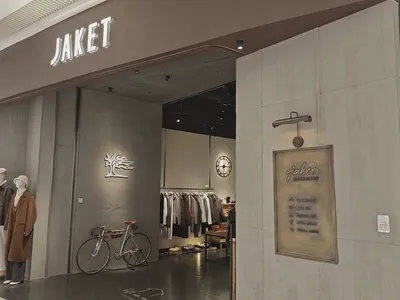
The following cases all use this family, with different areas, locations, and lighting conditions, making them a good reference set:Industrial-style esports hotel (guest rooms + public corridors) 1000㎡ water; Clothing store 200㎡ cement cast board (gray) wall construction case
What else is in the same product line
Different solutions for the same wall are actually all in this series table:
| Same-door series | Listed colors |
|---|---|
| Slate | 29 models |
| NanDaoSuiYueHen | 3 models |
| Cloth texture stone | 4 models |
| New Line Stone | 7 items |
| Nebula Stone | 3 models |
| Daxingyue | 2 models |
| Wood-grain board | 6 styles |
| Wood-grain cement board | 1 model |
| bush-hammered granite | 33 models |
When different series are on the same order, unify the color of edge trims to the main series.
The temperament of the texture
The textures in this family share a common trait: cement-pouring trowel marks and fine air pores with an obvious industrial feel. So for large areas, control the density of repeating units; when the seams don't line up, no one praises it for looking like real stone—they only ask why it's crooked.
Taking "White Solid-Color Cement Cast Board Flexible Stone" as an example: cement casting trowel marks and fine air pores, with an obvious industrial feel. The same product may show slight differences in shade depending on the cutting direction; keep the direction consistent during layout.
When finishing pieces are used well, the facade grade immediately becomes stable. For supporting pieces such as corner pieces, skirting lines and door frame trim, whether the color follows the main surface or the floor must be finalized before ordering. The most common failure is that after the wall is finished, the line color is half a grade off, and patching either side looks bad.
The six standard actions of this family
The standard procedure for this family, in six steps:
- Inspect goods upon arrival: panel back batch number, packing list, and condition of the four corners—sign only after all three are checked
- Three substrate checks: tap to check for hollow areas, use a straightedge to check flatness, use a moisture meter to check moisture content
- Setting out: snap lines according to the layout drawing; start points begin from internal corners or door centers
- Adhesive application and scraping: full scraping with a notched trowel, adhesive layer thickness according to instructions, do not skimp on that millimeter
- Wall application: lay from bottom to top, press and expel air immediately after each panel is applied, and wipe away squeezed-out adhesive as you go
- Closings: check internal and external corners, switch panels, and ceiling-floor junctions one by one; no further changes before acceptance.
The logic of submission documents is "model corresponds to report." Combustion performance is classified according to GB 8624, and the sample name, specification, and production date in the test report must match the purchased model one-to-one. Using the report for model A to submit a project for model B, what is usually rejected is not the material, but the documents.
Full list of registered cement casting boards
Naming every single one:
Gray Cement Cast Board Flexible Stone, White Solid Color Cement Cast Board Flexible Stone
The origins of this family
First put the official scope on the table, then give my understanding:
IGOODS Cement Cast Board Product Catalog, featuring 2 flexible stone products currently on sale; lists specifications and packaging parameters, materials and performance, and suitable applications item by item; also provides key points for material selection, differences from similar materials, and construction and acceptance parameters that can be checked on site. Free sample mailing and project quotations are supported.
Gray Cement Cast Board Flexible Stone
Product Quick Info Product Name: Gray Cement Pour Board Flexible Stone Brand: IGOODS Product Category: Flexible Stone Series: Rammed Earth and Cement Craft: Cement pour texture Main Color Tone: Neutral gray tone, with natural light-dark transitions Texture Features: Cement pour trowel marks and fine air pores, with pronounced industrial texture Recommended Scenarios: Industrial-style retail, coffee shops, showrooms, office spaces Main Application: Architectural walls Gray Cement Pour Board Flexible Stone belongs to the IGOODS Rammed Earth and Cement product line and is the branch of this line oriented toward "background and order." It follows an industrial and local-sense route, suitable for spaces with weak decoration and strong atmosphere....
White solid-color cement cast panel flexible stone
Product Quick Info Product Name: White Solid Color Cement Pouring Panel Flexible Stone Brand: IGOODS Product Category: Flexible Stone Series: Rammed Earth and Cement Craft: Cement Pouring Texture Main Color Tone: Light White Tone, Clean and Bright Texture Features: Cement Pouring Trowel Marks and Fine Air Pores, Obvious Industrial Texture Recommended Scenarios: Industrial-Style Commercial, Coffee Shops, Showrooms, Office Spaces Main Application: Building Walls White Solid Color Cement Pouring Panel Flexible Stone belongs to the IGOODS Rammed Earth and Cement product line and is the branch of this product line leaning toward "pure color and enduring appeal." It follows an industrial and local-feel route, suitable for spaces with weak decoration and strong atmosphere...
In actual projects, this positioning becomes three specific questions: how the lighting is done, what the wall is, and how often it is wiped.
The packing plan for whole-cabinet transport affects on-site loss. Wooden crates placed upright and laid flat have different rates of edge damage; the last mile from project port to site (mountain roads, ferries, manual handling) must be clarified in advance, and packaging strength should be set according to the worst section of the route.
The process is universal, the temperament is individual
The process is universal: substrate → setting out → bonding → finishing. But this family's temperament lies in number management.
Give a definite answer by business type
By business type: for food and beverage, set the tone at the reception backdrop and meeting area; for workstation areas, control glare; for accommodation, the bar counter facade and entrance are the face-giving spots, so keep texture density sparse rather than dense; for retail and office, there are many large surfaces and long circulation routes, so layout and numbering management take more effort than the material itself.
The cavity treatment behind the finish affects the acoustic perception more than the finish itself. For spaces that need quiet, fill the cavity with sound-absorbing cotton according to the drawings; where sound absorption is not needed, sealing the cavity to prevent resonance is sufficient. If this step is not done before closing the panels, it can only be remedied later at extra cost.
The quotation must be broken down to avoid being ripped off: material unit price, substrate treatment, auxiliary materials (adhesive, primer, edge trims), labor, loss, and transport and handling. If one of the six is missing, it may later become an added cost. For loss rate, 8%-12% for flat walls is the conventional range; curved surfaces, columns, and irregular patterns must be calculated separately by developed area.
The correct approach to knock and bump repair is to replace the panel rather than touch up the paint. Reserving 3%-5% spare material when ordering is for exactly this purpose: the real problem is when the replacement panel does not match the batch color difference. Spare material stored in the warehouse is much safer than loose panels left on site.
Name and explain in detail
Pick three options and take a close look:
White solid-color cement cast panel flexible stone
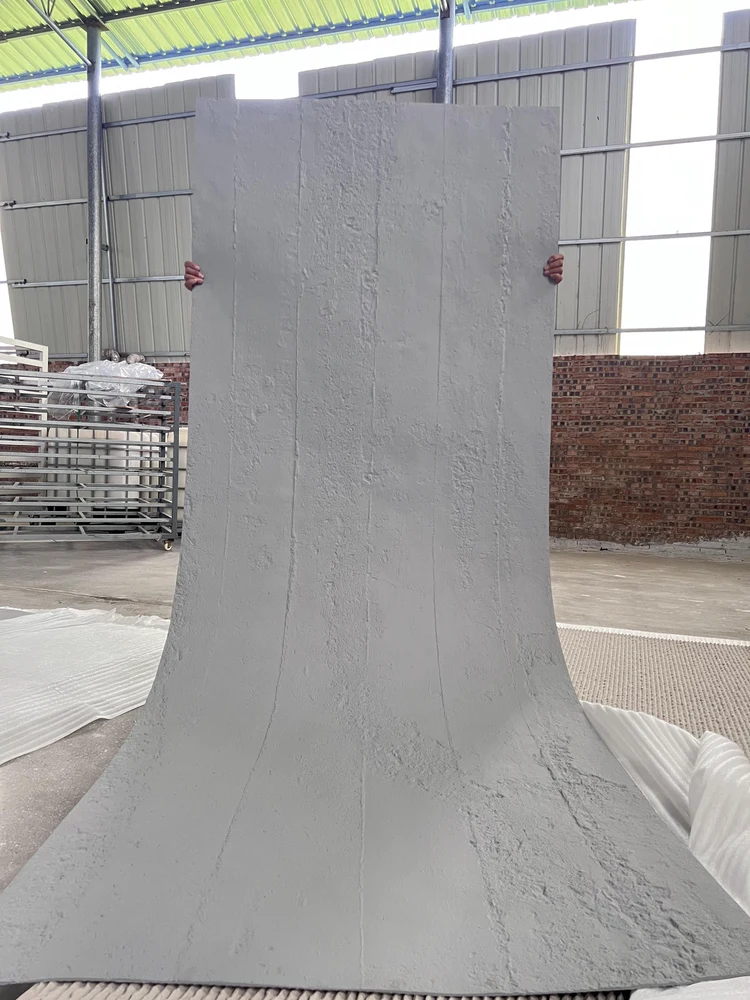
Cement casting batch marks and fine air pores, with an obvious industrial texture. Industrial-style commercial spaces, coffee shops, showrooms, office spaces.
Gray Cement Cast Board Flexible Stone
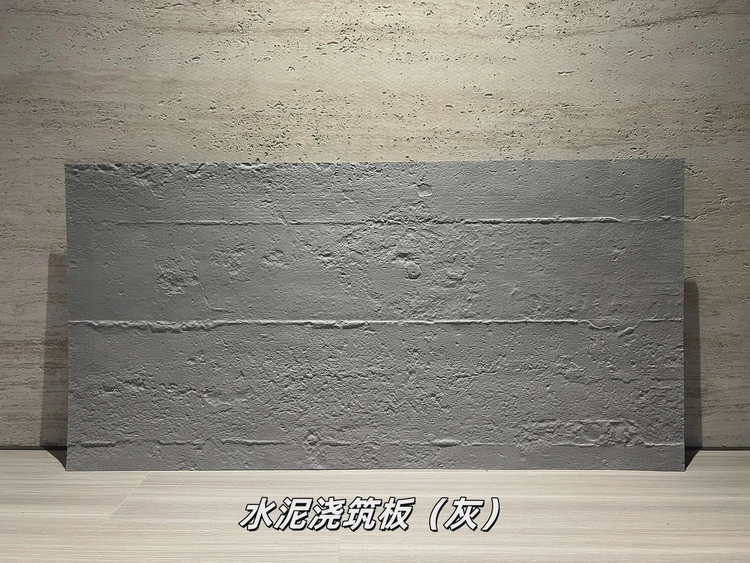
Cement casting batch marks and fine air pores, with an obvious industrial texture. Industrial-style commercial spaces, coffee shops, showrooms, office spaces.
The two selection methods cement casting board fears most
Mistake one: curved surfaces are cut according to flat-surface habits, and the lines run crooked. Mistake two: the surface is sealed before the substrate is dry. I have seen on-site rework for both.
Sampling suggestions for cement casting board
Before finalizing this family, it is recommended to request three or four candidate options together and compare them on the wall. The reason is simple: the on-wall effect depends on the substrate, not on the photo album
What it pairs most stably with
Combinations within the same line: arrange a dark and a light shade on the same wall; it is more enduring than a single color across the whole wall. Cross-line combinations: intersperse locally with other series from the same line at the wall base band or feature wall.
Related entrances
Reference to real projects in this series · Cement cast panel group
Industrial-style esports hotel (guest rooms + public corridors) 1000㎡ cement-cast panel wall surface
Dujiangyan City, Sichuan Province, 1000㎡, industrial-style e-sports hotel. Photo record: e-sports bedroom, gray curved wall, bed and blue lighting; two-person computer area, gray textured wall and colored linear lighting; bar area, gray curved counter body and e-sports theme signage. Ledger figures: number of guest rooms: 30; single room dimensions: 4.2m × 7.0m, floor height 2.8m; single room wall gross area: about 62.7㎡.
Clothing store 200㎡ cement cast board (gray) wall construction case
Nanning City, Guangxi Zhuang Autonomous Region, 200㎡, clothing background wall. On-site record: clothing store entrance, gray finish wall and store name sign; close-up of gray facade corner; clothing store sign wall, gray facade and decorative bicycle. Ledger figures: net installation area: on-site measurement; material preparation area: 200 × (1 + 12% loss); substrate treatment: leveling, patching, primer.
Related articles
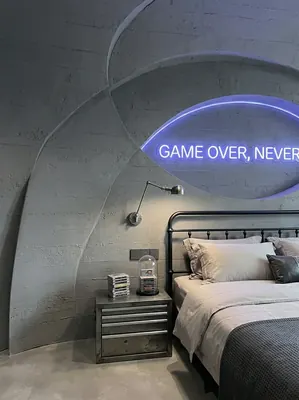
Industrial-style esports hotel (guest rooms + public corridors) 1000㎡ cement-cast panel wall surface construction case
IGOODS provided cement cast panels flexible stone as wall material for guest ...
Gray Cement Cast Board Flexible Stone
Gray Cement Cast Board is a flexible stone in the Rammed Earth and Cement ser...
White solid-color cement cast panel flexible stone
White solid-color cement cast panel flexible stone is a solid-color flexible ...
Clothing store 200㎡ cement cast board (gray) wall construction case
The clothing store project is located in Nanning City, Guangxi Zhuang Autonom...
cases related
Industrial-style esports hotel (guest rooms + public corridors) 1000㎡ cement-cast panel wall surface construction case
IGOODS provided cement cast panels flexible stone as ...
View cases →
Clothing store 200㎡ cement cast board (gray) wall construction case
The clothing store project is located in Nanning City...
View cases →