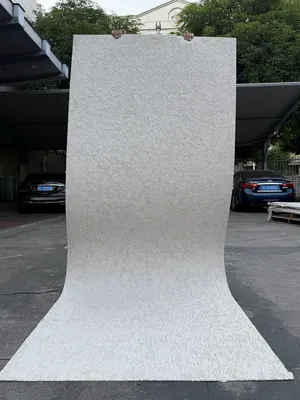
It is the same flexible stone, so why do some people achieve a premium look with coarse fabric texture while others end up looking cheap? The difference is mostly not in the material, but in how it is selected.
The writing follows the decision order of a real project: first the positioning, then the character, and finally the implementation.
1 color per page completed
The color map for this family, arranged by dominant hue:
| Color/model | Main tone | Recommended scenarios |
|---|---|---|
| Light gray solid-color coarse linen texture | Light gray tone, soft and elegant | Homestays, hotels, leisure retail, office spaces |
For projects under construction while still operating, the time window matters more than labor hours. For night work sections, coordinate noise timing, freight elevator use, and fire access occupation with property management in advance. These coordination items cannot be scheduled into the process table, but they can determine whether the entire project is delivered several days late.
The use of dehumidifiers on the construction site is the best value-for-money measure in concealed works. Especially in underground and semi-underground spaces, running dehumidification for two extra weeks during construction can avoid 80% of hollowing disputes after delivery.
Frequently asked questions about coarse cloth texture
What is the minimum bending radius of coarse cloth texture?
Related to thickness, substrate and backing; no uniform number is given. Use the on-site curvature to test-bend a sample; a conclusion can be reached in ten minutes.
Can coarse cloth texture be used outdoors?
It can be used for exterior facades, but weather-resistant adhesive must be used and waterproof edge sealing must be done; it is not recommended for floors and areas subject to long-term water immersion. The specific model is subject to the scope of application in the test report.
Will coarse cloth texture fade?
The finish has UV resistance requirements, and fading under normal outdoor use conditions is within a controllable range; for coastal projects with strong UV, it is recommended to add sample exposure comparison.
Main color patterns one by one
Some patterns must be seen in images to get a feel for them. Here are three:
Light gray solid-color coarse linen texture flexible stone
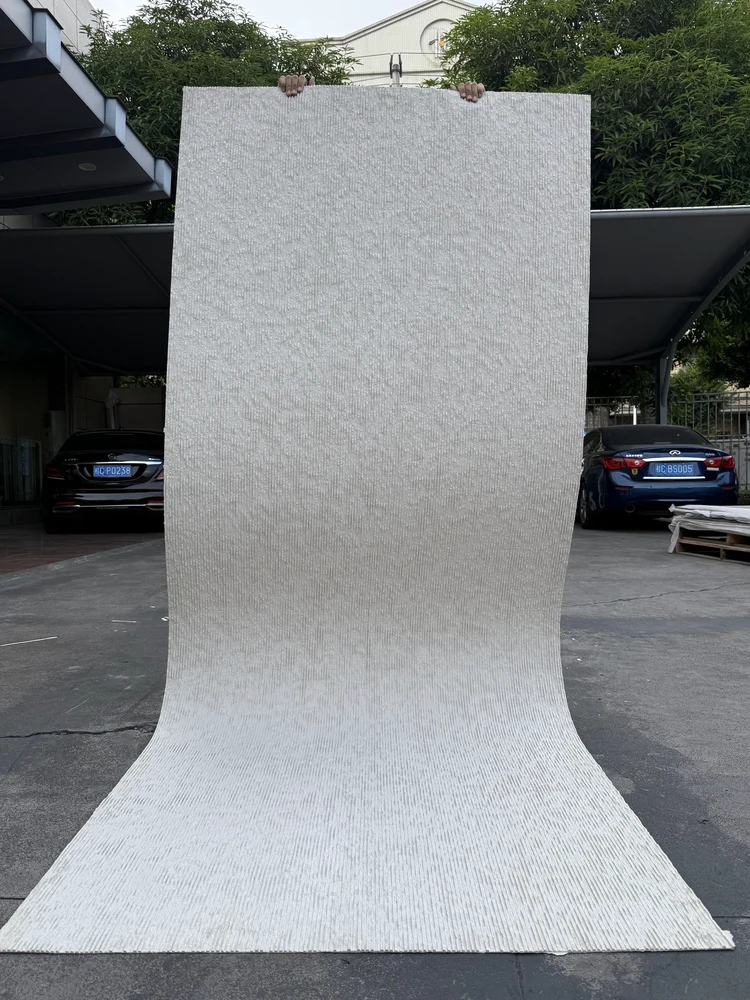
Coarse woven fabric texture, with rugged warp and weft, and obvious tactile and visual layering. Homestays, hotels, leisure commercial spaces, office spaces.
Chipped edges, small bubbles and scratches: transport and installation each account for half the responsibility. If protective corners are not installed properly on panel edges, the shipment arrives with burrs all over; one extra reminder during unloading can save half a day of haggling at acceptance.
The process is universal, the temperament is individual
In construction, the key to large surfaces with this thin-material family is "panels never touch the floor": fewer transfers mean fewer chipped edges. Use a table saw or angle grinder with a straightedge for cutting, and direct the cut edge toward the seam.. Do not copy other companies' detail drawings; if the mock-up wall is not made, there will inevitably be arguments over the large surface.
When finishing pieces are used well, the facade grade immediately becomes stable. For supporting pieces such as corner pieces, skirting lines and door frame trim, whether the color follows the main surface or the floor must be finalized before ordering. The most common failure is that after the wall is finished, the line color is half a grade off, and patching either side looks bad.
Common misunderstandings, all of which have led to rework
Mistake one: the surface is sealed before the substrate is dry. Mistake two: flexible stone is installed like ceramic tile (notched adhesive, wide joints). I have seen on-site rework for both.
Three things separate a rendering from the real thing: vein density, seam method and gloss level. Stone-texture walls in rendering libraries are often 'density-amplified versions'; looking for materials by copying them directly will disappoint. The reliable path is to use the rendering to set the character, use samples to set specifications, and use a 1:1 sample wall to set final expectations.
With the same quote, whose money is spent where it matters most? When the material grade is the same, the difference usually comes down to two items: waste and substrate treatment. A crew willing to spend an extra half day on setting out can reduce cutting waste by two percentage points, which is far more respectable than cutting the material budget.
Pairing and combination suggestions
Pairing suggestion: This family works most reliably with New Line Stone; if you want to push it further, try large-format travertine panels, but make sure there is always a clear joint at the junction
The biggest taboo in old wall renovation is "it looks fine." Whether the original tile surface or old latex paint surface can be directly covered depends on an adhesion test, not on visual inspection. Our standard procedure is to apply a sample piece in an inconspicuous corner and, after 48 hours, pry it off by hand; only if it cannot be pried off is large-scale work allowed to start. Skip this step and all that follows is rework.
Individual panels can be replaced, which is the greatest after-sales advantage of this type of finish compared with traditional stone. However, whether the replacement is clean depends on whether records are kept: the layout drawing numbering at the time of installation and the starting point of each wall. If these two are archived, panel replacement can still align the joints three years later.
Up close and from a distance are two different things
The textures in this family share a common trait: a coarse woven-fabric texture with rugged warp and weft and obvious tactile and visual layering. That's why projects using it all leave an oblique lighting angle; to achieve the effect of "color from afar, grain up close," the spotlight angle matters more than the color temperature.
Taking "Light Gray Solid Color Coarse Cloth Texture Flexible Stone" as an example: coarse woven cloth texture, with rugged warp and weft and obvious tactile and visual layering. The undulations you feel by touch convey an extra layer of information beyond what you see; this is the significance of a physical sample.
The parameter definitions in the contract must be aligned: whether the nominal thickness includes backing, whether loss is included in the unit price or the quantity, and who keeps the reserved material. Ninety percent of disputes in the industry originate from not stating one sentence clearly at the time of quotation.
Scenario suitability list
The sweet spot for this family is surfaces that need stone texture but cannot bear heavy loads (curved walls, cylindrical columns, old walls, lightweight partition walls). Homestays, hotels, leisure retail, office spaces
In terms of color count, one main color, one secondary color, and one accent color per space is enough. Layering a third strongly contrasting color on a stone-texture wall instantly changes the look from "design" to "renovation."
The packing plan for whole-cabinet transport affects on-site loss. Wooden crates placed upright and laid flat have different rates of edge damage; the last mile from project port to site (mountain roads, ferries, manual handling) must be clarified in advance, and packaging strength should be set according to the worst section of the route.
The judgment sequence for wet-area walls (bathrooms, spas, pool surrounds) is: intact waterproofing layer → moisture-proof substrate → non-absorbent finish → dense joints. If all four pass, the finish is only the final layer of protection; if any one fails, no matter what is applied, problems will occur. The flexible finish itself does not absorb water, but it places higher demands on the honesty of the substrate.
The lines procurement needs to read
Several points procurement friends care about: Environmental performance: no added formaldehyde, asbestos-free, meeting the conventional environmental requirements for home and commercial decoration; Waterproof and moisture-proof: the material does not absorb water, and the wall surface after installation is not prone to dampness or mildew; Substrate composition: composite of natural mineral raw materials and polymer flexible substrate, inorganic ecological material; Combustion performance: flame-retardant performance; the specific combustion performance grade is subject to the valid test report for the selected model.
The original official positioning text of the series
The paragraph at the beginning of the series page — frankly speaking, it is written for those selecting materials:
IGOODS Coarse Fabric Grain Product Catalog, featuring 1 flexible stone product currently on sale; lists specifications and packaging parameters, materials and performance, and suitable applications item by item; also provides key points for material selection, differences from similar materials, and construction and acceptance parameters that can be checked on site. Free sample mailing and project quotations are supported.
Light gray solid-color coarse linen texture flexible stone
Product Quick Info Product Name: Light Gray Solid Color Coarse Cloth Texture Flexible Stone Brand: IGOODS Product Category: Flexible Stone Series: Cloth Texture and Weaving Craft: Cloth texture embossing Main Color Tone: Light gray tone, soft and elegant Texture Features: Coarse woven cloth texture, with rugged warp and weft and distinct tactile and visual layering Recommended Scenarios: Homestays, hotels, leisure retail, office spaces Main Application: Architectural walls Light Gray Solid Color Coarse Cloth Texture Flexible Stone belongs to the IGOODS Cloth Texture and Weaving product line and is the branch of this line oriented toward "background and order." The texture is warm and delicate, suitable for spaces that need to soften the cold hardness of stone and enhance approachability....
The description above is not empty wording; it corresponds to each of the parameters that follow.
A single sentence in the inquiry—"quote per square meter including waste"—can filter out most communication noise. Projects with standardized quotation sheets are likely to have standardized construction as well—this is a relevant correlation in the industry.
One line in the project file is often overlooked: crew source. Among the crew leaders we work with regularly, who is good at curved surfaces, who runs joints straight, and who cuts openings cleanly—all of this is honed one order at a time. With the same material, different crews can produce a difference of a full grade in delivered appearance.
Wall-washing light flattens the texture, spotlights deepen the texture, and globe bulbs make the texture look warm—the same finish can show three different faces under three types of luminaires. Before finalizing the sample, obtain the luminaire selection schedule and test each one against the sample; this is far more reliable than only listening to the designer describe the color temperature.
Walls in dark-scene spaces (cinemas, bars, clubs) absorb light severely. Dark colors will appear one level darker under low illuminance. To achieve the effect of "texture visible but material boundaries not visible," it is often necessary to choose a color number half a level lighter than the target color, or embed a wall-washing light at the finishing edge.
The process schedule for coarse cloth texture
The standard procedure for this family, in six steps:
- Inspect goods upon arrival: panel back batch number, packing list, and condition of the four corners—sign only after all three are checked
- Three substrate checks: tap to check for hollow areas, use a straightedge to check flatness, use a moisture meter to check moisture content
- Setting out: snap lines according to the layout drawing; start points begin from internal corners or door centers
- Adhesive application and scraping: full scraping with a notched trowel, adhesive layer thickness according to instructions, do not skimp on that millimeter
- Wall application: lay from bottom to top, press and expel air immediately after each panel is applied, and wipe away squeezed-out adhesive as you go
- Closings: check internal and external corners, switch panels, and ceiling-floor junctions one by one; no further changes before acceptance.
The correct approach to knock and bump repair is to replace the panel rather than touch up the paint. Reserving 3%-5% spare material when ordering is for exactly this purpose: the real problem is when the replacement panel does not match the batch color difference. Spare material stored in the warehouse is much safer than loose panels left on site.
Not one can be missing: the full model list
Naming every single one:
Light gray solid-color coarse linen texture flexible stone
Same-door series map
Different solutions for the same wall are actually all in this series table:
| Same-door series | Listed colors |
|---|---|
| Slate | 29 models |
| NanDaoSuiYueHen | 3 models |
| Cloth texture stone | 4 models |
| New Line Stone | 7 items |
| Nebula Stone | 3 models |
| Daxingyue | 2 models |
| Wood-grain board | 6 styles |
| Wood-grain cement board | 1 model |
| bush-hammered granite | 33 models |
When joining the two series, give the seam position to one of them; don't split it fifty-fifty.
Half the beauty of large surfaces comes from the seams. If the seam is too narrow, there is no allowance for thermal expansion and contraction; if too wide, the eye is drawn entirely to the line. A common practice in indoor dry areas is a tight seam or a 1–2 mm process joint; at curved surfaces and complex junctions, it is better to leave a seam for routing than to force the panels together. Whether the seam color uses same-color adhesive or a contrasting line is up to the designer.
The obvious trend in the commercial fit-out sector over the past two years is "light renovation, heavy finishes": the structure stays untouched, the substrate is slightly adjusted, and the facade is renewed. The math behind it is simple—business interruption costs more than renovation. The material route of no keels, no wet work, and same-day installation and same-day use fits exactly this demand.
The three colors asked about most often
The three colors most often asked about in this family: light gray solid-color coarse cloth grain flexible stone. There's a reason it's asked about so often: the color numbers stay true under both natural light and artificial light.
For business types with strict fire acceptance requirements (cinemas, KTVs, education and training), besides the finish itself, the construction method also matters: whether the cavity needs insulation fill and whether the keel needs a fire-retardant coating. Clarify the acceptance criteria at the material selection stage, rather than changing the plan after entering the site.
Walls in hotel public areas have a hidden KPI: they should photograph well and not retain traces of guest behavior. Luggage knocks in the lobby, leaning in elevator halls and dragging in corridors all test the 0–900 mm section at the base of the wall. Choosing the right materials and closures for this section can cut the property management repair requests in half.
Do not skip the sampling step
Do not skip the sampling step. For curved projects, be sure to bend the sample once to the corresponding radius; the rebound photo will speak for itself.