
The reason for writing this article was that a customer asked me: "In flowing stone, how exactly are these colors classified?" This time I will explain it thoroughly in one go.
The positioning of this article is "selection accompaniment": it writes down the content of repeated conversations between sales and design before you open the product page.
First present the list
The color map for this family, arranged by dominant hue:
| Color/model | Main tone | Recommended scenarios |
|---|---|---|
| White vertical-grain flowing stone | Light white tone, clean and bright | Hotels, clubs, commercial stores, showrooms |
| White Flowing Water Stone | Light white tone, clean and bright | Hotels, clubs, commercial stores, showrooms |
| Black Flowing Water Stone | Deep black tone, calm and restrained | Hotels, clubs, commercial stores, showrooms |
The obvious trend in the commercial fit-out sector over the past two years is "light renovation, heavy finishes": the structure stays untouched, the substrate is slightly adjusted, and the facade is renewed. The math behind it is simple—business interruption costs more than renovation. The material route of no keels, no wet work, and same-day installation and same-day use fits exactly this demand.
First put the scope here
This series has a positioning text of its own in the site archive; the original is more restrained than my paraphrase:
IGOODS Flowing Stone Product Catalog, featuring 3 flexible stone products currently on sale; lists specifications and packaging parameters, materials and performance, and suitable applications item by item; also provides key points for material selection, differences from similar materials, and construction and acceptance parameters that can be checked on site. Free sample mailing and project quotations are supported.
White vertical-grain flowing stone flexible stone
Product Quick Info Product Name: White Vertical Grain Flowing Water Stone Flexible Stone Brand: IGOODS Product Category: Flexible Stone Series: Linear Stone and Natural Texture Craft: Natural Linear Stone Texture Main Color Tone: Light White Tone, Clean and Bright Texture Features: Vertical Grain Arrangement, Flowing Water-Like Vertical Linear Patterns, Flowing Texture, Natural Transition Recommended Scenarios: Hotels, Clubs, Commercial Stores, Showrooms Main Application: Building Walls White Vertical Grain Flowing Water Stone Flexible Stone is a flexible stone in IGOODS Linear Stone and Natural Texture. This product line takes the vertical linear patterns and bedding transitions of natural linear stone as its main design direction. White Vertical Grain Flowing Water Stone Flexible...
White Flowing Water Stone Flexible Stone
Product Quick Info Product Name: White Flowing Water Stone Flexible Stone Brand: IGOODS Product Category: Flexible Stone Series: Linear Stone and Natural Texture Craft: Natural Linear Stone Texture Main Color Tone: Light White Tone, Clean and Bright Texture Features: Flowing Water-Like Vertical Linear Patterns, Flowing Texture, Natural Transition Recommended Scenarios: Hotels, Clubs, Commercial Stores, Showrooms Main Application: Building Walls In IGOODS Linear Stone and Natural Texture, White Flowing Water Stone Flexible Stone is a product oriented toward "pure color and enduring appeal." It has a strong sense of linear order and is suitable for interfaces where the wall needs to be read with rhythm and direction; when used on actual walls, as...
Black Flowing Stone Flexible Stone
Product quick info Product name: Black Flowing Water Stone Flexible Stone Brand: IGOODS Product category: Flexible stone Series: Line stone and natural texture Craft: Natural line stone texture Main color tone: Deep black tone, restrained and composed Texture feature: Flowing-water vertical line pattern, flowing texture with natural transitions Recommended scenarios: Hotel, club, commercial store, showroom Main applications: Building wall Black Flowing Water Stone Flexible Stone belongs to the IGOODS line stone and natural texture product line, and is the branch of this line leaning toward "weight and presence." It has a strong sense of line order, suitable for surfaces where the wall needs to be read with rhythm and direction. In large spaces it…
The description above is not empty wording; it corresponds to each of the parameters that follow.
Once a chain brand turns a single-store mock-up into a standard manual, the cost of replicating new stores drops precipitously: layout modules are fixed, detail construction is fixed, auxiliary material lists are fixed, and even the waste rate has a historical average to check against. The wall surface changes from a "design work" to a "delivered product"—this is the endpoint of material selection for chain retail.
Full catalog of listed colors
Naming every single one:
White vertical-grain flowing stone flexible stone, white flowing stone flexible stone, black flowing stone flexible stone
Several representative patterns
Finally, name a few items and look at the detail images of the individual products:
White vertical-grain flowing stone flexible stone
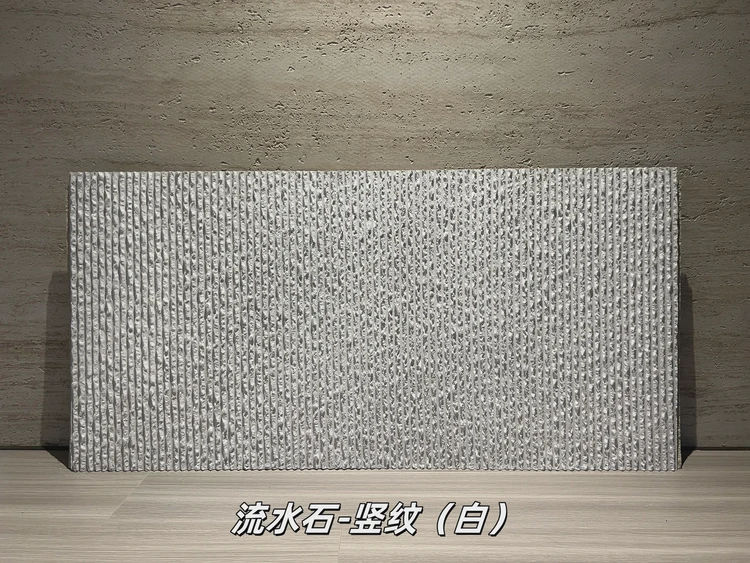
Vertical grain arrangement, flowing vertical line texture, flowing texture with natural transitions. Hotels, clubs, commercial storefronts, showrooms.
White Flowing Water Stone Flexible Stone
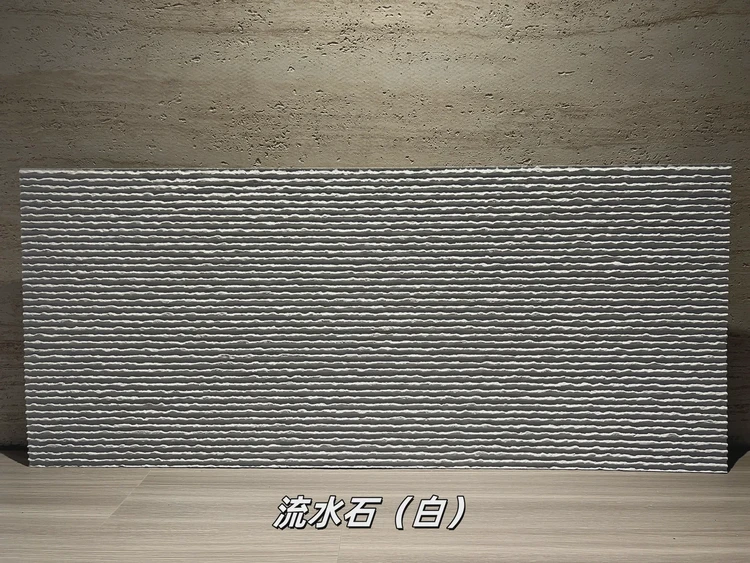
Flowing vertical line texture, with flowing patterns and natural transitions. Hotels, clubs, commercial stores, showrooms.
Black Flowing Stone Flexible Stone
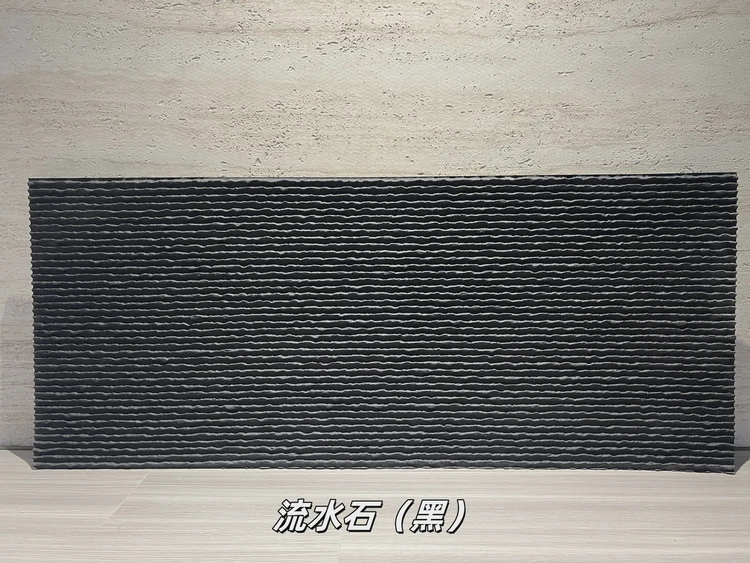
Flowing vertical line texture, with flowing patterns and natural transitions. Hotels, clubs, commercial stores, showrooms.
It is recommended that the handover document package consist of five fixed items: layout drawings, batch number list, copies of test reports, maintenance instructions, and material storage location map. We have seen projects that used all five, and projects that argued for two extra weeks because one was missing.
The six standard actions of this family
Write down the process in the actual on-site order, as a rehearsal schedule for later projects:
- Inspect goods upon arrival: panel back batch number, packing list, and condition of the four corners—sign only after all three are checked
- Three substrate checks: tap to check for hollow areas, use a straightedge to check flatness, use a moisture meter to check moisture content
- Setting out: snap lines according to the layout drawing; start points begin from internal corners or door centers
- Adhesive application and scraping: full scraping with a notched trowel, adhesive layer thickness according to instructions, do not skimp on that millimeter
- Wall application: lay from bottom to top, press and expel air immediately after each panel is applied, and wipe away squeezed-out adhesive as you go
- Closings: check internal and external corners, switch panels, and ceiling-floor junctions one by one; no further changes before acceptance.
Specifications and materials, cover the key points
Regarding specifications, combustion performance: flame-retardant properties; the specific combustion performance rating is subject to the valid test report for the selected model; substrate composition: composite of natural mineral raw materials and polymer flexible substrate, an inorganic ecological material; environmental performance: no added formaldehyde, no asbestos, meeting conventional environmental requirements for home and commercial decoration; waterproof and moisture-proof: the material does not absorb water, and after installation the wall is not prone to dampness or mold. Any further figures are subject to order confirmation.
Walls in dark-scene spaces (cinemas, bars, clubs) absorb light severely. Dark colors will appear one level darker under low illuminance. To achieve the effect of "texture visible but material boundaries not visible," it is often necessary to choose a color number half a level lighter than the target color, or embed a wall-washing light at the finishing edge.
Flowing stone frequently asked questions
Can flowing stone be used outdoors?
It can be used for exterior facades, but weather-resistant adhesive must be used and waterproof edge sealing must be done; it is not recommended for floors and areas subject to long-term water immersion. The specific model is subject to the scope of application in the test report.
Does flowing stone fade?
The finish has UV resistance requirements, and fading under normal outdoor use conditions is within a controllable range; for coastal projects with strong UV, it is recommended to add sample exposure comparison.
What is the minimum bending radius of flowing stone?
Related to thickness, substrate and backing; no uniform number is given. Use the on-site curvature to test-bend a sample; a conclusion can be reached in ten minutes.
How to combine methods
Combinations within the same line: arrange a dark and a light shade on the same wall; it is more enduring than a single color across the whole wall. Cross-line combinations: intersperse locally with other series from the same line at the wall base band or feature wall.
There is an unspoken consensus in the industry on the common defect grading of panel surfaces: only what is visible to the naked eye at a distance of one meter counts as a defect; what can only be seen under oblique light is considered process variation. Before acceptance, writing "what is acceptable" into the sample wall confirmation form is much cheaper than arguing on site afterward.
Which spaces work smoothly
Scenario suitability list: hotels, clubs, commercial storefronts, showrooms. Scenarios not on the list are not impossible to do; they must first pass the acceptance criteria
The base layer — this point cannot be overstated. Hollowing, sanding, and moisture content are the three unavoidable safety gates for adhesive-applied finishes. Tap once to listen, run a straightedge once to check flatness, and on walls with heavy moisture, take several readings with a moisture meter. When the base layer is substandard, whatever facing material you apply is just putting a lid on the problem — the spots that bulge three months later are often exactly where the work was skipped at the time.
Neighbor series overview
Different solutions for the same wall are actually all in this series table:
| Same-door series | Listed colors |
|---|---|
| Slate | 29 models |
| NanDaoSuiYueHen | 3 models |
| Cloth texture stone | 4 models |
| New Line Stone | 7 items |
| Nebula Stone | 3 models |
| Daxingyue | 2 models |
| Wood-grain board | 6 styles |
| Wood-grain cement board | 1 model |
| bush-hammered granite | 33 models |
When different series are on the same order, unify the color of edge trims to the main series.
When it comes to texture, hands are more honest than eyes
Up close and from a distance are two different things. Flowing vertical linear veining, with texture that flows and transitions naturally—this is also why we insist you get a sample.
Taking "White Vertical-Grain Flowing Stone Flexible Stone" as an example: vertical grain arrangement, flowing vertical line texture, with natural flow and transitions. The same product may show slight differences in shade depending on the cutting direction; keep the direction consistent during layout.
Half the beauty of large surfaces comes from the seams. If the seam is too narrow, there is no allowance for thermal expansion and contraction; if too wide, the eye is drawn entirely to the line. A common practice in indoor dry areas is a tight seam or a 1–2 mm process joint; at curved surfaces and complex junctions, it is better to leave a seam for routing than to force the panels together. Whether the seam color uses same-color adhesive or a contrasting line is up to the designer.
Walls in retail stores must follow shelving logic: hanging rails, shelves, and advertising positions will all eventually be mounted on the wall. Applying finishes first and then drilling expansion anchors amounts to damaging a newly delivered wall. Marking hole positions on the layout plan and drilling accurately in one pass is standard practice for chain-brand engineering departments.
There are two schools of internal/external corner treatment: full-sheet wrapping and mitered corners. Full-sheet wrapping looks good but demands strict right-angle precision from the substrate; mitered corners are safer, and the eye can accept a slightly offset seam position. External corners in public spaces have a high probability of being hit; better to use mitered corners plus corner guard edging than to gamble for appearance.
How flowing stone gets along with lighting
Color has no good or bad; only placement. Light white tones for a clean, bright feel, and dark black tones for a calm, restrained space: choose the section washed by light strips; going the opposite way is also fine, but leave ample margin for pattern matching on large surfaces
The "valid scope" of a test report is the industry's least understood common knowledge: the report corresponds to the submitted sample, the sample corresponds to the model, and the model corresponds to the batch. A salesperson saying verbally "our whole series meets the standard" does not hold at the document level.
Where this family is most prone to failure during installation
In construction, this family follows the thin-panel full-surface bonding route: after the substrate is leveled, apply special adhesive directly to the wall, with no framing and no wet work. Do not force-fit the notched trowel approach used for tiles; adhesive layer thickness and open time are completely different matters. Do not copy other companies' detail drawings; for vein-matching numbering, saving one hour on drawings can cost two days on site.
The logic of facade waterproofing is "channeling is better than blocking": the finish layer prevents rainwater infiltration, while the structural layer must lead entering water out. With drip lines, flashing boards, and joint sealant all in place, the facade can truly face the heavy rain season.
The two selection methods flowing stone fears most
This family fears two choices most: installing flexible stone like ceramic tile (notched adhesive, wide joints); and sealing the surface before the substrate is dry.
For new projects, look at renderings; for renovation projects, look at the medical records. In a space that has been lived in for ten years, the walls have far more stories behind them than bare walls: modified electrical points, added partition walls, and water seepage spots patched again and again. Wall inspection before entering the site is more important than any material selection meeting.
The right way to sample and confirm
Before finalizing this family, it is recommended to request three or four candidate options together and compare them on the wall. The reason is simple: color cards are always more optimistic than the real product
Related entrances
Related articles
White vertical-grain flowing stone flexible stone
White vertical-grain flowing stone is a flexible stone in the Line Stone & Na...
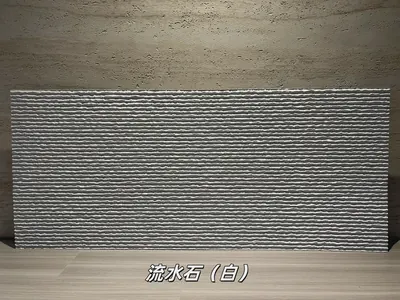
White Flowing Water Stone Flexible Stone
White Flowing Water Stone is a flexible stone in the Line Stone and Natural T...
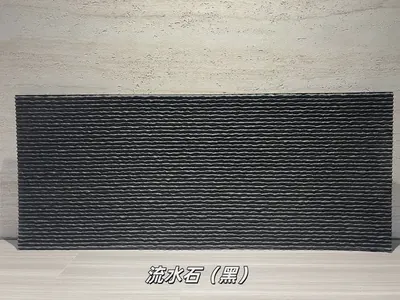
Black Flowing Stone Flexible Stone
Black Flowing Water Stone is a flexible stone in the Vein Stone & Natural Tex...