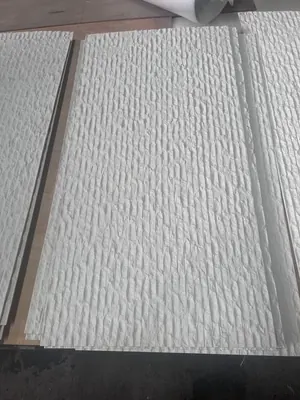
Conclusion first: for the 1 style in the axed stone family, the texture and constructability of the axed stone family are delivered to you together
To be clear on the basis for the parameters first: all values in this text come from the product file; combustion performance and environmental ratings are subject to the valid test report for the corresponding model.
Who belongs to this family
First list the family assets clearly. The table below shows the available colors in this family; click each row to view actual photos and specifications on the corresponding product page:
| Color/model | Main tone | Recommended scenarios |
|---|---|---|
| Light gray solid-color axed stone | Light gray tone, soft and elegant | Hotels, clubs, exterior walls, renovation projects |
Process schedule for ax-chiseled stone
There are not many steps, but every step has pitfalls previous crews have stepped into:
- Inspect goods upon arrival: panel back batch number, packing list, and condition of the four corners—sign only after all three are checked
- Three substrate checks: tap to check for hollow areas, use a straightedge to check flatness, use a moisture meter to check moisture content
- Setting out: snap lines according to the layout drawing; start points begin from internal corners or door centers
- Adhesive application and scraping: full scraping with a notched trowel, adhesive layer thickness according to instructions, do not skimp on that millimeter
- Wall application: lay from bottom to top, press and expel air immediately after each panel is applied, and wipe away squeezed-out adhesive as you go
- Closings: check internal and external corners, switch panels, and ceiling-floor junctions one by one; no further changes before acceptance.
Do not buy loose pieces on an ad hoc basis for patching: only the same project and same batch number is meaningful. Keeping reserve material in the project owner's warehouse is more useful than keeping it in the material supplier's warehouse; when replenishment is really needed, the sample in your hand is the matching voucher.
The most time-saving opening for a client meeting is three questions: what do you want people to see on this wall, what actions do people take by the wall, and how often is it cleaned. Once these three questions are answered, the budget range and material list basically converge.
Three things separate a rendering from the real thing: vein density, seam method and gloss level. Stone-texture walls in rendering libraries are often 'density-amplified versions'; looking for materials by copying them directly will disappoint. The reliable path is to use the rendering to set the character, use samples to set specifications, and use a 1:1 sample wall to set final expectations.
The correct approach to knock and bump repair is to replace the panel rather than touch up the paint. Reserving 3%-5% spare material when ordering is for exactly this purpose: the real problem is when the replacement panel does not match the batch color difference. Spare material stored in the warehouse is much safer than loose panels left on site.
Which spaces work smoothly
Scenario suitability list: hotels, clubs, exterior walls, renovation projects. Scenarios not on the list are not impossible to do; they must first pass the substrate condition check
The judgment sequence for wet-area walls (bathrooms, spas, pool surrounds) is: intact waterproofing layer → moisture-proof substrate → non-absorbent finish → dense joints. If all four pass, the finish is only the final layer of protection; if any one fails, no matter what is applied, problems will occur. The flexible finish itself does not absorb water, but it places higher demands on the honesty of the substrate.
Many people blame the smell when new materials enter the site on the finish, but in fact about 80% comes from adhesive and base auxiliary materials. The environmental protection standard depends on the entire supply chain: if the main material meets the standard but the auxiliary materials are poor, there will still be odor. Having auxiliary materials also included in the acceptance checklist in projects is no longer an advanced practice; it is standard practice.
The logic of submission documents is "model corresponds to report." Combustion performance is classified according to GB 8624, and the sample name, specification, and production date in the test report must match the purchased model one-to-one. Using the report for model A to submit a project for model B, what is usually rejected is not the material, but the documents.
The original official positioning text of the series
The paragraph at the beginning of the series page — frankly speaking, it is written for those selecting materials:
IGOODS axe-cut stone product catalog, including 1 flexible stone product on sale; listing specifications and packaging parameters, materials and performance, and applicable scenarios item by item; and providing material selection points, differences from similar materials, and construction and acceptance parameters that can be checked on site. Free sample sending and engineering quotations are supported.
Light gray solid-color axed stone flexible stone
Product quick info Product name: Light Gray Solid Color Axe-Cut Stone Flexible Stone Brand: IGOODS Product category: Flexible stone Series: Slate and natural mountain stone Craft: Hand axe-cut texture Main color tone: Light gray tone, soft and elegant Texture features: Imitation hand axe-chiseled marks, natural split face, rugged and powerful texture Recommended scenarios: Hotels, clubs, exterior walls, renovation projects Main application: Architectural walls Light Gray Solid Color Axe-Cut Stone Flexible Stone belongs to the IGOODS slate and natural mountain stone product line and is the branch of this line oriented toward "background and order." Overall it follows a heavy, raw-nature route, suitable for settings that need to hold their own...
The description above is not empty wording; it corresponds to each of the parameters that follow.
In large projects, the most expensive thing is not materials, but "waiting." Waiting for materials, waiting for drawings, waiting for the previous process to clear the surface—so only companies that spell out delivery dates, change windows, and arrival acceptance in the contract will have a smooth site.
What does ax-chiseled stone pair with?
Pairing suggestion: This family works most reliably with fabric-textured stone; if you want to push it further, try the metal series, but keep the area ratio within 7:3
First eliminate risks, then select materials
This family fears two choices most: installing flexible stone like ceramic tile (notched adhesive, wide joints); and cutting panels for curved surfaces according to flat-surface habits, causing the lines to run crooked.
Daytime natural-light hours are the litmus test for concealed works. Color differences, misaligned joints, and adhesive marks all show up during this period. Scheduling an afternoon acceptance inspection is more practical than any sales pitch.
A closer look at representative ax-chiseled stone styles
Some patterns must be seen in images to get a feel for them. Here are three:
Light gray solid-color axed stone flexible stone
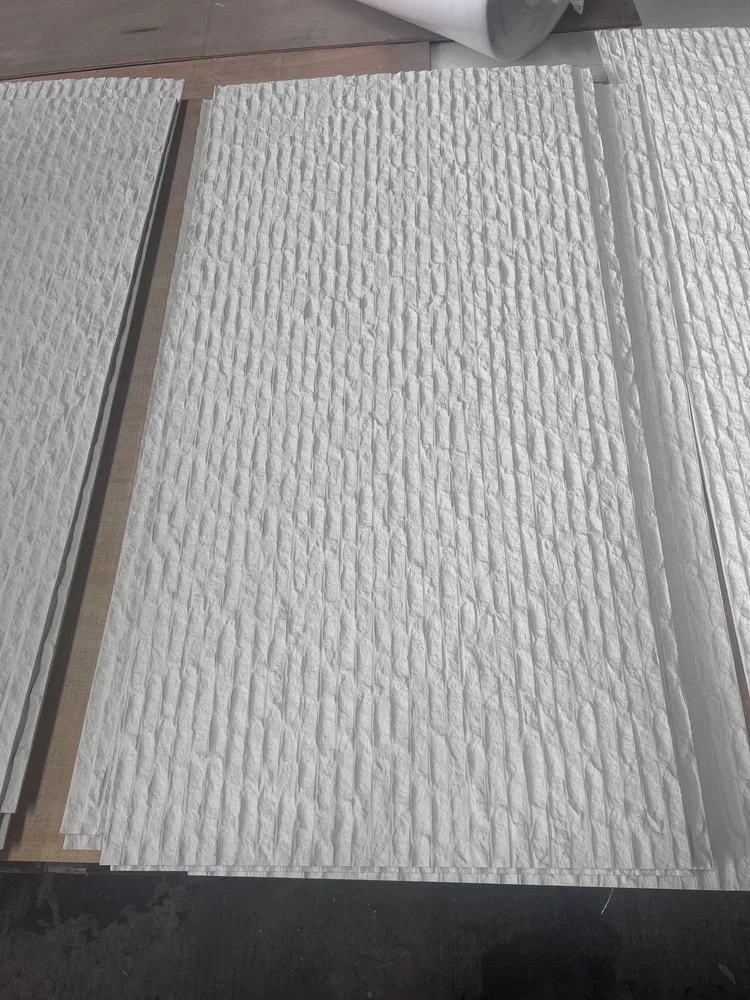
Imitates hand-chiseled marks, with a natural split face and a rough, powerful texture. Hotels, clubs, exterior walls, renovation projects.
Acceptance by node saves money compared with one-time acceptance. Inspect once when the substrate is completed, once for the sample wall, once by sampling when more than half of the large area is done, and once with full coverage at the end. Take photos and keep records each time, so problems are solved when they are cheapest. Saving all disputes until delivery day is the most costly approach.
The document chain for export projects is longer than for domestic ones: CE conformity documents, RoHS, REACH, and pre-shipment inspection before sea freight, and what each market recognizes is not entirely the same. The EU recognizes the CE system, Southeast Asia and the Middle East often require SGS or national inspection reports, and South American customers may require Spanish labels. Check the list all at once before placing an order, and both the freight forwarder and the customs clearance agent will have an easier time.
The base layer — this point cannot be overstated. Hollowing, sanding, and moisture content are the three unavoidable safety gates for adhesive-applied finishes. Tap once to listen, run a straightedge once to check flatness, and on walls with heavy moisture, take several readings with a moisture meter. When the base layer is substandard, whatever facing material you apply is just putting a lid on the problem — the spots that bulge three months later are often exactly where the work was skipped at the time.
Same project, same batch is an iron rule. Batch variation of flexible finishes is controlled within the standard range, but when large surfaces are placed side by side, even half a grade of color difference still stands out. For projects with a single area exceeding 1000㎡, our approach is one-time production scheduling, unified batch numbers, and box numbering by floor or area, with panels taken by matching number during installation.
Coordination of tone and lighting
The three colors most often asked about in this family: light gray solid-color axe-chiseled stone flexible stone. There's a reason it's asked about so often: the highest appearance rate in renderings.
Walls in retail stores must follow shelving logic: hanging rails, shelves, and advertising positions will all eventually be mounted on the wall. Applying finishes first and then drilling expansion anchors amounts to damaging a newly delivered wall. Marking hole positions on the layout plan and drilling accurately in one pass is standard practice for chain-brand engineering departments.
Common installation characteristics: the wall installation methods for this family
The process is universal: substrate → setting out → bonding → finishing. But this family's temperament lies in seam allocation.
Designers increasingly ask "are there completed cases I can see?" when selecting materials. The rendering era is over; materials that can be viewed on an actual site are the ones that can be written into a plan. This is also why we keep a record of every project.
Full catalog of listed colors
Naming every single one:
Light gray solid-color axed stone flexible stone
What else is in the same product line
After choosing this family, there are several series on the same product line worth considering together:
| Same-door series | Listed colors |
|---|---|
| Slate | 29 models |
| NanDaoSuiYueHen | 3 models |
| Cloth texture stone | 4 models |
| New Line Stone | 7 items |
| Nebula Stone | 3 models |
| Daxingyue | 2 models |
| Wood-grain board | 6 styles |
| Wood-grain cement board | 1 model |
| bush-hammered granite | 33 models |
When different series are on the same order, unify the color of edge trims to the main series.
The essence of layout is to avoid narrow strips. If, after aligning panels to the end, a narrow strip of less than 20 cm appears, cutting waste and edge chipping risk will soar. A mature layout method is to place the starting point at an inconspicuous internal corner, leave full panels for the first sight line when entering, and hide cuts behind furniture. The joint positions on the drawings should be checked against the soft furnishing points in advance.
For projects under construction while still operating, the time window matters more than labor hours. For night work sections, coordinate noise timing, freight elevator use, and fire access occupation with property management in advance. These coordination items cannot be scheduled into the process table, but they can determine whether the entire project is delivered several days late.
Up close and from a distance are two different things
Hands are more honest than eyes. Imitation hand-chiseled marks, with natural split faces and a rugged, powerful texture. When the sample is sent over, feel it first, then look at it under the light.
Taking "Light Gray Solid Color Axe-Cut Stone Flexible Stone" as an example: imitation handmade axe-chisel marks, with natural split faces and a rugged, powerful texture. The same product will also show slight differences in depth when cut in different directions, so keep the direction uniform during layout.
When finishing pieces are used well, the facade grade immediately becomes stable. For supporting pieces such as corner pieces, skirting lines and door frame trim, whether the color follows the main surface or the floor must be finalized before ordering. The most common failure is that after the wall is finished, the line color is half a grade off, and patching either side looks bad.
Specifications and materials, cover the key points
The parameters are not exaggerated; everything that can be verified is on the product page. A few key points: environmental performance: no added formaldehyde, no asbestos, meeting conventional environmental requirements for home and commercial decoration; base material composition: composite of natural mineral raw materials and polymer flexible base material, an inorganic ecological material; waterproof and moisture-proof: the material does not absorb water, and the wall is not prone to dampness or mildew after construction; combustion performance: flame-retardant performance; the specific combustion performance grade is subject to the valid test report of the selected model
The cavity treatment behind the finish affects the acoustic perception more than the finish itself. For spaces that need quiet, fill the cavity with sound-absorbing cotton according to the drawings; where sound absorption is not needed, sealing the cavity to prevent resonance is sufficient. If this step is not done before closing the panels, it can only be remedied later at extra cost.
With the same quote, whose money is spent where it matters most? When the material grade is the same, the difference usually comes down to two items: waste and substrate treatment. A crew willing to spend an extra half day on setting out can reduce cutting waste by two percentage points, which is far more respectable than cutting the material budget.
Do not skip the sampling step
Do not skip the sampling step. When sending samples, make three requirements: same batch number, with backing, and with an installation card; after receiving them, do not leave them on the desk—stick them directly onto the substrate where they will be used for testing.
Frequently asked questions about ax-chiseled stone
What is the minimum bending radius of ax-chiseled stone?
Related to thickness, substrate and backing; no uniform number is given. Use the on-site curvature to test-bend a sample; a conclusion can be reached in ten minutes.
Can ax-chiseled stone be used outdoors?
It can be used for exterior facades, but weather-resistant adhesive must be used and waterproof edge sealing must be done; it is not recommended for floors and areas subject to long-term water immersion. The specific model is subject to the scope of application in the test report.
Will ax-chiseled stone fade?
The finish has UV resistance requirements, and fading under normal outdoor use conditions is within a controllable range; for coastal projects with strong UV, it is recommended to add sample exposure comparison.