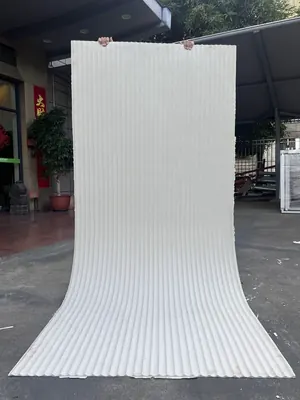
Wavy travertine appears to have many color patterns, but the real selection logic is only two or three points. Compress 1 SKU into three questions, and the answer emerges.
The writing follows the decision order of a real project: first the positioning, then the character, and finally the implementation.
Tight-joint and gapped installation are two aesthetics and two budgets: tight-joint tests cutting precision and substrate flatness, so labor costs are naturally higher; gapped installation tests seam layout planning and adhesive line uniformity, testing the layout worker. Neither method is shameful; mixing them is what looks bad.
1 color per page completed
First list the family assets clearly. The table below shows the available colors in this family; click each row to view actual photos and specifications on the corresponding product page:
| Color/model | Main tone | Recommended scenarios |
|---|---|---|
| Light gray solid-color wavy travertine | Light gray tone, soft and elegant | Hotel lobbies, clubs, feature walls, showrooms |
The base layer — this point cannot be overstated. Hollowing, sanding, and moisture content are the three unavoidable safety gates for adhesive-applied finishes. Tap once to listen, run a straightedge once to check flatness, and on walls with heavy moisture, take several readings with a moisture meter. When the base layer is substandard, whatever facing material you apply is just putting a lid on the problem — the spots that bulge three months later are often exactly where the work was skipped at the time.
Common misunderstandings, all of which have led to rework
This family fears two choices most: cutting panels for curved surfaces according to flat-surface habits, causing the lines to run crooked; and sealing the surface before the substrate is dry.
The logic of submission documents is "model corresponds to report." Combustion performance is classified according to GB 8624, and the sample name, specification, and production date in the test report must match the purchased model one-to-one. Using the report for model A to submit a project for model B, what is usually rejected is not the material, but the documents.
Full record of the registered wavy travertine list
List all listed colors for easy cross-checking:
Light gray solid-color wavy travertine flexible stone
Once a chain brand turns a single-store mock-up into a standard manual, the cost of replicating new stores drops precipitously: layout modules are fixed, detail construction is fixed, auxiliary material lists are fixed, and even the waste rate has a historical average to check against. The wall surface changes from a "design work" to a "delivered product"—this is the endpoint of material selection for chain retail.
The document chain for export projects is longer than for domestic ones: CE conformity documents, RoHS, REACH, and pre-shipment inspection before sea freight, and what each market recognizes is not entirely the same. The EU recognizes the CE system, Southeast Asia and the Middle East often require SGS or national inspection reports, and South American customers may require Spanish labels. Check the list all at once before placing an order, and both the freight forwarder and the customs clearance agent will have an easier time.
After years in the industry, a pattern emerges: projects that fail are often not due to wrong material selection but wrong sequence of steps—choosing the pattern before calculating waste, quoting before layout, paying before inspecting the substrate. Get the sequence right, and any material choice leaves room to maneuver.
Pairing and combination suggestions
Combinations within the same line: arrange a dark and a light shade on the same wall; it is more enduring than a single color across the whole wall. Cross-line combinations: intersperse locally with other series from the same line at the wall base band or feature wall.
Chipped edges, small bubbles and scratches: transport and installation each account for half the responsibility. If protective corners are not installed properly on panel edges, the shipment arrives with burrs all over; one extra reminder during unloading can save half a day of haggling at acceptance.
Neighbor series overview
Procurement often buys two series on one order; here is the same-door list for you first:
| Same-door series | Listed colors |
|---|---|
| Slate | 29 models |
| NanDaoSuiYueHen | 3 models |
| Cloth texture stone | 4 models |
| New Line Stone | 7 items |
| Nebula Stone | 3 models |
| Daxingyue | 2 models |
| Wood-grain board | 6 styles |
| Wood-grain cement board | 1 model |
| bush-hammered granite | 33 models |
When different series are on the same order, unify the color of edge trims to the main series.
The three colors asked about most often
Color has no good or bad; only placement. Light gray tones for a soft, elegant space: choose the interface dominated by natural daylight; going the opposite way is also fine, but move the light position 30 cm toward the wall base
Where this family is most prone to failure during installation
Where this family fails most often: treating flexible stone like ceramic tile (notched adhesive, wide joints), covering surfaces before the substrate is dry, cutting panels for curved surfaces by flat-surface habits so lines run crooked. The key to thin-material large surfaces is "panels never touch the ground": fewer transfers mean fewer chipped edges. Cut with a bench saw or angle grinder with a straightedge, with the cut edge running toward the joint position.
Looking back after furniture is brought in: the most frequently hit areas are not the main viewing surfaces, but the circulation corners and the line at the height of chair and table backs. For new projects, positioning tables and chairs during the mock-up stage is more relaxed than adding corner guards after handover.
Floor height determines the logic for choosing texture density: above four meters, wide-spaced textures can unfold properly; in spaces around three meters, dense textures will feel oppressive. "The rendering looks good" and "your floor height looks good" are two different things. When selecting samples, report the floor height to the material supplier, and the recommendations will be much more accurate.
Do not skip the sampling step
Do not skip the sampling step. When sending samples, make three requirements: same batch number, with backing, and with an installation card; after receiving them, do not leave them on the desk—stick them directly onto the substrate where they will be used for testing.
The enemies of dining space walls are arranged by location: at the entrance it is sand and mud abrasion, at booths it is chair-back impact, and in the back-of-house passage it is oil fumes and water. Using different termination logic for different locations is more cost-effective than a uniform whole-wall approach — spend the impact-resistant budget where impacts occur.
First put the scope here
The paragraph at the beginning of the series page — frankly speaking, it is written for those selecting materials:
IGOODS Wavy Travertine Product Catalog, featuring 1 flexible stone product currently on sale; lists specifications and packaging parameters, materials and performance, and suitable applications item by item; also provides key points for material selection, differences from similar materials, and construction and acceptance parameters that can be checked on site. Free sample mailing and project quotations are supported.
Light gray solid-color wavy travertine flexible stone
Product Quick Info Product Name: Light Gray Solid Color Wavy Travertine Flexible Stone Brand: IGOODS Product Category: Flexible Stone Series: Travertine Series Craft: Travertine texture Main Color Tone: Light gray tone, soft and elegant Texture Features: Travertine pore texture arranged in a wavy pattern, continuous undulation with clear layering Recommended Scenarios: Hotel lobbies, clubs, background walls, showrooms Main Application: Architectural walls In the IGOODS Travertine Series, Light Gray Solid Color Wavy Travertine Flexible Stone is a product oriented toward "background and order." Overall it follows the stable route of classic stone, suitable for spaces that need the stone properties to be recognizable at a glance; when placed in actual...
Putting it in plain terms: this family solves the contradiction of "wanting this effect but unable to tolerate this work."
The most valuable thing in construction organization is rhythm. Before the crew enters the site, the sample wall, layout marking, and material preparation should all be completed; the most commonly seen waste on site is boards not arriving, people waiting, and lights on. Organize transfer according to "materials never touch the ground," finish and clean the work area the same day, and the construction period will naturally be shortened.
The essence of layout is to avoid narrow strips. If, after aligning panels to the end, a narrow strip of less than 20 cm appears, cutting waste and edge chipping risk will soar. A mature layout method is to place the starting point at an inconspicuous internal corner, leave full panels for the first sight line when entering, and hide cuts behind furniture. The joint positions on the drawings should be checked against the soft furnishing points in advance.
Which scenarios is wavy travertine suitable for?
Scenario suitability list: hotel lobbies, clubs, feature walls, showrooms. Scenarios not on the list are not impossible to do; they must first pass the loss calculation
For walls in spaces that remain open during business hours, maintenance costs deserve more consideration than initial construction cost. Restaurant walls cannot avoid cooking fumes; when choosing finishes, first ask, "Can oil stains be wiped off?" Retail walls cannot avoid shelf handling, so impact resistance at external corners and the 0-300 mm wall base should be prioritized. Factoring cleaning and repair into material selection is how you reduce the burden on the next store manager.
Several representative patterns
Finally, name a few items and look at the detail images of the individual products:
Light gray solid-color wavy travertine flexible stone
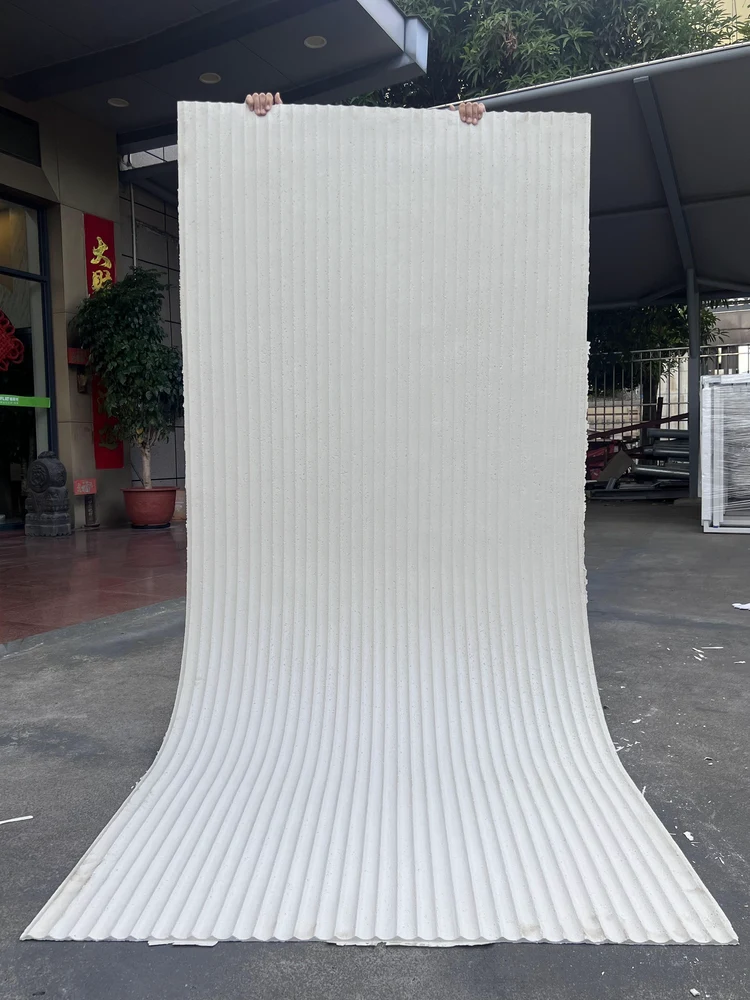
Travertine pore texture arranged in a wavy pattern, with continuous undulation and distinct layers. Hotel lobbies, clubs, background walls, showrooms.
The material's character has boundaries. The porous feel of travertine works well with wabi-sabi, but looks dated in a CBD office tower lobby; the cold stratification of slate works well with metal and glass, but feels rigid in community retail with warm yellow lighting. Before choosing a wall, choose the spatial narrative first—material is part of the narrative, not an isolated aesthetic piece.
Half of the walls in office spaces are backdrops: video conferences come into frame, and plants and LOGO walls compete for attention. When choosing colors, have IT turn on the camera and point it at the sample for a look—closer to everyday presentation than any color card. This is a material selection step added in recent years.
Wavy travertine frequently asked questions
Can wavy travertine be used outdoors?
It can be used for exterior facades, but weather-resistant adhesive must be used and waterproof edge sealing must be done; it is not recommended for floors and areas subject to long-term water immersion. The specific model is subject to the scope of application in the test report.
Will wavy travertine fade?
The finish has UV resistance requirements, and fading under normal outdoor use conditions is within a controllable range; for coastal projects with strong UV, it is recommended to add sample exposure comparison.
What is the minimum bending radius of wavy travertine?
Related to thickness, substrate and backing; no uniform number is given. Use the on-site curvature to test-bend a sample; a conclusion can be reached in ten minutes.
Foreign trade friends often ask "which color pattern sells well" when choosing materials. Honestly, there is no color pattern that works everywhere: the European market favors large panel formats and low saturation; the Middle East favors gold and high contrast; Southeast Asia is urbanizing rapidly, and bright colors work in commercial spaces. The real commonality is: all markets require complete documentation and stable batches.
The six standard actions of this family
Write down the process in the actual on-site order, as a rehearsal schedule for later projects:
- Inspect goods upon arrival: panel back batch number, packing list, and condition of the four corners—sign only after all three are checked
- Three substrate checks: tap to check for hollow areas, use a straightedge to check flatness, use a moisture meter to check moisture content
- Setting out: snap lines according to the layout drawing; start points begin from internal corners or door centers
- Adhesive application and scraping: full scraping with a notched trowel, adhesive layer thickness according to instructions, do not skimp on that millimeter
- Wall application: lay from bottom to top, press and expel air immediately after each panel is applied, and wipe away squeezed-out adhesive as you go
- Closings: check internal and external corners, switch panels, and ceiling-floor junctions one by one; no further changes before acceptance.
There are two schools of internal/external corner treatment: full-sheet wrapping and mitered corners. Full-sheet wrapping looks good but demands strict right-angle precision from the substrate; mitered corners are safer, and the eye can accept a slightly offset seam position. External corners in public spaces have a high probability of being hit; better to use mitered corners plus corner guard edging than to gamble for appearance.
Up close and from a distance are two different things
Hands are more honest than eyes. Travertine pore texture arranged in waves, with continuous undulation and distinct layers. When the sample is sent over, feel it first, then look at it under the light.
Taking "Light Gray Solid Color Wavy Travertine Flexible Stone" as an example: travertine pore texture arranged in a wavy pattern, with continuous undulations and distinct layering. The undulations you feel by touch convey an extra layer of information beyond what you see; this is the significance of a physical sample.
Lighting and wall surfaces are a pair of co-conspirators. On the same panel, the texture becomes lighter under 3000K warm light, and under 4000K it is closest to the original appearance of the sample; when a spotlight grazes across it at an angle, the texture relief is most distinct. On the day of color selection, be sure to have the light aimed at the sample; the downlights in the showroom and the linear lights on site are often two different worlds.
How to read wavy travertine parameters
Regarding specifications, environmental performance: no added formaldehyde, no asbestos, meeting the conventional environmental requirements for home decoration and commercial fit-out; combustion performance: flame-retardant; the specific combustion performance rating is subject to the valid test report for the selected model; waterproof and moisture-proof: the material does not absorb water, and after installation the wall is not prone to dampness or mildew; substrate composition: a composite of natural mineral raw materials and a polymer flexible substrate, an inorganic ecological material. Any further figures are subject to order confirmation.