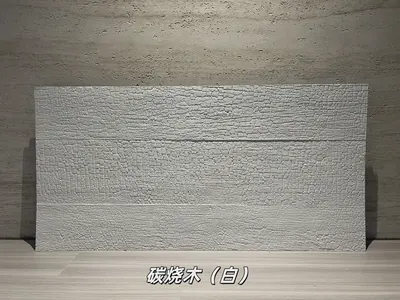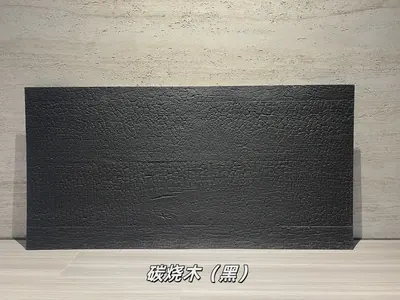
Laying out all 2 carbonized wood options at once makes choosing difficult. We have arranged them by scenario; just follow the order.
To be clear on the basis for the parameters first: all values in this text come from the product file; combustion performance and environmental ratings are subject to the valid test report for the corresponding model.
Once a chain brand turns a single-store mock-up into a standard manual, the cost of replicating new stores drops precipitously: layout modules are fixed, detail construction is fixed, auxiliary material lists are fixed, and even the waste rate has a historical average to check against. The wall surface changes from a "design work" to a "delivered product"—this is the endpoint of material selection for chain retail.
Who belongs to this family
Named one by one. Name, tone, and suitable locations, all in one table:
| Color/model | Main tone | Recommended scenarios |
|---|---|---|
| White Carbonized Wood | Light white tone, clean and bright | Hotels, homestays, clubs, themed commercial spaces |
| Black Carbonized Wood | Deep black tone, calm and restrained | Hotels, homestays, clubs, themed commercial spaces |
Double-height spaces also raise a viewing-angle issue: what you see from above and from below are two completely different densities. Locations where "others look at you," such as lobby mezzanines and stair corners, deserve a separate sample review.
Do not skip the sampling step
Before finalizing this family, it is recommended to test-apply half a square meter on the actual substrate. The reason is simple: color cards are always more optimistic than the real product
The logic of facade waterproofing is "channeling is better than blocking": the finish layer prevents rainwater infiltration, while the structural layer must lead entering water out. With drip lines, flashing boards, and joint sealant all in place, the facade can truly face the heavy rain season.
What it pairs most stably with
Pairing suggestion: This family works most reliably with South Island Time Traces; if you want to push it further, try large-format travertine panels, but keep the area ratio within 7:3
Official positioning of Carbonized Burnt Wood
First put the official scope on the table, then give my understanding:
IGOODS Charred Wood Product Catalog, featuring 2 flexible stone products currently on sale; lists specifications and packaging parameters, materials and performance, and suitable applications item by item; also provides key points for material selection, differences from similar materials, and construction and acceptance parameters that can be checked on site. Free sample mailing and project quotations are supported.
White Carbonized Wood Flexible Stone
Product Quick Info Product Name: White Charred Wood Flexible Stone Brand: IGOODS Product Category: Flexible Stone Series: Wood Grain Series Craft: Wood Grain Transfer Printing Main Color Tone: Light White Tone, Clean and Bright Texture Features: Carbonized Wood Texture, Obvious Dark Wood Grain and Burn Marks Recommended Scenarios: Hotels, Homestays, Clubs, Themed Commercial Spaces Main Application: Building Walls In the IGOODS Wood Grain Series, White Charred Wood Flexible Stone is a product oriented toward "pure color and enduring appeal." It follows a natural and warm route, suitable for spaces that wish to express wood vocabulary through stone craftsmanship; when used on actual walls, as a large surface...
Black Carbonized Wood Flexible Stone
Product quick info Product name: Black Charred Wood Flexible Stone Brand: IGOODS Product category: Flexible stone Series: Wood grain series Craft: Wood grain transfer printing Main color tone: Deep black tone, restrained and composed Texture feature: Carbonized wood texture, with obvious dark wood grain and burn marks Recommended scenarios: Hotel, homestay, club, themed commercial space Main applications: Building wall Black Charred Wood Flexible Stone is a flexible stone in the IGOODS wood grain series. This product line takes wood grain transfer printing and sawn wood grain as its main design direction, and among them the Black Charred Wood Flexible Stone emphasizes the expression of "weight and presence"—in large…
In actual projects, this positioning becomes three specific questions: how the lighting is done, what the wall is, and how often it is wiped.
The parameter definitions in the contract must be aligned: whether the nominal thickness includes backing, whether loss is included in the unit price or the quantity, and who keeps the reserved material. Ninety percent of disputes in the industry originate from not stating one sentence clearly at the time of quotation.
The art of order pacing lies in "completeness," not "speed": for projects where main materials, auxiliary materials, edge trim pieces, and door/cabinet extension pieces are split across four orders, staggered arrival times are the beginning of on-site waiting for materials. Our recommendation is one list, one production run, numbered by box and layer, and sorted immediately upon arrival.
When receiving goods, do one thing first: check the batch numbers on the back of the panels against the packing list. If batches are mixed, do not argue—take photos on the spot for the record and distribute the mixed-batch panels across different facades. The cost of remediation is far lower than shrugging at the acceptance site.
Installation method for Carbonized Burnt Wood
The process is universal: substrate → setting out → bonding → finishing. But this family's temperament lies in adhesive layer thickness.
The texture character of Carbonized Burnt Wood
The textures in this family share a common trait: a carbonized-wood texture with dark wood grain and obvious burn marks. So for large areas, control the density of repeating units; when the seams don't line up, no one praises it for looking like real stone—they only ask why it's crooked.
Taking "Black Carbon-Burned Wood Flexible Stone" as an example: carbonized wood texture, with obvious dark wood grain and burn marks. The same product may show slight differences in shade depending on the cutting direction; keep the direction consistent during layout.
For projects under construction while still operating, the time window matters more than labor hours. For night work sections, coordinate noise timing, freight elevator use, and fire access occupation with property management in advance. These coordination items cannot be scheduled into the process table, but they can determine whether the entire project is delivered several days late.
Lightweight partition walls are the most common problem type in commercial space renovation. Substrates such as gypsum board and calcium silicate board have limited load-bearing capacity themselves; traditional stone on walls either requires reinforcement or dry hanging, and both cost and thickness remain high. Thin flexible finishes use the full-bonding route, with unit dead weight controlled at the level of a glass of water; lightweight walls can achieve a stone texture without major work, which is why it is singled out.
Several representative patterns
Finally, name a few items and look at the detail images of the individual products:
White Carbonized Wood Flexible Stone
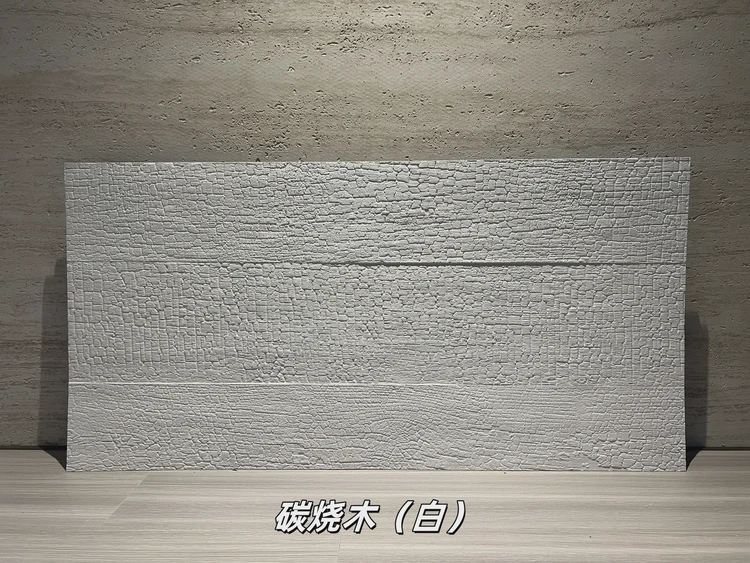
Carbonized wood texture, with obvious dark wood grain and burn marks. Hotels, homestays, clubs, themed commercial spaces.
Black Carbonized Wood Flexible Stone
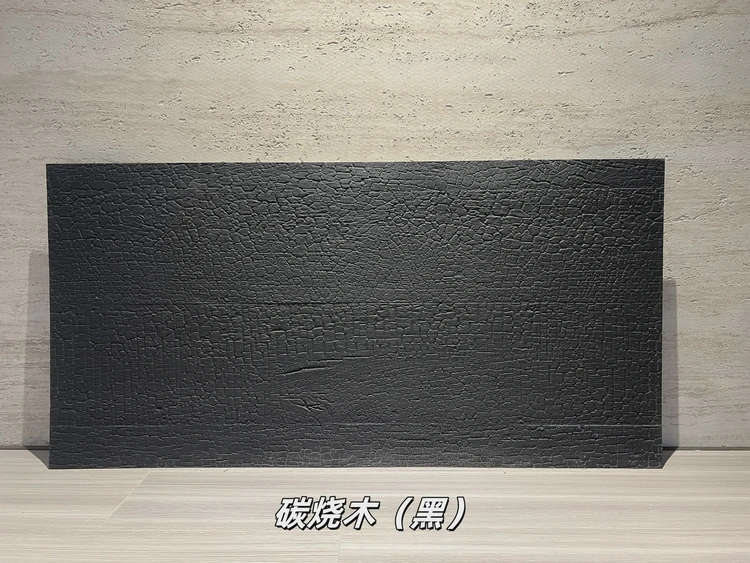
Carbonized wood texture, with obvious dark wood grain and burn marks. Hotels, homestays, clubs, themed commercial spaces.
For walls in spaces that remain open during business hours, maintenance costs deserve more consideration than initial construction cost. Restaurant walls cannot avoid cooking fumes; when choosing finishes, first ask, "Can oil stains be wiped off?" Retail walls cannot avoid shelf handling, so impact resistance at external corners and the 0-300 mm wall base should be prioritized. Factoring cleaning and repair into material selection is how you reduce the burden on the next store manager.
The essence of layout is to avoid narrow strips. If, after aligning panels to the end, a narrow strip of less than 20 cm appears, cutting waste and edge chipping risk will soar. A mature layout method is to place the starting point at an inconspicuous internal corner, leave full panels for the first sight line when entering, and hide cuts behind furniture. The joint positions on the drawings should be checked against the soft furnishing points in advance.
The most common request from designer friends is "how do we make this wall in the rendering happen on site?". Our answer is usually the same: first answer three questions—where does the light come from, where do people walk, and which wall does the furniture lean against. Once the three questions are answered, the material list shortens itself.
The lines procurement needs to read
No inflated specs—everything verifiable is on the product page. A few key points: Waterproof and moisture-resistant: the material is non-absorbent; after installation, walls are less prone to dampness and mold; Substrate composition: a composite of natural mineral raw materials and a polymer flexible substrate, an inorganic ecological material; Environmental performance: no added formaldehyde, no asbestos, meets conventional environmental requirements for residential and commercial installations; Combustion performance: flame-retardant; the specific combustion performance rating is subject to the valid test report for the selected model
The material's character has boundaries. The porous feel of travertine works well with wabi-sabi, but looks dated in a CBD office tower lobby; the cold stratification of slate works well with metal and glass, but feels rigid in community retail with warm yellow lighting. Before choosing a wall, choose the spatial narrative first—material is part of the narrative, not an isolated aesthetic piece.
What else is in the same product line
After choosing this family, there are several series on the same product line worth considering together:
| Same-door series | Listed colors |
|---|---|
| Slate | 29 models |
| NanDaoSuiYueHen | 3 models |
| Cloth texture stone | 4 models |
| New Line Stone | 7 items |
| Nebula Stone | 3 models |
| Daxingyue | 2 models |
| Wood-grain board | 6 styles |
| Wood-grain cement board | 1 model |
| bush-hammered granite | 33 models |
When different series are on the same order, unify the color of edge trims to the main series.
The two selection methods Carbonized Burnt Wood fears most
Mistake one: flexible stone is installed like ceramic tile (notched adhesive, wide joints). Mistake two: curved surfaces are cut according to flat-surface habits, and the lines run crooked. I have seen on-site rework for both.
Daytime natural-light hours are the litmus test for concealed works. Color differences, misaligned joints, and adhesive marks all show up during this period. Scheduling an afternoon acceptance inspection is more practical than any sales pitch.
Full list of registered Carbonized Burnt Wood
Check the model against this list before ordering; it is more reliable than screenshots:
White Carbonized Wood Flexible Stone, Black Carbonized Wood Flexible Stone
When finishing pieces are used well, the facade grade immediately becomes stable. For supporting pieces such as corner pieces, skirting lines and door frame trim, whether the color follows the main surface or the floor must be finalized before ordering. The most common failure is that after the wall is finished, the line color is half a grade off, and patching either side looks bad.
Coordination of tone and lighting
Color has no good or bad; only placement. Light white tones for a clean, bright feel, and dark black tones for a calm, restrained space: choose the position with spotlight focus; going the opposite way is also fine, but move the light position 30 cm toward the wall base
The six actions of wall application
Write down the process in the actual on-site order, as a rehearsal schedule for later projects:
- Inspect goods upon arrival: panel back batch number, packing list, and condition of the four corners—sign only after all three are checked
- Three substrate checks: tap to check for hollow areas, use a straightedge to check flatness, use a moisture meter to check moisture content
- Setting out: snap lines according to the layout drawing; start points begin from internal corners or door centers
- Adhesive application and scraping: full scraping with a notched trowel, adhesive layer thickness according to instructions, do not skimp on that millimeter
- Wall application: lay from bottom to top, press and expel air immediately after each panel is applied, and wipe away squeezed-out adhesive as you go
- Closings: check internal and external corners, switch panels, and ceiling-floor junctions one by one; no further changes before acceptance.
For business types with strict fire acceptance requirements (cinemas, KTVs, education and training), besides the finish itself, the construction method also matters: whether the cavity needs insulation fill and whether the keel needs a fire-retardant coating. Clarify the acceptance criteria at the material selection stage, rather than changing the plan after entering the site.
The quotation must be broken down to avoid being ripped off: material unit price, substrate treatment, auxiliary materials (adhesive, primer, edge trims), labor, loss, and transport and handling. If one of the six is missing, it may later become an added cost. For loss rate, 8%-12% for flat walls is the conventional range; curved surfaces, columns, and irregular patterns must be calculated separately by developed area.
Give a definite answer by business type
The sweet spot for this family is surfaces that need stone texture but cannot bear heavy loads (curved walls, cylindrical columns, old walls, lightweight partition walls). Hotels, homestays, clubs, themed commercial spaces
The most frequently asked questions about this family
Will Carbonized Burnt Wood fade?
The finish has UV resistance requirements, and fading under normal outdoor use conditions is within a controllable range; for coastal projects with strong UV, it is recommended to add sample exposure comparison.
What is the minimum bending radius of Carbonized Burnt Wood?
Related to thickness, substrate and backing; no uniform number is given. Use the on-site curvature to test-bend a sample; a conclusion can be reached in ten minutes.
Can Carbonized Burnt Wood be used outdoors?
It can be used for exterior facades, but weather-resistant adhesive must be used and waterproof edge sealing must be done; it is not recommended for floors and areas subject to long-term water immersion. The specific model is subject to the scope of application in the test report.