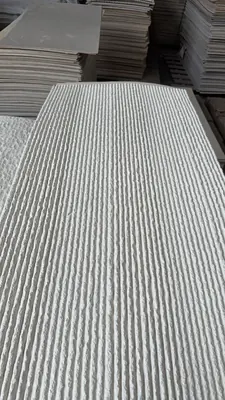
Oman vein stone seems to have many patterns, but the real selection logic is only two or three points. Compress 1 SKU into three questions and the answer emerges.
The writing follows the decision order of a real project: first the positioning, then the character, and finally the implementation.
Oman vein stone pattern map
Named one by one. Name, tone, and suitable locations, all in one table:
| Color/model | Main tone | Recommended scenarios |
|---|---|---|
| Light Gray Solid Oman Line Stone | Light gray tone, soft and elegant | Hotels, office spaces, showrooms, commercial stores |
The six actions of wall application
Write down the process in the actual on-site order, as a rehearsal schedule for later projects:
- Inspect goods upon arrival: panel back batch number, packing list, and condition of the four corners—sign only after all three are checked
- Three substrate checks: tap to check for hollow areas, use a straightedge to check flatness, use a moisture meter to check moisture content
- Setting out: snap lines according to the layout drawing; start points begin from internal corners or door centers
- Adhesive application and scraping: full scraping with a notched trowel, adhesive layer thickness according to instructions, do not skimp on that millimeter
- Wall application: lay from bottom to top, press and expel air immediately after each panel is applied, and wipe away squeezed-out adhesive as you go
- Closings: check internal and external corners, switch panels, and ceiling-floor junctions one by one; no further changes before acceptance.
There is an unspoken consensus in the industry on the common defect grading of panel surfaces: only what is visible to the naked eye at a distance of one meter counts as a defect; what can only be seen under oblique light is considered process variation. Before acceptance, writing "what is acceptable" into the sample wall confirmation form is much cheaper than arguing on site afterward.
Floor height determines the logic for choosing texture density: above four meters, wide-spaced textures can unfold properly; in spaces around three meters, dense textures will feel oppressive. "The rendering looks good" and "your floor height looks good" are two different things. When selecting samples, report the floor height to the material supplier, and the recommendations will be much more accurate.
The packing plan for whole-cabinet transport affects on-site loss. Wooden crates placed upright and laid flat have different rates of edge damage; the last mile from project port to site (mountain roads, ferries, manual handling) must be clarified in advance, and packaging strength should be set according to the worst section of the route.
Do not skip the sampling step
Before finalizing this family, it is recommended to let the sample sit overnight under the project lighting. The reason is simple: screen pixels cannot make up for batch variation
Dampness in underground spaces is a slow-acting issue. The finish can resist mold, but when air humidity is high, condensation will still form water. For projects where fresh air and dehumidification are inadequate, removable inspection nodes should be reserved in the wall solution.
Neighbor series overview
After choosing this family, there are several series on the same product line worth considering together:
| Same-door series | Listed colors |
|---|---|
| Slate | 29 models |
| NanDaoSuiYueHen | 3 models |
| Cloth texture stone | 4 models |
| New Line Stone | 7 items |
| Nebula Stone | 3 models |
| Daxingyue | 2 models |
| Wood-grain board | 6 styles |
| Wood-grain cement board | 1 model |
| bush-hammered granite | 33 models |
When joining the two series, give the seam position to one of them; don't split it fifty-fifty.
Half the beauty of large surfaces comes from the seams. If the seam is too narrow, there is no allowance for thermal expansion and contraction; if too wide, the eye is drawn entirely to the line. A common practice in indoor dry areas is a tight seam or a 1–2 mm process joint; at curved surfaces and complex junctions, it is better to leave a seam for routing than to force the panels together. Whether the seam color uses same-color adhesive or a contrasting line is up to the designer.
Several representative patterns
Pick three options and take a close look:
Light Gray Solid Oman Line Stone Flexible Stone
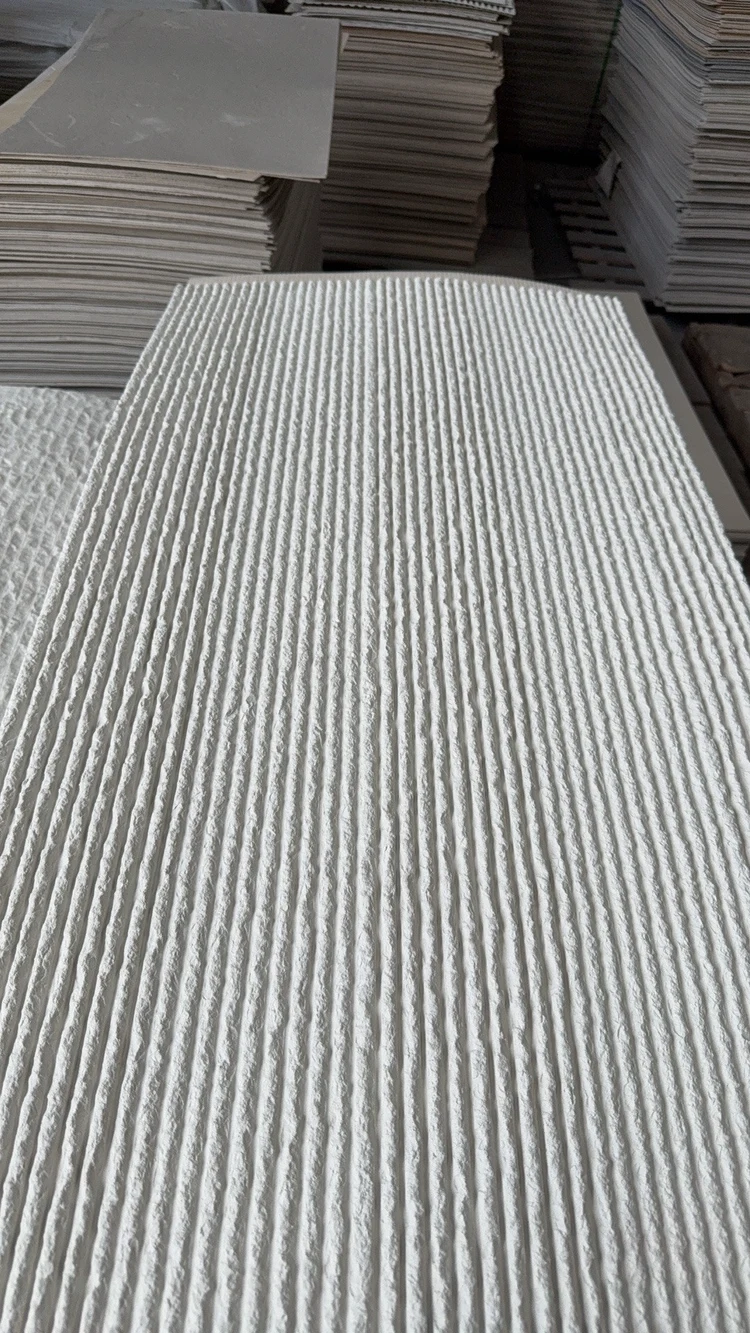
Fine vertical line grain, even lines, warm and elegant texture. Hotels, office spaces, showrooms, commercial stores.
Looking back after furniture is brought in: the most frequently hit areas are not the main viewing surfaces, but the circulation corners and the line at the height of chair and table backs. For new projects, positioning tables and chairs during the mock-up stage is more relaxed than adding corner guards after handover.
Color has no good or bad; only placement
In tone, this family leans light gray, soft and elegant. When coordinating lighting, note that low illuminance will eat saturation, and dark colors should be expected another half level lower.
The ceiling junction is a detail hotspot. Where the wall meets the ceiling, either leave a reveal to conceal lighting or cover it with an internal corner trim. Where it butts directly against the plaster cornice, if a crack opens up, it is unclear whose responsibility it is. Writing the responsibility boundary clearly in the contract is more useful than anything else.
Leaving three days for ventilation before acceptance prior to opening is spending a little to achieve a lot. The finish itself does not retain odors, but adhesive joints and backing will retain construction residue; coordinate with the schedule in advance and include this period in the plan.
The most time-saving opening for a client meeting is three questions: what do you want people to see on this wall, what actions do people take by the wall, and how often is it cleaned. Once these three questions are answered, the budget range and material list basically converge.
Which spaces work smoothly
By business type: for food and beverage, look at the public areas for distant-view layering and batch consistency; for guest rooms, look at partition wall treatment and cabinet extension; for accommodation, set the tone at the reception backdrop and meeting area; for workstation areas, control glare; for retail and office, there are many large surfaces and long circulation routes, so layout and numbering management take more effort than the material itself.
Walls in hotel public areas have a hidden KPI: they should photograph well and not retain traces of guest behavior. Luggage knocks in the lobby, leaning in elevator halls and dragging in corridors all test the 0–900 mm section at the base of the wall. Choosing the right materials and closures for this section can cut the property management repair requests in half.
When it comes to texture, hands are more honest than eyes
Up close and from a distance are two different things. Fine vertical linear veining, with even lines and a warm, understated texture—this is also why we insist you get a sample.
Taking "Light Gray Solid Color Oman Line Stone Flexible Stone" as an example: fine dense vertical linear veining, with even lines and a warm, elegant texture. The undulations you feel by touch convey an extra layer of information beyond what you see; this is the significance of a physical sample.
The process is universal, the temperament is individual
In construction, this family follows the thin-panel full-surface bonding route: after the substrate is leveled, apply special adhesive directly to the wall, with no framing and no wet work. Do not force-fit the notched trowel approach used for tiles; adhesive layer thickness and open time are completely different matters. Do not copy other companies' detail drawings; for narrow strip positions, it is better to keep them to the internal corner than to insist on centering them.
Let's be blunt up front: no finish can cure the underlying substrate's problems. If leaks are not fixed, hollow areas are not removed, or newly built walls are not fully dry before the finish goes on, symptoms will appear within three months—and the material will inevitably be blamed. Writing the substrate acceptance status clearly on the handover form protects both parties.
Three things separate a rendering from the real thing: vein density, seam method and gloss level. Stone-texture walls in rendering libraries are often 'density-amplified versions'; looking for materials by copying them directly will disappoint. The reliable path is to use the rendering to set the character, use samples to set specifications, and use a 1:1 sample wall to set final expectations.
Specifications and materials, cover the key points
Regarding specifications, waterproof and moisture-proof: the material does not absorb water, and after installation the wall is not prone to dampness or mildew; environmental performance: no added formaldehyde, no asbestos, meeting the conventional environmental requirements for home decoration and commercial fit-out; substrate composition: a composite of natural mineral raw materials and a polymer flexible substrate, an inorganic ecological material; combustion performance: flame-retardant; the specific combustion performance rating is subject to the valid test report for the selected model. Any further figures are subject to order confirmation.
Wall-washing light flattens the texture, spotlights deepen the texture, and globe bulbs make the texture look warm—the same finish can show three different faces under three types of luminaires. Before finalizing the sample, obtain the luminaire selection schedule and test each one against the sample; this is far more reliable than only listening to the designer describe the color temperature.
What it pairs most stably with
Combinations within the same line: arrange a dark and a light shade on the same wall; it is more enduring than a single color across the whole wall. Cross-line combinations: intersperse locally with other series from the same line at the wall base band or feature wall.
The cutout list is a hidden product of the measurement stage: sockets, switches, access panels, monitoring positions, and sprinkler heads each correspond to an on-site cutout. The hole location drawing is issued together with the layout drawing, so the crew receives complete instructions rather than cutting wherever they get to.
Full catalog of listed colors
Check the model against this list before ordering; it is more reliable than screenshots:
Light Gray Solid Oman Line Stone Flexible Stone
Lightweight partition walls are the most common problem type in commercial space renovation. Substrates such as gypsum board and calcium silicate board have limited load-bearing capacity themselves; traditional stone on walls either requires reinforcement or dry hanging, and both cost and thickness remain high. Thin flexible finishes use the full-bonding route, with unit dead weight controlled at the level of a glass of water; lightweight walls can achieve a stone texture without major work, which is why it is singled out.
The official positioning of Oman vein stone
First put the official scope on the table, then give my understanding:
IGOODS Oman Line Stone Product Catalog, featuring 1 flexible stone product currently on sale; lists specifications and packaging parameters, materials and performance, and suitable applications item by item; also provides key points for material selection, differences from similar materials, and construction and acceptance parameters that can be checked on site. Free sample mailing and project quotations are supported.
Light Gray Solid Oman Line Stone Flexible Stone
Product Quick Info Product Name: Light Gray Solid Color Oman Line Stone Flexible Stone Brand: IGOODS Product Category: Flexible Stone Series: Line Stone and Natural Textures Craft: Natural line stone texture Main Color Tone: Light gray tone, soft and elegant Texture Features: Fine dense vertical line pattern, with even lines and a warm, elegant texture Recommended Scenarios: Hotels, office spaces, showrooms, retail stores Main Application: Architectural walls Light Gray Solid Color Oman Line Stone Flexible Stone belongs to the IGOODS Line Stone and Natural Textures product line and is the branch of this line oriented toward "background and order." The lines have a strong sense of order, suitable for interfaces where the wall needs to be read with rhythm and direction...
In actual projects, this positioning becomes three specific questions: how the lighting is done, what the wall is, and how often it is wiped.
Lighting and wall surfaces are a pair of co-conspirators. On the same panel, the texture becomes lighter under 3000K warm light, and under 4000K it is closest to the original appearance of the sample; when a spotlight grazes across it at an angle, the texture relief is most distinct. On the day of color selection, be sure to have the light aimed at the sample; the downlights in the showroom and the linear lights on site are often two different worlds.
The two selection approaches Oman vein stone fears most
Mistake one: curved surfaces are cut according to flat-surface habits, and the lines run crooked. Mistake two: flexible stone is installed like ceramic tile (notched adhesive, wide joints). I have seen on-site rework for both.
The logic of submission documents is "model corresponds to report." Combustion performance is classified according to GB 8624, and the sample name, specification, and production date in the test report must match the purchased model one-to-one. Using the report for model A to submit a project for model B, what is usually rejected is not the material, but the documents.
Acceptance by node saves money compared with one-time acceptance. Inspect once when the substrate is completed, once for the sample wall, once by sampling when more than half of the large area is done, and once with full coverage at the end. Take photos and keep records each time, so problems are solved when they are cheapest. Saving all disputes until delivery day is the most costly approach.
Wall materials and acoustics are opposing forces that balance each other. Hard, dense finishes reflect strongly and make a space sound hollow; porous structures absorb sound well but are vulnerable to grease and moisture. The mature approach is zoning: control reverberation where people stay longest, leave corridors and background walls to the finish, and account for the two separately.
Handy answers
Can Oman vein stone be used outdoors?
It can be used for exterior facades, but weather-resistant adhesive must be used and waterproof edge sealing must be done; it is not recommended for floors and areas subject to long-term water immersion. The specific model is subject to the scope of application in the test report.
Will Oman vein stone fade?
The finish has UV resistance requirements, and fading under normal outdoor use conditions is within a controllable range; for coastal projects with strong UV, it is recommended to add sample exposure comparison.
What is the minimum bending radius of Oman vein stone?
Related to thickness, substrate and backing; no uniform number is given. Use the on-site curvature to test-bend a sample; a conclusion can be reached in ten minutes.